
MakeWave MHS-R Series Mobile High-Temperature Microwave Pyrolysis System
| Brand | MakeWave (makewave) |
|---|---|
| Origin | Shandong, China |
| Manufacturer Type | Direct Manufacturer |
| Region of Origin | Domestic (China) |
| Model | MHS-R Series |
| Pricing | Upon Request |
Overview
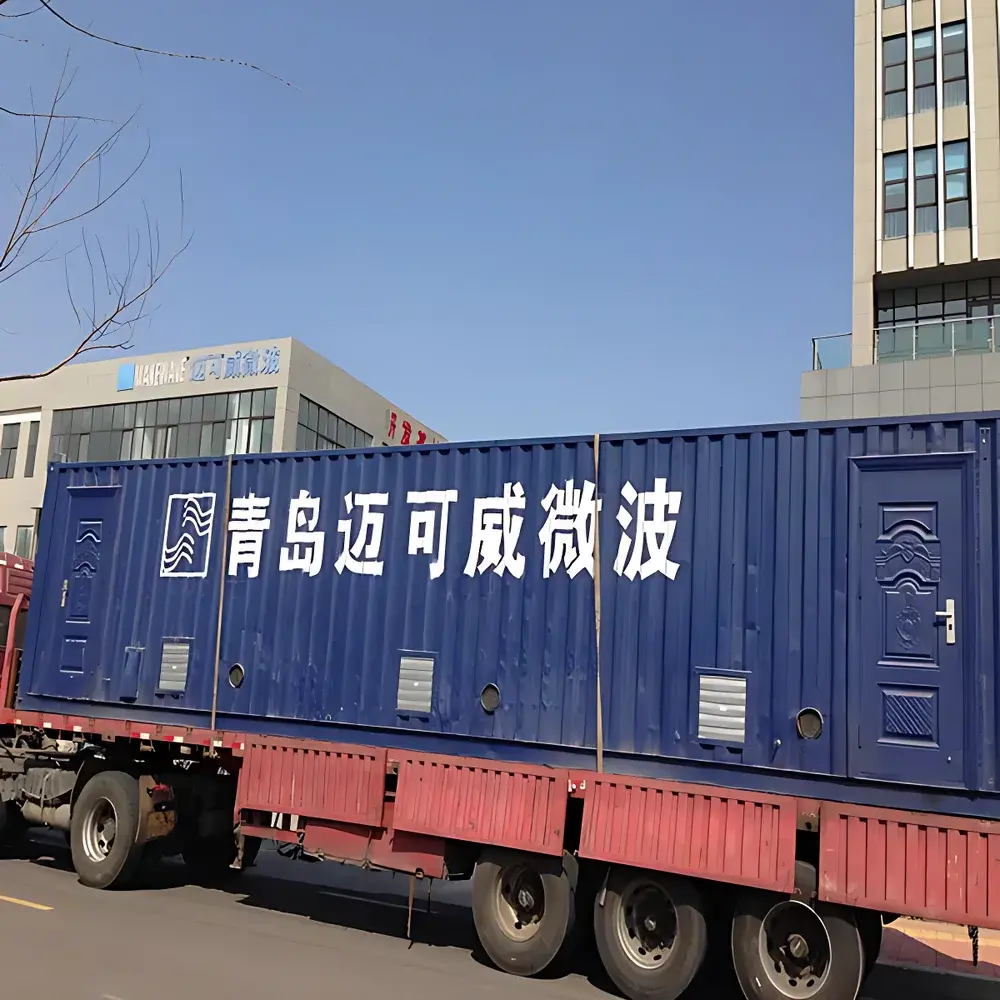
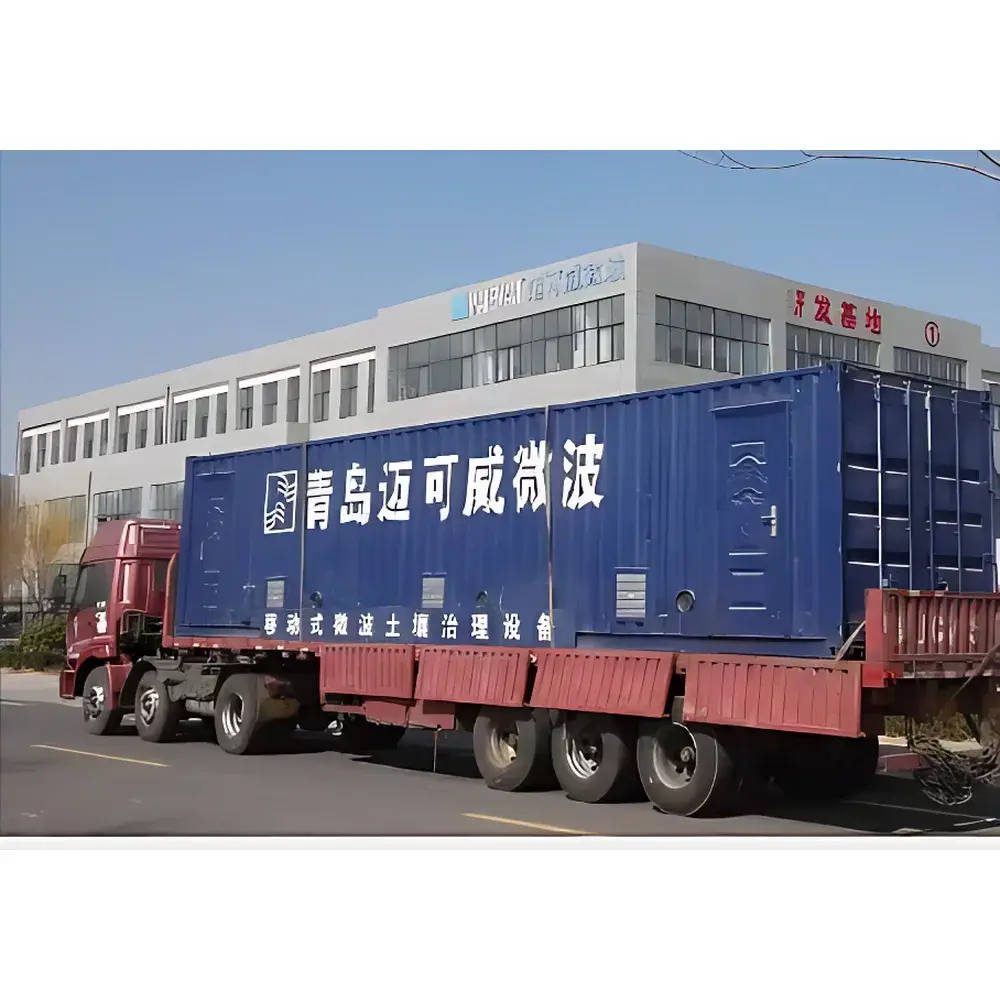
The MakeWave MHS-R Series Mobile High-Temperature Microwave Pyrolysis System is an engineered solution for on-site thermal remediation of contaminated soils and organic-laden solid waste. Designed around industrial microwave heating principles—specifically resonant cavity coupling at 2450 MHz—the system leverages volumetric, selective, and rapid energy deposition to drive endothermic pyrolysis, thermal desorption, and volatilization reactions within heterogeneous, irregularly shaped matrices. Unlike conventional conduction- or convection-based kilns, this system delivers uniform thermal profiles across bulk material via multi-source, broadband waveguide feed architecture integrated into a thermally isolated 12-meter-long tunnel cavity housed inside a standard 40-foot ISO shipping container. Its compact, mobile platform enables deployment at brownfield sites, landfill perimeters, or emergency spill zones without requiring permanent infrastructure—making it compliant with rapid-response environmental engineering protocols under ISO 14001 and ASTM D7349 (Standard Guide for Thermal Desorption of Organic Compounds from Soils).
Key Features
- Mobile turnkey platform based on a reinforced 40-ft ISO container chassis, enabling road transport and rapid site commissioning without civil foundation work
- High-temperature continuous-feed conveyor system using ceramic-reinforced stainless steel chain plates, rated for sustained operation up to 500 °C in inert or semi-closed atmospheres
- Multi-zone temperature control architecture with distributed thermocouple and infrared sensor arrays, supporting segmented thermal profiling along the 10-meter reaction tunnel
- Industrial-grade variable-frequency microwave power supply (2450 MHz), scalable to 100 kW nominal output, optimized for 24/7 duty cycles under load variation
- Integrated negative-pressure exhaust manifold with ducted connection to downstream off-gas treatment (e.g., condensation, activated carbon adsorption, or catalytic oxidation)
- Automated material handling subsystems: vibratory feeder, precision spreader, and post-treatment discharge/sieving module with real-time particle size feedback
- Comprehensive safety envelope including λ/4 choke-type microwave suppression at all access ports, double-layer insulated cavity walls, and leakage <5 mW/cm² (per GB 5959.6–2008 and IEC 61000-3-2)
Sample Compatibility & Compliance
The MHS-R system accommodates heterogeneous soil matrices—including clay-rich, gravel-inclusive, and moisture-variable feedstocks—with particle sizes up to 50 mm pre-screening. It operates effectively under nitrogen-purged, air-limited, or vacuum-assisted conditions to suppress oxidation and promote controlled carbonization pathways. Regulatory alignment includes adherence to GB 5959.6–2008 (industrial microwave safety), ISO 10381-5 (soil sampling and analysis), and compatibility with U.S. EPA Method 8260D and EU EN 14039 for volatile organic compound (VOC) and semi-volatile organic compound (SVOC) removal verification. The system supports GLP-compliant data logging for audit-ready process records.
Software & Data Management
Control logic is implemented via a CE-certified industrial PLC with deterministic scan cycle timing. A 10.1-inch capacitive touchscreen HMI provides real-time visualization of temperature gradients, microwave power modulation, conveyor speed, and exhaust gas flow rates. All operational parameters are timestamped and stored locally with optional OPC UA integration for SCADA-level remote monitoring. Audit trails include user login logs, parameter change history, alarm event timestamps, and calibration status—fully traceable for FDA 21 CFR Part 11–aligned validation environments when configured with electronic signature modules.
Applications
Primary applications include ex-situ thermal remediation of petroleum hydrocarbon–contaminated soils (TPH, PAHs), PCB-laden sediments, pesticide-treated agricultural soils, and emerging contaminant matrices such as PFAS-impacted media (when coupled with high-temperature oxidative post-treatment). Secondary uses span resource recovery contexts: biochar production from sewage sludge, tire-derived char synthesis, and pre-treatment of municipal solid waste for syngas generation. The system’s modularity allows integration with condensate recovery skids, fixed-bed catalytic crackers, or sorbent injection units for tailored process trains.
FAQ
What is the maximum continuous operating temperature inside the reaction tunnel?
The system is engineered for stable operation between 100 °C and 500 °C; prolonged exposure above 500 °C is not recommended due to material degradation limits of the ceramic-conveyor interface.
Can the system operate under inert atmosphere?
Yes—integrated nitrogen generator option provides on-demand N₂ purging to maintain O₂ <1% vol, enabling pyrolytic rather than oxidative decomposition pathways.
Is remote diagnostics supported out-of-the-box?
Standard configuration includes Ethernet port and Modbus TCP interface; optional 4G/LTE telemetry module enables cloud-based health monitoring and predictive maintenance alerts.
How is microwave leakage monitored during operation?
A permanently installed RF leakage detection probe network continuously samples at six strategic locations (door seams, waveguide flanges, viewing windows); readings are logged and trigger automatic power rollback if thresholds exceed 3 mW/cm².
Does the system comply with electromagnetic compatibility (EMC) standards for field deployment?
Yes—certified to EN 61000-6-2 (immunity) and EN 61000-6-4 (emission) for industrial environments, with additional shielding applied to control cabinet I/O lines.
Related Products





