
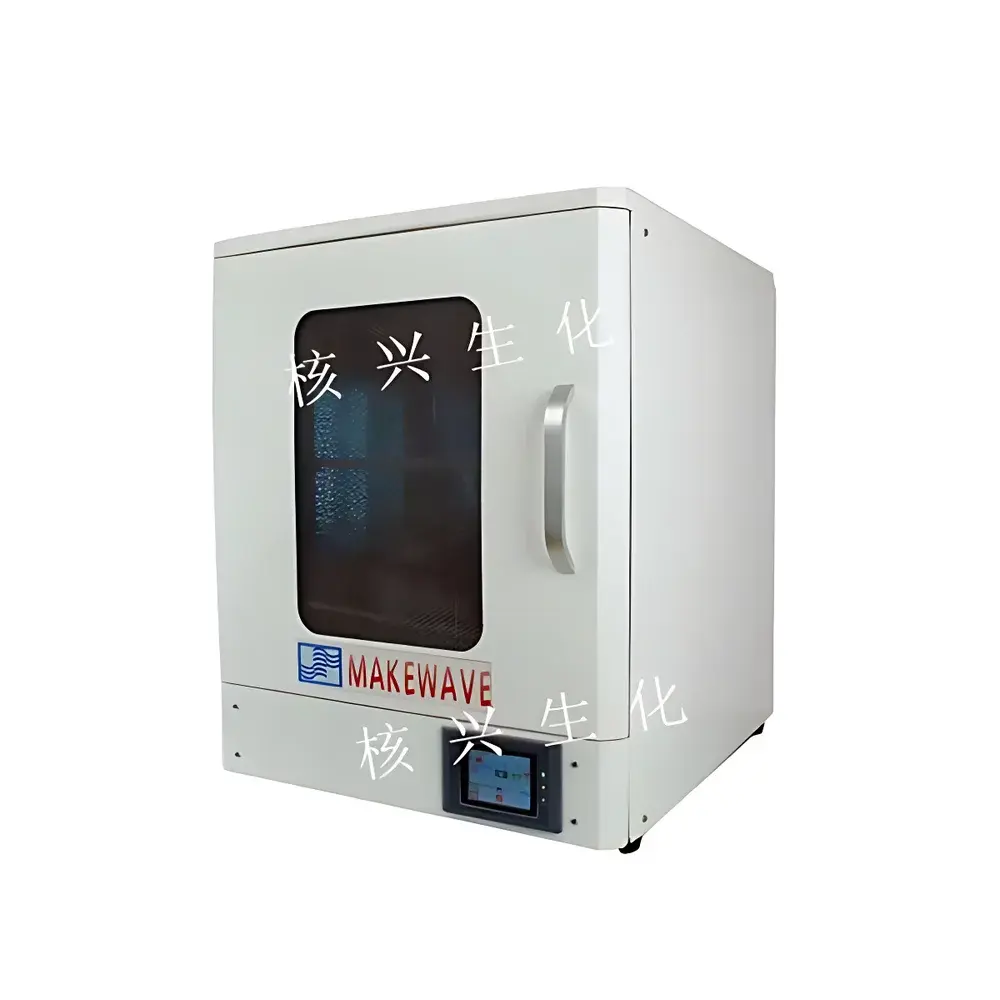
HEXING BIOCHEMICAL MSX-G2A Microwave-Steam-UV Integrated Sterilization and Drying Workstation
| Key | Brand: HEXING BIOCHEMICAL |
|---|---|
| Origin | Shandong, China |
| Model | MSX-G2A |
| Microwave Power | 0–1600 W (continuously adjustable, 2450 MHz) |
| Cavity Volume | 33 L |
| Cavity Material | Industrial-grade 304 stainless steel, fully welded, interior coated with multi-layer PTFE |
| Temperature Range | 0–300 °C (steam/microwave-controlled), optional thermocouple up to 1200 °C |
| UV System | Dual-sided UVC irradiation (254 nm) |
| Steam System | Sealed, recirculating high-temperature steam generator with pressure regulation |
| Air Management | Independent ducted airflow with motorized gate valves for humidification, steaming, drying, and dehumidification modes |
| Control System | PLC-based intelligent controller with 7-inch color touchscreen, multi-stage programmable protocols, real-time temperature/time curve display, data export (USB) |
| Safety Compliance | Interlocked door switch, surface temperature <50 °C, microwave leakage <5 mW/cm² (GB 4706.21–2008), explosion-proof & corrosion-resistant design |
| Dimensions (W×D×H) | 520 × 550 × 618 mm |
| Configuration Options | MSX-G2A1 (Sterilization-Optimized), MSX-G2A2 (Drying-Optimized) |
| Sample Capacity | 1–4 layer stackable trays (metal or PTFE-coated polymer) |
| Regulatory Context | Designed for GLP-compliant sample prep environments |
Overview
The HEXING BIOCHEMICAL MSX-G2A is an integrated sample preparation workstation engineered for precise, multi-modal thermal and non-thermal processing of diverse laboratory specimens. It combines three physically distinct sterilization and conditioning mechanisms—microwave dielectric heating, saturated steam thermal treatment, and germicidal ultraviolet-C (254 nm) irradiation—within a single, compact, fully sealed cavity. Unlike sequential or standalone units, the MSX-G2A enables simultaneous, synergistic, or independently scheduled activation of each modality, allowing users to tailor treatment profiles to specific microbiological, physicochemical, or regulatory requirements. Its operational principle leverages complementary biocidal mechanisms: microwave energy induces rapid intracellular water agitation and thermal denaturation; pressurized steam ensures penetrative thermal inactivation across porous and irregular surfaces; and UVC photons disrupt microbial DNA/RNA at the molecular level. This tri-modal architecture delivers broad-spectrum efficacy against bacteria, spores, viruses, and fungi without chemical residues—critical for applications in public health laboratories, pharmaceutical quality control, food safety testing, and environmental monitoring where trace contamination must be eliminated prior to downstream analysis.
Key Features
- Tri-functional integration: Independently controllable microwave (0–1600 W, 2450 MHz), steam (sealed recirculating system, adjustable pressure/temperature), and dual-sided UVC (254 nm) modules within a single 33 L cavity.
- Engineered cavity: Fully welded 304 stainless steel chamber with multi-layer PTFE coating ensures chemical inertness, ease of cleaning, and resistance to corrosion from repeated steam/UV exposure.
- Precision thermal management: PID-regulated microwave power output (non-pulsed, continuous-wave), coupled with thermocouple feedback (0–1200 °C range), enables reproducible ramp-hold-cool cycles across 0–300 °C.
- Modular sample handling: Configurable tray systems support 1–4 layers of metal or polymer carriers—optimized for liquids in vials, solid tools, filter membranes, or powdered reagents.
- Intelligent airflow architecture: Dedicated ducting with motorized gate valves allows dynamic switching between humidification, steam saturation, convective drying, and active dehumidification—enabling moisture content control down to <5% RH residual.
- Regulatory-ready operation: PLC-based controller logs timestamped process parameters (power, temperature, UV intensity, valve position, cycle duration); data export via USB supports 21 CFR Part 11–compatible documentation workflows.
- Multi-level safety engineering: Interlocked access door, surface temperature containment (<50 °C), verified microwave shielding (<5 mW/cm²), explosion-proof enclosure rating, and emergency venting pathways meet GB 4706.21–2008 and IEC 61000-6-3 emission standards.
Sample Compatibility & Compliance
The MSX-G2A accommodates heterogeneous sample types—including aqueous solutions, glassware, stainless steel instruments, plastic consumables, biological filters, and dry powders—without material degradation or cross-contamination risk. Its non-oxidizing, low-oxygen steam environment prevents oxidation of sensitive analytes, while the absence of organic solvents or reactive gases preserves sample integrity for subsequent HPLC, GC-MS, or PCR analysis. The system is routinely deployed in laboratories adhering to WHO Laboratory Biosafety Manual (4th ed.), ISO 15189:2022 (medical testing), ISO 11135 (ethylene oxide alternatives), and USP (sterility assurance). For GMP/GLP environments, its deterministic process control and electronic audit trail support qualification (IQ/OQ/PQ) and routine revalidation per FDA guidance on computerized systems.
Software & Data Management
The embedded PLC controller features a 7-inch capacitive touchscreen interface with intuitive icon-driven navigation. Users define multi-step protocols (e.g., “3 min UV pre-treatment → 5 min 121 °C steam → 8 min 80 °C microwave-assisted drying”) with independent setpoints for each module. Up to 99 protocols can be stored, each with configurable hold times, ramp rates, and safety limits. Real-time graphs display temperature vs. time, microwave power history, and UV lamp status. All events—including door openings, parameter overrides, and alarm triggers—are time-stamped and archived. Export formats include CSV and PDF reports compatible with LIMS integration. Optional firmware updates provide enhanced cybersecurity (TLS 1.2 encryption for remote diagnostics) and expanded compliance templates (e.g., Annex 11-aligned metadata tagging).
Applications
- Rapid sterilization of pipette tips, Petri dishes, and surgical tools in CDC, provincial CDC, and hospital microbiology labs.
- Residue-free drying of chromatography vials, filter cartridges, and lyophilized standards prior to mass spectrometry.
- Pre-analytical decontamination of environmental swabs, air sampling filters, and food homogenates under ISO 16140-2 validation frameworks.
- On-site field deployment: Low power draw (<2.2 kW) and compact footprint enable integration into mobile biosafety units or disaster response vehicles.
- Pharmaceutical excipient conditioning: Controlled moisture removal from hygroscopic APIs without thermal degradation or polymorphic transition.
- Research-scale thermal inactivation studies: Precise modulation of microwave/steam synergy permits mechanistic investigation of spore resistance kinetics.
FAQ
Does the MSX-G2A comply with international electromagnetic compatibility (EMC) standards?
Yes—the unit meets IEC 61000-6-3 (radiated emissions) and IEC 61000-6-2 (immunity) requirements for laboratory equipment, verified during third-party EMC testing.
Can the system validate sterilization cycles per ISO 17665?
While the MSX-G2A provides deterministic process control and data logging, formal validation requires user-specific biological indicator (BI) challenge studies per ISO 17665-1; the system’s precision instrumentation supports such qualification protocols.
Is remote monitoring supported?
Local network connectivity (Ethernet) enables read-only status monitoring and protocol upload; full remote control is restricted to on-site operation per safety interlock architecture.
What maintenance is required for long-term reliability?
Annual verification of microwave leakage, UV lamp intensity (with calibrated radiometer), steam pressure sensor calibration, and PTFE coating integrity is recommended; all service points are accessible without disassembly.
How does the system handle liquid samples during combined microwave-steam operation?
The sealed cavity and controlled steam saturation prevent boiling over; microprocessor-regulated power ramping avoids thermal shock—validated for aqueous volumes up to 500 mL in standard 50 mL conical tubes.



