
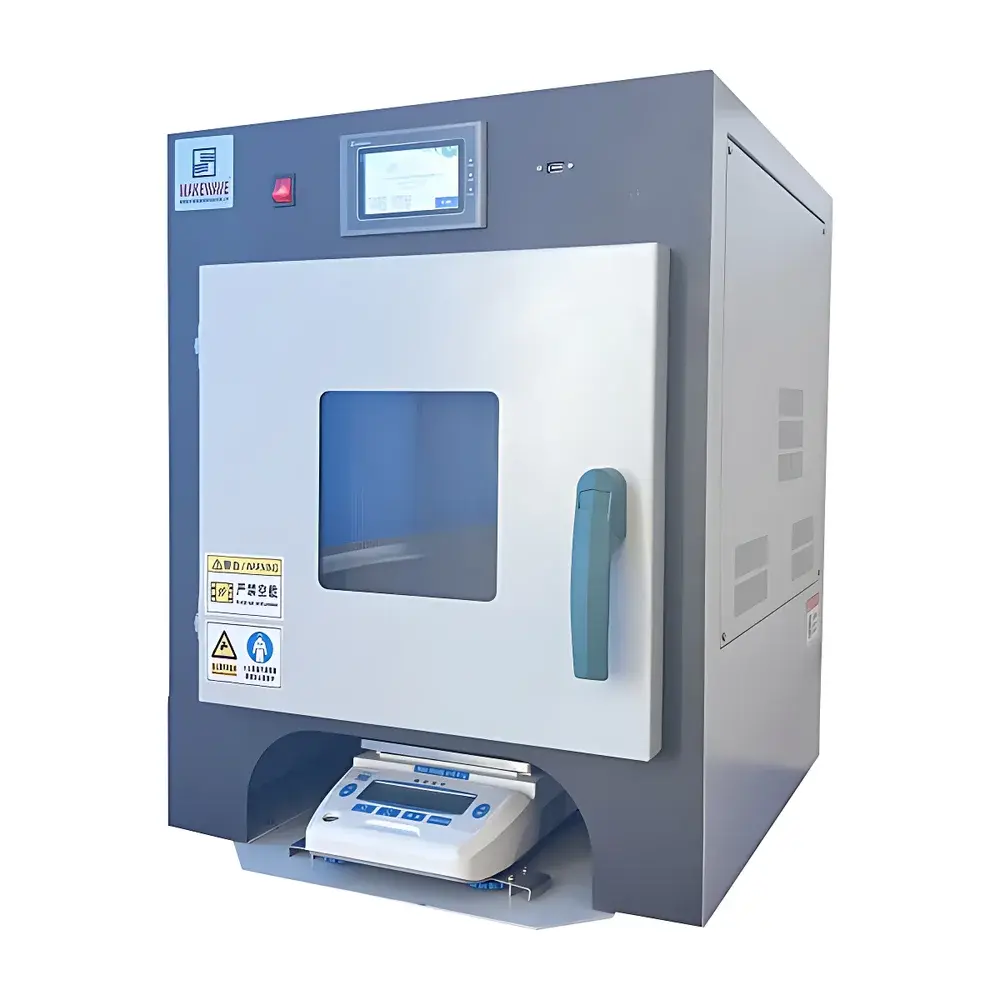
MakeWave MKC-G1A Microwave Thermogravimetric Analyzer (TGA)
| Brand | MakeWave |
|---|---|
| Origin | Shandong, China |
| Manufacturer Type | Direct Manufacturer |
| Country of Origin | China |
| Model | MKC-G1A |
| Price Range | USD 14,000–28,000 (FOB) |
| Operating Environment | Ambient Pressure |
| Sample Capacity | Single Sample |
| Instrument Type | Dedicated Microwave TGA System |
| Temperature Range | 0–300 °C |
| Temperature Accuracy | ±1 °C |
| Temperature Uniformity | ±3 K |
| Balance Sensitivity | 1 µg |
| Heating/Cooling Rate | Up to 100 K/min |
| Maximum Sample Mass | 500 g |
| Microwave Frequency | 2450 MHz |
| Rated Microwave Power | 800 W (Continuously Adjustable, Non-Pulsed) |
| Cavity Volume | ~20 L |
| Balance Resolution | 0.01 g |
| Exhaust Mode | Negative-Pressure Ventilation |
| Safety Leakage | <5 mW/cm² (per GB 10436 & IEC 62233) |
Overview
The MakeWave MKC-G1A Microwave Thermogravimetric Analyzer (TGA) represents a paradigm shift in thermal stability and compositional analysis by replacing conventional resistive or radiant heating with controlled microwave energy delivery. Unlike conventional TGA systems that rely on conductive/convective heat transfer through furnace walls—resulting in thermal lag, slow response, and heterogeneous sample heating—the MKC-G1A employs dielectric heating principles: electromagnetic energy at 2450 MHz couples directly with polar molecules and ionic species within the sample, enabling rapid, volumetric, and selective internal heating. This mechanism yields fundamentally different thermal response profiles, especially for materials with high dielectric loss (e.g., hydrated salts, polymers, biomass, pharmaceutical excipients), where traditional TGA may underestimate decomposition onset or misrepresent kinetic parameters. Engineered for research-grade precision under ambient pressure, the MKC-G1A operates continuously from room temperature to 300 °C with real-time mass tracking at 1 µg sensitivity, supporting ASTM E1131, ISO 11358, and USP methodologies—while enabling novel investigation into microwave–matter interaction dynamics (e.g., ε′, ε″, tan δ dependence on temperature and frequency).
Key Features
- Open-cavity microwave TGA platform optimized for moisture, volatiles, and solvent loss quantification under atmospheric or negative-pressure exhaust conditions.
- Integrated high-stability analytical balance (500 g capacity, 0.01 g resolution) co-located within the 20 L 304 stainless steel microwave cavity—ensuring minimal thermal drift and direct mass–temperature correlation.
- Infrared non-contact temperature measurement system mounted inside the cavity, providing real-time, surface-agnostic thermal feedback independent of emissivity assumptions.
- Fully programmable PLC-based control architecture with 7-inch touchscreen HMI; supports multi-step ramp–soak–hold protocols with simultaneous logging of time, temperature, microwave power (%), and mass change (%).
- Patented microwave–TGA coupling design (CN ZL201821307125.9) featuring λ/4 choke suppression, interlocked side-sliding door, and dual-function thermal/microwave shielding—validated to <5 mW/cm² leakage (IEC 62233 compliant).
- Modular expandability path: compatible with optional high-temperature upgrade kit (MKC-M1A) for extended operation up to 800 °C using hybrid microwave–resistive heating architecture.
Sample Compatibility & Compliance
The MKC-G1A accommodates standard ceramic, quartz, or inert polymer crucibles (500–1000 mL volume), enabling analysis of bulk powders, granules, slurries, and composite pellets without pre-grinding. Its open-atmosphere configuration supports oxidative, inert, or mildly reducing atmospheres via external gas purging (N₂, air, Ar)—with integrated negative-pressure exhaust for safe venting of evolved gases (e.g., H₂O, CO₂, VOCs). All operational firmware and data handling comply with GLP documentation requirements: audit trails, user access levels, electronic signatures, and raw data immutability are enforced per FDA 21 CFR Part 11 when paired with validated software modules. The system is certified to ISO 9001:2015 and conforms to electromagnetic compatibility (EMC) standards IEC 61000-6-3 and safety standard IEC 61010-1.
Software & Data Management
Data acquisition is performed via embedded industrial controller with 100 Hz sampling rate for mass and temperature channels. Real-time curves (mass vs. time, derivative DTG, temperature vs. time, power vs. time) are rendered on-screen and exportable in CSV, TXT, and universal .TGA formats compatible with Thermo Scientific™ Kinetics, TA Instruments™ TRIOS, and Netzsch Proteus®. Internal storage retains ≥100 full experiments; USB 2.0 interface enables offline backup and third-party post-processing. Optional cloud-sync module (sold separately) provides remote monitoring, role-based access control, and automated report generation aligned with ISO/IEC 17025 laboratory accreditation templates.
Applications
- Quantitative moisture and residual solvent analysis in APIs and excipients per ICH Q5C guidelines.
- Thermal degradation kinetics of biopolymers (cellulose, chitosan, PLA) under microwave-specific activation pathways.
- Volatiles profiling in food matrices (coffee, spices, dairy powders) with reduced charring artifacts.
- Decomposition behavior of battery cathode precursors (e.g., LiCoO₂, NMC) where microwave selectivity reveals phase transition sequences invisible to conventional TGA.
- Material screening for microwave-assisted pyrolysis feedstocks (e.g., waste tires, sewage sludge) under controlled thermal ramping.
- Validation of microwave–thermal coupling models for process scale-up in continuous manufacturing lines.
FAQ
Is the MKC-G1A suitable for inert atmosphere testing?
Yes—external purge gas (N₂, Ar, forming gas) can be introduced via standardized inlet ports; negative-pressure exhaust ensures consistent flow control and prevents cavity overpressure.
Can the system be integrated into an automated lab workflow?
It supports RS-485 Modbus RTU and Ethernet TCP/IP interfaces for SCADA-level integration; OEM SDK available for custom LIMS or MES linkage.
What calibration standards are recommended for routine verification?
NIST-traceable CuSO₄·5H₂O (dehydration at 30–120 °C) and CaC₂O₄·H₂O (three-stage decomposition) are used for mass–temperature–time cross-validation.
Does the system meet international electromagnetic safety requirements?
Yes—certified to IEC 62233 (microwave leakage), IEC 61000-6-3 (emissions), and IEC 61010-1 (electrical safety); test reports available upon request.
Is firmware update capability supported remotely?
Firmware updates are delivered via secure USB key with cryptographic signature verification; no internet connectivity required during operation.
Related Products



