
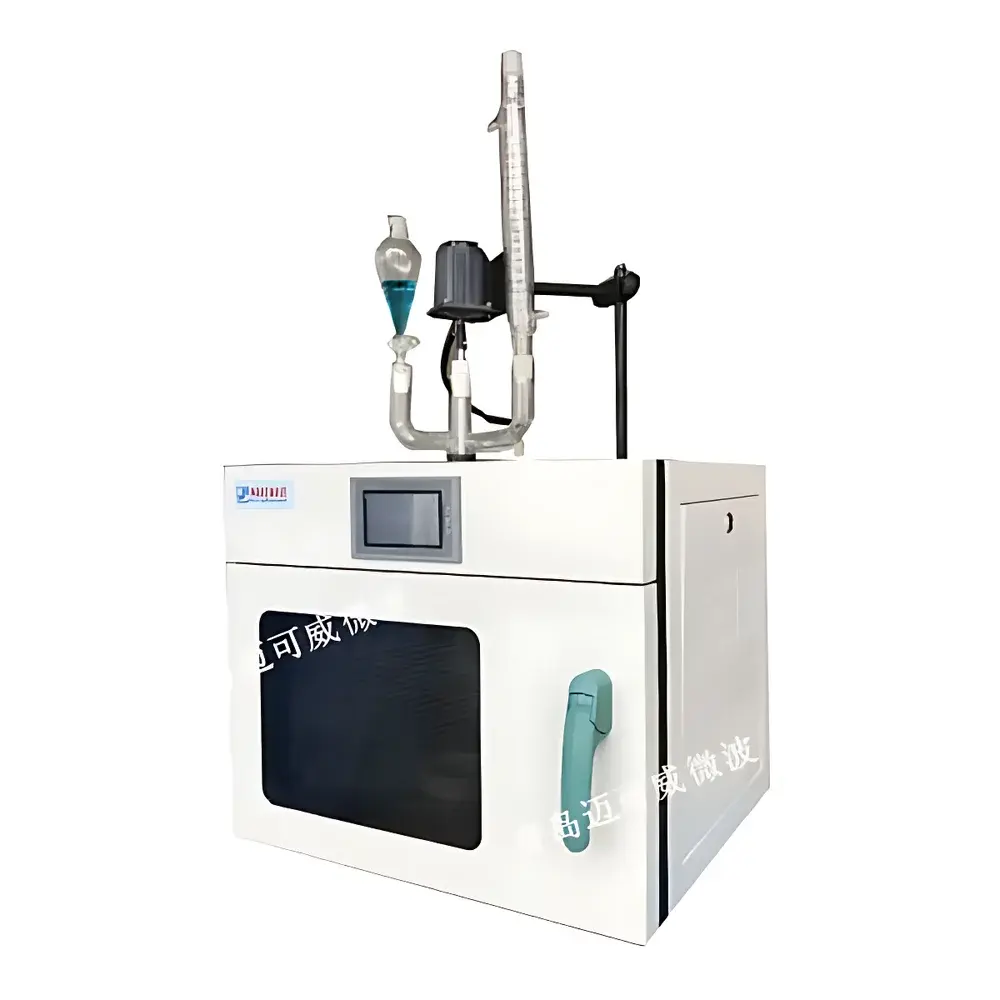
MakeWave MKX-H1CB Microwave-Assisted Synthesis and Extraction System
| Brand | MakeWave |
|---|---|
| Origin | Shandong, China |
| Manufacturer Type | Direct Manufacturer |
| Country of Origin | China |
| Model | MKX-H1CB |
| Microwave Power | 800 W (continuous, non-pulsed) |
| Microwave Frequency | 2450 MHz |
| Temperature Control Range | 0–300 °C |
| Temperature Control Accuracy | ±1 °C |
| Cavity Material | 304 Stainless Steel with Multi-Layer PTFE Coating |
| Cavity Volume | ~30 L |
| Input Voltage | 220 V AC / 50 Hz |
| Total Power Consumption | 1300 W |
| Net Weight | 55 kg |
| Safety Compliance | Microwave Leakage < 5 mW/cm² (per GB 10436 & IEC 61000-3-2) |
Overview
The MakeWave MKX-H1CB Microwave-Assisted Synthesis and Extraction System is an open-atmosphere, benchtop platform engineered for reproducible, controllable microwave-enhanced chemical synthesis and solvent-based extraction under ambient pressure. It operates on the principle of dielectric heating—where polar molecules (e.g., water, ethanol, ethyl acetate) absorb 2450 MHz microwave energy, enabling rapid and volumetric internal heating of reaction mixtures. Unlike sealed-vessel systems, the MKX-H1CB supports scalable open-vessel configurations (500–5000 mL), making it suitable for applications requiring real-time monitoring, reflux condensation, or sequential reagent addition. Its design integrates thermal, mechanical, and electromagnetic process control to meet method development and routine analytical requirements in regulated and research environments—including ISO 9001-certified laboratories.
Key Features
- Open-vessel architecture with atmospheric-pressure operation, compatible with standard single-neck glassware (default 1000 mL, scalable up to 5000 mL)
- Dual-mode agitation: motor-driven PTFE-coated anchor stirrer + magnetic stirring with PTFE-encapsulated rotor—enabling homogeneous mixing across viscous or heterogeneous matrices
- Infrared non-contact temperature sensing at the vessel sidewall, providing real-time feedback within ±1 °C accuracy over 0–300 °C range
- Continuous, non-pulsed 800 W microwave output at 2450 MHz—engineered for stable power delivery without thermal overshoot
- 30 L resonant cavity constructed from welded 304 stainless steel with multi-layer PTFE interior coating—resistant to organic solvents, mineral acids, and alkaline media
- Integrated reflux and dropwise addition capability via standardized glassware interface (condenser, dropping funnel, thermometer port)
- PLC-based control system with 7-inch capacitive touchscreen: stores up to 20 user-defined protocols; logs time-temperature-power profiles with timestamped CSV export
- Comprehensive safety architecture: interlocked door with λ/4 choke suppression, spring-assisted pressure-relief hinge, and forced-air exhaust fan for volatile vapor management
Sample Compatibility & Compliance
The MKX-H1CB accommodates a broad spectrum of solid and liquid samples—including plant biomass (e.g., mint, rosemary), soil/sediment extracts, air particulate filters, pesticide-spiked matrices, and pharmaceutical intermediates. Its open-system configuration allows direct compatibility with ASTM D5071 (essential oil extraction), USP & EP methods for botanical active ingredient isolation, and EPA Method 3546 (microwave-assisted extraction of semivolatile organics). The PTFE-lined cavity meets GLP traceability requirements for cleaning validation, while the <5 mW/cm² microwave leakage level complies with national occupational exposure limits (GB 10436) and aligns with IEC 61000-3-2 electromagnetic compatibility standards. All electrical components conform to CE-marked safety directives.
Software & Data Management
The embedded PLC controller provides full audit trail functionality: each run records operator ID (optional login), start/stop timestamps, setpoints, actual temperature/power curves, and manual intervention events. Data are stored internally (≥10,000 cycles) and exportable via USB to standard CSV format for integration into LIMS or statistical analysis tools (e.g., JMP, Minitab). No proprietary software installation is required—raw files are human-readable and compatible with FDA 21 CFR Part 11–aligned electronic record workflows when paired with institutional IT validation protocols. Firmware updates are performed offline via SD card to maintain system integrity during GxP operations.
Applications
- Natural product chemistry: accelerated hydrodistillation and steam-assisted extraction of terpenes, flavonoids, and alkaloids from botanical materials
- Environmental analysis: EPA-compliant extraction of PAHs, PCBs, and organochlorine pesticides from soil, sediment, and airborne PM₂.₅ filters
- Pharmaceutical R&D: optimization of API crystallization, esterification, and Suzuki coupling reactions under controlled thermal ramping
- Food & agriculture testing: rapid recovery of mycotoxins, antioxidants, and residual solvents from cereals, spices, and processed foods
- Materials science: precursor synthesis for metal-organic frameworks (MOFs) and nanocatalysts using mixed-solvent microwave irradiation
FAQ
Is the MKX-H1CB suitable for hazardous solvents such as chloroform or hexane?
Yes—the PTFE-coated cavity and integrated exhaust system are chemically resistant and rated for continuous use with halogenated and aliphatic solvents. Always pair with appropriate fume hood ventilation per OSHA guidelines.
Can the system be validated for GMP production batches?
While designed for R&D and QC labs, the MKX-H1CB supports IQ/OQ documentation packages. Full PQ validation requires site-specific protocol development due to matrix-dependent extraction efficiency.
What is the maximum recommended vessel volume for reliable temperature uniformity?
For optimal infrared sensing and microwave coupling, 1000–3000 mL is recommended. Vessels >4000 mL may require extended equilibration and manual calibration verification.
Does the system support external data logging via RS-232 or Ethernet?
No—data transfer is USB-only. For networked lab environments, third-party USB-to-Ethernet adapters may be used, though not officially supported or validated.
How often does the PTFE coating require maintenance or recoating?
Under normal use (≤300 °C, non-oxidizing solvents), the multi-layer coating exhibits ≥5 years service life. Visual inspection every 6 months is advised; recoating services are available directly from MakeWave.



