
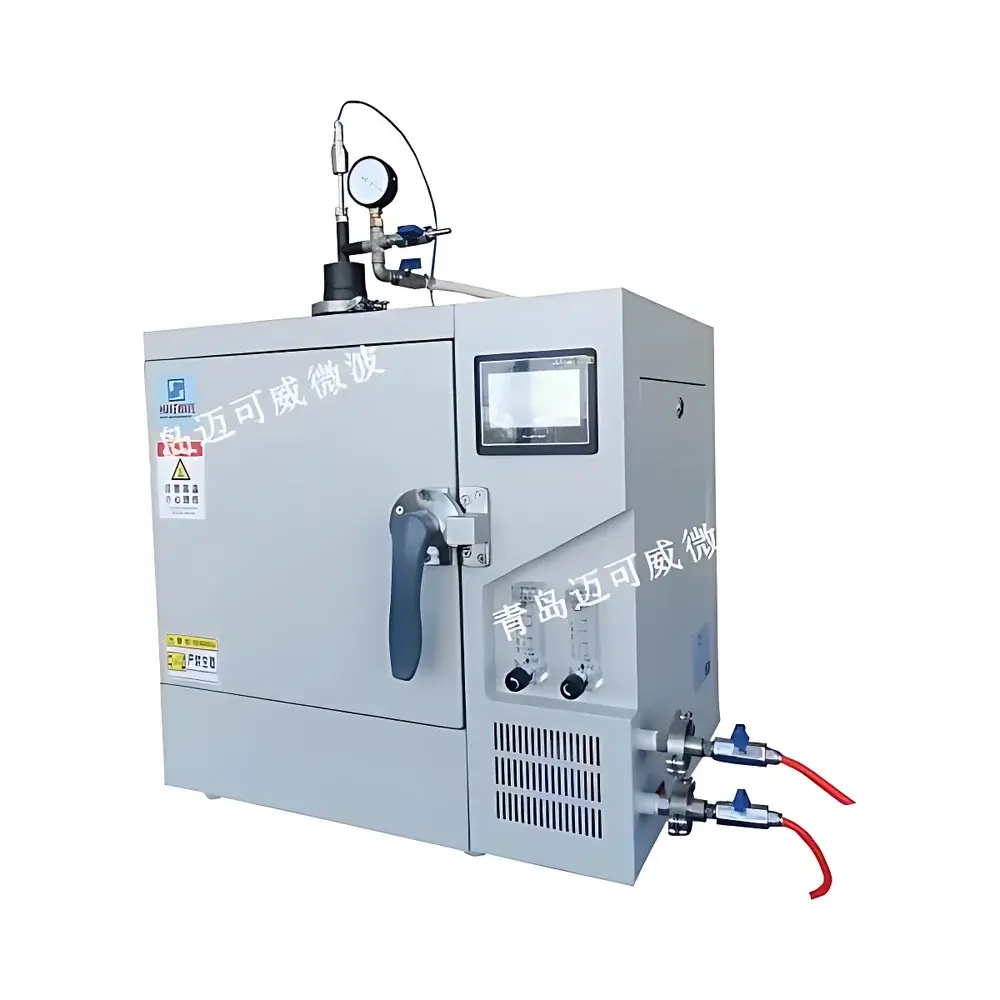
MakeWave MKG-M1UB Microwave High-Temperature Tube Furnace
| Brand | MakeWave |
|---|---|
| Origin | Shandong, China |
| Manufacturer Type | Direct Manufacturer |
| Product Category | Domestic |
| Model | MKG-M1UB |
| Price Range | USD 7,000–14,000 |
| Instrument Type | Tube Furnace |
| Maximum Temperature | 0–1000 °C |
| Temperature Control Accuracy | ±1 °C |
| Rated Power | 1300 W |
| Heating Rate to Max Temp | ≤30 min |
| Heating Method | 2450 MHz Continuous Non-Pulsed Microwave |
| Internal Chamber Dimensions | 100 × 100 mm (Crucible System) |
| Microwave Cavity Volume | ~1.2 L |
| Microwave Output Power | 800 W (Adjustable, 0–100%) |
| Atmosphere Compatibility | Inert, Reducing, Oxidizing (via Optional Gas Lines) |
| Safety Leakage | <5 mW/cm² (per GB 10436 & IEC 61000-3-2) |
Overview
The MakeWave MKG-M1UB Microwave High-Temperature Tube Furnace is an engineered hybrid platform integrating microwave volumetric heating with the controlled atmosphere integrity of a conventional horizontal tube furnace. Unlike resistive-heated tube furnaces—where thermal gradients arise from conduction and radiation—the MKG-M1UB delivers rapid, uniform energy coupling directly into dielectric and semiconducting materials via 2450 MHz continuous-wave microwave irradiation. This enables accelerated heating kinetics (≤30 min to 1000 °C), reduced thermal inertia, and minimized temperature overshoot during dynamic ramp-hold-cool cycles. Its dual-mode architecture supports both crucible-based batch processing (100 × 100 mm chamber) and insertable Φ40 mm quartz tube operation—enabling precise control over gas flow dynamics, residence time, and partial pressure conditions for solid-state reactions, catalyst activation, or precursor decomposition under inert, reducing, or oxidizing atmospheres. Designed for R&D laboratories in materials science, catalysis, and advanced ceramics, the system complies with ISO 9001 quality management standards and meets international electromagnetic safety requirements (IEC 61000-3-2, GB 10436).
Key Features
- Hybrid configuration: Simultaneous support for open-crucible microwave sintering and sealed-tube gas-phase thermal processing
- 800 W continuous non-pulsed microwave source (2450 MHz) with real-time power modulation (0–100%) for reproducible energy delivery
- Integrated 304 stainless steel cavity with multi-layer low-εr ceramic fiber insulation (thermal conductivity ≈ 0.226 W/m·K), minimizing parasitic heat loss
- Direct-contact thermocouple feedback loop (type K) embedded in sample zone for closed-loop temperature regulation (±1 °C accuracy)
- Modular atmosphere interface: Standardized VCR/NPT ports for integration with mass flow controllers, vacuum pumps, or gas cylinders
- PLC-based control system with 7-inch HMI touchscreen; stores ≥20 programmable thermal profiles with timestamped power/temperature/time logging
- λ/4 choke-sealed door with triple safety interlock (mechanical, electrical, microwave), ensuring <5 mW/cm² leakage (tested per IEC 62233)
Sample Compatibility & Compliance
The MKG-M1UB accommodates heterogeneous samples—including powders, pellets, foams, fibers, and irregularly shaped monoliths—within its 100 × 100 mm crucible zone or Φ40 mm quartz tube. Crucible options include high-purity alumina, silicon carbide, and graphite, selected based on material compatibility with target atmospheres (e.g., SiC for air, graphite for argon). For gas-solid reactions, the integrated “T”-junction bypass permits laminar cross-flow through the heated zone while maintaining stable pressure differentials. The system conforms to GLP-aligned data integrity requirements: all thermal profiles are time-stamped, non-editable in runtime, and exportable as CSV for audit trails. While not FDA 21 CFR Part 11 certified out-of-the-box, its data logging architecture supports validation protocols required for ISO/IEC 17025-accredited labs.
Software & Data Management
The embedded PLC controller records temperature, microwave power, elapsed time, and user-defined event markers at 1 Hz resolution. Historical runs are stored locally on industrial-grade flash memory and retrievable via USB export. No proprietary software installation is required—CSV files open natively in Excel, MATLAB, or Python-based analysis environments. Optional Ethernet/Wi-Fi modules enable remote monitoring and integration into lab-wide SCADA systems. All firmware updates are delivered via signed binary packages with SHA-256 verification to ensure traceability and prevent unauthorized modification.
Applications
- Controlled-atmosphere synthesis of transition metal oxides (e.g., LiCoO₂, Ni-rich NMC cathodes)
- Fast pyrolysis of biomass precursors for porous carbon development
- In-situ activation of supported metal catalysts (Pt/Al₂O₃, Pd/C) under H₂/N₂ mixtures
- Thermal annealing of thin-film photovoltaic absorbers (CIGS, CZTS)
- Decomposition kinetics studies of metal-organic frameworks (MOFs) under dynamic gas flows
- Rapid ashing of polymer composites for elemental residue analysis (ASTM D3174)
FAQ
Can the MKG-M1UB operate under vacuum?
Yes—when paired with an external vacuum pump and compatible quartz tube seals, it achieves ≤10⁻² mbar base pressure. Note: Microwave coupling efficiency decreases below 1 mbar due to reduced plasma initiation threshold.
Is quartz tube replacement included in standard configuration?
A single Φ40 mm × 600 mm fused quartz tube (operating limit: 1100 °C) is supplied. Additional tubes and custom lengths are available as accessories.
What safety certifications does the unit hold?
It carries CE marking per EMC Directive 2014/30/EU and Low Voltage Directive 2014/35/EU. Microwave leakage compliance is verified against GB 10436-2008 and IEC 62233:2005.
Does the system support ramp-hold-cool programming with multiple segments?
Yes—up to 10 independent segments per program, each with defined ramp rate (°C/min), dwell time (min), and power setpoint (% of 800 W).
How is temperature calibration performed?
Users may perform two-point calibration using NIST-traceable reference thermocouples at 300 °C and 800 °C; offset values are retained in non-volatile memory.



