
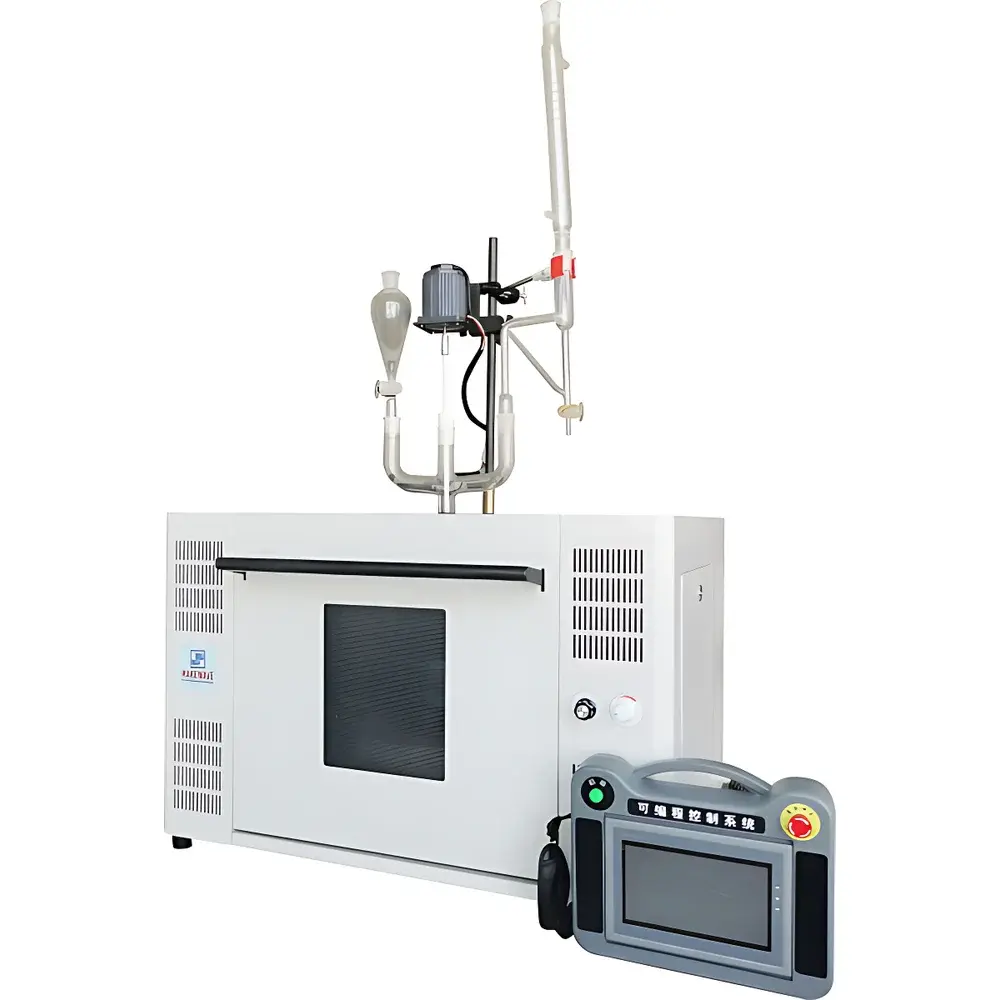
MakeWave MKX-H2C1 5L Open-Atmosphere Microwave Synthesis and Extraction System
| Brand | MakeWave |
|---|---|
| Origin | Shandong, China |
| Manufacturer Type | Direct Manufacturer |
| Country of Origin | China |
| Model | MKX-H2C1 |
| Microwave Power | 1600 W (continuous, non-pulsed) |
| Microwave Frequency | 2450 MHz |
| Temperature Range | 0–300 °C |
| Temperature Control Accuracy | ±1 °C |
| Cavity Material | 304 Stainless Steel with Multi-Layer PTFE Coating |
| Cavity Volume | ~40 L |
| Input Voltage | 220 VAC / 50 Hz |
| Total Power Consumption | 3000 W |
| Net Weight | 75 kg |
| Dimensions (W×H×D) | 782 × 610 × 493 mm (main unit), +500 mm vertical support |
Overview
The MakeWave MKX-H2C1 is an open-atmosphere, continuous-wave microwave synthesis and extraction system engineered for scalable laboratory-scale chemical processing. Unlike sealed-vessel microwave reactors, this platform operates under ambient pressure—enabling direct integration with standard glassware (e.g., single-neck flasks), reflux condensers, dropping funnels, and inert gas manifolds. Its core microwave source delivers 1600 W of non-pulsed, frequency-stabilized 2450 MHz energy, ensuring uniform field distribution and reproducible thermal coupling across heterogeneous reaction mixtures. The system is optimized for applications requiring real-time process observation, sequential reagent addition, vapor-phase condensation, and multi-phase (solid–liquid–gas) interaction—making it particularly suitable for natural product isolation, phytochemical extraction, environmental sample preparation, and pilot-stage synthetic methodology development.
Key Features
- Open-system architecture supporting 500 mL to 5 L single-neck round-bottom flasks—compatible with standard lab glassware and modular accessories.
- Dual-mode agitation: PTFE-coated anchor-type mechanical stirrer (variable-speed motor-driven) combined with magnetic stirring (PTFE-coated stir bar), enabling efficient mixing in viscous or particulate-laden media.
- Infrared-based side-wall temperature monitoring of the reaction vessel, providing real-time feedback for closed-loop PID control within ±1 °C accuracy over 0–300 °C range.
- 304 stainless steel cavity (≈40 L volume) with multi-layer PTFE interior coating—resistant to acidic, alkaline, and high-temperature exposure; facilitates rapid cleaning and long-term corrosion resistance.
- Integrated LED illumination and high-resolution color video monitoring system—enables visual assessment of phase separation, reflux behavior, solid suspension, and foam formation during operation.
- PLC-based control interface with 7-inch capacitive touchscreen: displays dynamic time–temperature–power curves; supports up to 20 programmable protocols with storage, recall, editing, and export (CSV format) capabilities.
- Comprehensive safety architecture: λ/4 choke door seal, dual interlock circuitry (instant power cutoff upon door opening), spring-loaded pressure-relief door mechanism, and active exhaust fan for volatile byproduct removal.
Sample Compatibility & Compliance
The MKX-H2C1 accommodates a broad spectrum of sample matrices—including plant biomass, soil extracts, atmospheric particulates, pesticide-spiked aqueous standards, and pharmaceutical intermediates—without requiring specialized consumables or disposable vessels. Its open-flask configuration allows direct sampling for offline GC-MS, HPLC, or ICP-MS analysis post-extraction. The system complies with GB 4706.21 (China’s microwave appliance safety standard) and demonstrates microwave leakage <5 mW/cm² at 5 cm distance—exceeding IEC 60705 and FDA 21 CFR Part 1030.10 requirements. ISO 9001:2015 certification confirms adherence to documented design, manufacturing, and quality assurance procedures. While not intrinsically rated for Class I Div 1 environments, optional nitrogen purging and explosion-proof add-ons are available per client specification.
Software & Data Management
Control logic resides in an industrial-grade PLC with deterministic scan cycles, minimizing latency between sensor input and actuator response. All operational parameters—including setpoint temperature, actual cavity temperature, microwave output (% of max), stirring speed (RPM), and elapsed time—are timestamped and logged at user-selectable intervals (1–60 s). Exported CSV files contain raw sensor values and derived metrics (e.g., cumulative energy input in kJ), facilitating traceability in GLP-compliant workflows. Audit trail functionality records operator ID, protocol selection, parameter modifications, and emergency stop events—supporting 21 CFR Part 11 readiness when deployed with network-authenticated user accounts and electronic signature modules (optional upgrade).
Applications
- Essential oil extraction from citrus peels, lavender, or eucalyptus via microwave-assisted hydrodistillation.
- Accelerated leaching of bioactive compounds (e.g., flavonoids, alkaloids) from herbal matrices under controlled reflux conditions.
- Soil and airborne particulate matter digestion for PAH, PCB, or organochlorine pesticide quantification prior to GC-ECD or LC-MS/MS analysis.
- Development of solvent-free or low-solvent green synthesis routes for heterocyclic scaffolds, metal–organic frameworks (MOFs), and functional polymers.
- Method validation studies comparing microwave-assisted extraction (MAE) against Soxhlet, ultrasound, or pressurized liquid extraction (PLE) per ASTM D7678 and ISO 21721 guidelines.
FAQ
Can the MKX-H2C1 be used with corrosive solvents such as concentrated HNO₃ or HF?
Yes—the cavity’s multi-layer PTFE coating and 304 stainless steel substrate provide robust resistance to most common acids and bases; however, HF requires dedicated quartz or PFA-lined accessories and strict procedural controls due to its unique etching behavior.
Is external cooling water required for condenser operation?
Yes—standard operation with reflux condensation necessitates connection to a recirculating chiller or tap-water supply (max. inlet temp: 25 °C; flow rate ≥2 L/min).
Does the system support inert atmosphere reactions?
Yes—via optional gas inlet port and vacuum/pressure gauge; users may purge with N₂ or Ar before and during irradiation using standard Schlenk-line techniques.
What is the maximum recommended fill volume for stable temperature control in a 5 L flask?
For optimal infrared sensing and thermal homogeneity, fill volume should be maintained between 30% and 70% of nominal capacity (i.e., 1.5–3.5 L), especially above 200 °C.
Are firmware updates and technical support provided post-purchase?
Yes—MakeWave offers free remote firmware upgrades and application engineering support for one year; extended service contracts include on-site calibration and preventive maintenance visits.



