
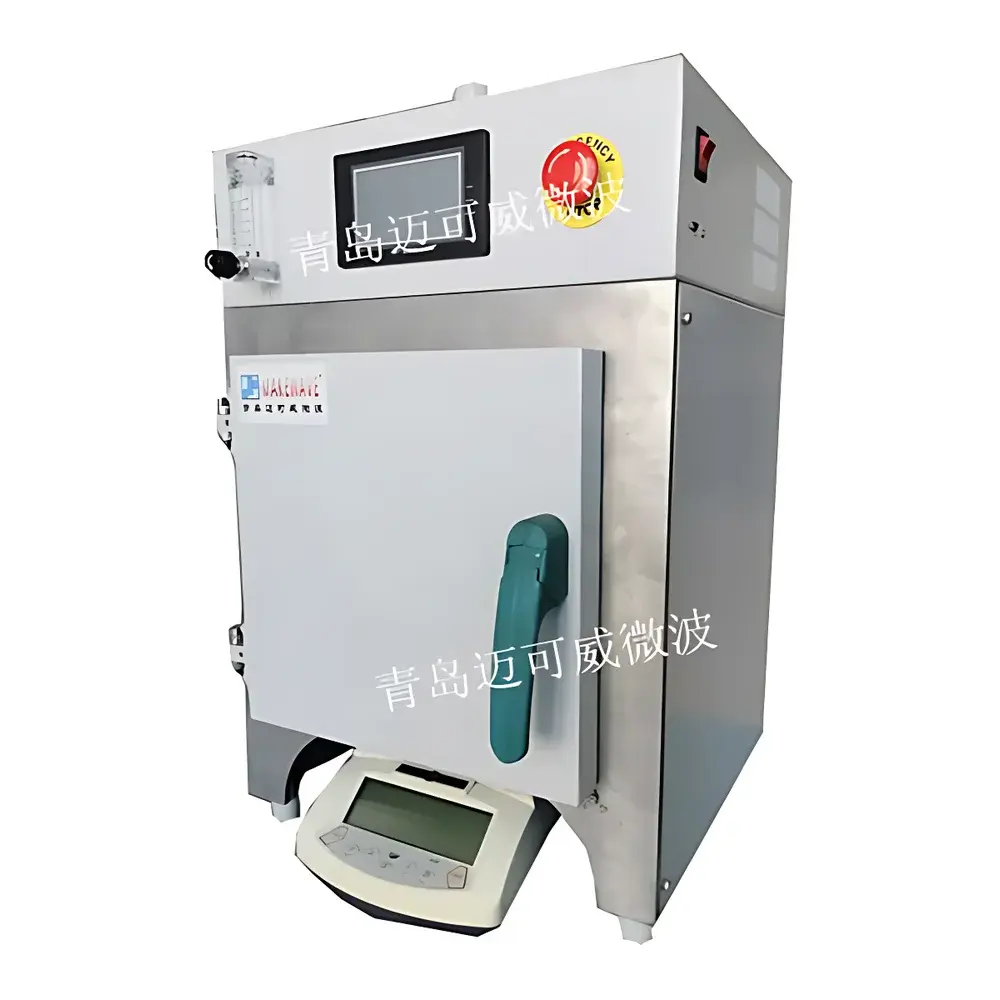
MakeWave MKC-M1A Microwave Thermogravimetric Analyzer (TGA) with 800 °C Capability
| Brand | MakeWave |
|---|---|
| Origin | Shandong, China |
| Manufacturer Type | Direct Manufacturer |
| Instrument Type | Dedicated Microwave TGA |
| Temperature Range | 0–900 °C |
| Temperature Accuracy | ±3 K |
| Balance Sensitivity | 1 µg |
| Heating/Cooling Rate | Up to 100 K/min |
| Microwave Frequency | 2450 MHz |
| Rated Microwave Power | 800 W (Continuously Adjustable, Non-Pulsed) |
| Balance Capacity | 50 g |
| Balance Resolution | 0.001 g |
| Chamber Volume | ~8 L |
| Microwave Leakage | <5 mW/cm² (Compliant with GB 10436 & IEC 62233) |
Overview
The MakeWave MKC-M1A Microwave Thermogravimetric Analyzer represents a paradigm shift in thermal analysis methodology by replacing conventional resistive or radiant heating with controlled, volumetric microwave energy delivery. Unlike traditional TGA systems that rely on conductive/convective heat transfer—introducing thermal lag, temperature gradients, and slow response—the MKC-M1A employs dielectric heating principles, where electromagnetic energy couples directly with polar molecules and ionic species within the sample. This enables rapid, uniform, and selective heating of materials based on their complex permittivity (ε* = ε′ − jε″) and loss tangent (tan δ), facilitating real-time correlation between mass loss kinetics and intrinsic dielectric behavior. Engineered for precision and reproducibility, the system operates across a validated thermal range of 0–900 °C with ±3 K accuracy and supports dynamic heating/cooling rates up to 100 K/min—making it suitable for kinetic studies, pyrolysis optimization, ash content quantification, and high-throughput thermal stability screening under controlled atmospheres.
Key Features
- Integrated microwave–thermogravimetric platform with fully sealed, positive-pressure air environment and condensable off-gas collection capability
- High-stability microbalance with 50 g capacity and 0.001 g resolution, optimized for ceramic crucibles (20–50 mL) compatible with oxidative and inert thermal treatments
- Monolithic 304 stainless-steel microwave cavity featuring embedded thermal insulation and patented cavity design (ZL201821307125.9) for minimized energy loss and enhanced thermal efficiency at elevated temperatures
- Non-pulsed, continuously variable 2450 MHz microwave source (0–800 W) enabling precise power modulation synchronized with temperature ramp profiles
- Direct infrared pyrometry for real-time, non-contact sample surface temperature monitoring—eliminating thermocouple-induced measurement artifacts
- PLC-based control architecture with industrial-grade HMI touchscreen interface; supports multi-step programmable protocols with full data logging of time, temperature, microwave power, and mass
- Comprehensive safety system including interlocked side-sliding door with λ/4 choke structure, automatic microwave cutoff on door opening, and integrated natural exhaust duct for fume management in conjunction with laboratory ventilation hoods
Sample Compatibility & Compliance
The MKC-M1A accommodates a broad spectrum of solid and powdered samples—including polymers, biomass, coal, pharmaceutical excipients, catalysts, and inorganic salts—without requiring pre-comminution beyond standard TGA practice. Its closed-air configuration ensures consistent oxidation conditions for volatile matter, fixed carbon, and ash determination per ASTM D3172, ISO 1171, and GB/T 212. Optional inert gas purging (N₂, Ar) can be implemented via external manifold integration. The instrument conforms to ISO 9001:2015 quality management requirements and meets electromagnetic compatibility and occupational safety standards specified in GB 10436 (microwave radiation limits) and IEC 62233 (household and similar electronic appliances). While not FDA 21 CFR Part 11–certified out-of-the-box, audit-ready data export (CSV, TXT) and user-accessible protocol logs support GLP/GMP-aligned validation workflows when deployed in regulated environments.
Software & Data Management
Data acquisition and visualization are handled through an embedded industrial control system—not third-party PC software—ensuring deterministic timing and immunity to host OS interruptions. Real-time curves for mass change (%), derivative thermogravimetry (DTG), temperature, and microwave power are rendered simultaneously on the 7-inch capacitive touchscreen. All raw and processed datasets are timestamped and stored internally (SD card backup optional); export is supported via USB 2.0 to standard spreadsheet formats. Multi-program memory allows storage of ≥50 custom thermal protocols, each configurable with dwell times, ramp rates, power setpoints, and alarm thresholds. Event-triggered logging (e.g., mass loss onset, inflection point detection) facilitates post-run kinetic analysis using established models such as Flynn–Wall–Ozawa or Kissinger–Akahira–Sunose.
Applications
- Quantitative thermal decomposition profiling of biochar precursors and lignocellulosic feedstocks under simulated pyrolysis conditions
- Determination of moisture, volatile matter, fixed carbon, and ash content in coal and coke per ISO 562 and ASTM D3172
- Dielectric property–driven thermal behavior mapping: correlating tan δ peaks with mass loss events to identify polarization relaxation mechanisms
- Rapid screening of polymer thermal stability and filler dispersion effects under microwave-specific heating dynamics
- In-process monitoring of catalytic coke burn-off kinetics in petrochemical R&D laboratories
- Validation of microwave-assisted synthesis intermediates for pharmaceutical solid-state characterization
FAQ
Does the MKC-M1A support inert or reducing atmospheres?
Yes—while configured for positive-pressure air operation by default, the system features standardized gas inlet/outlet ports compatible with external mass flow controllers for N₂, Ar, H₂, or forming gas integration.
Can the balance resolution be upgraded to 0.1 µg?
No—the current 0.001 g (1 mg) resolution is optimized for robustness at elevated temperatures and microwave field exposure; sub-milligram sensitivity requires vacuum-isolated analytical balances incompatible with this microwave-coupled architecture.
Is remote monitoring or Ethernet connectivity available?
Not natively; however, the USB data export interface enables seamless integration into lab-wide LIMS or SCADA platforms via external middleware.
What maintenance is required for the microwave generator?
The magnetron-based source is rated for ≥5000 h MTBF; routine inspection includes cooling fan function verification and waveguide seal integrity check every 6 months.
How is temperature calibration performed?
Calibration uses certified reference materials (e.g., Ni, Cu, Al₂O₃) traceable to NIST SRMs, with IR sensor offset correction applied via the HMI calibration utility—documented per ISO/IEC 17025 guidelines.



