
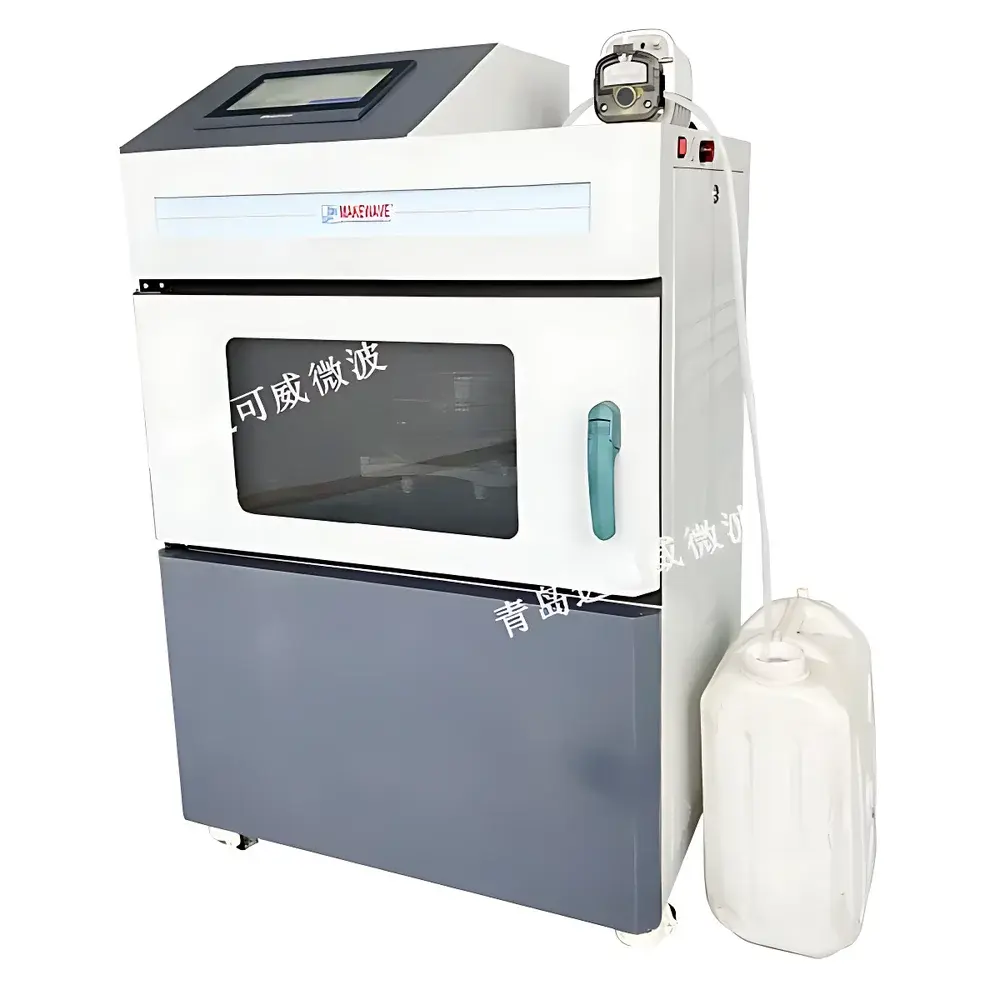
Continuous Microwave-Assisted Large-Volume Evaporative Concentrator for Aqueous Gamma Spectrometry Samples (HXN-W50L)
| Brand | Makewave |
|---|---|
| Origin | Shandong, China |
| Manufacturer Type | Direct Manufacturer |
| Country of Origin | China |
| Model | HXN-W50L |
| Instrument Type | Automated Quantitative Concentrator |
| Temperature Range | 0–100 °C |
| Temperature Control Accuracy | ±1 °C |
| Maximum Sample Volume Capacity | 20 L |
| Microwave Power Output | 3200 W at 2450 MHz |
| Cavity Volume | ~60 L |
| Microwave Leakage | <5 mW/cm² |
| Power Supply | 220/380 V AC, 50 Hz |
| Total Power Consumption | ≤5000 W |
| Dimensions (W×H×D) | 950×800×600 mm (excl. handles) |
| Weight Monitoring | Integrated dynamic liquid-level sensing with auto-refill logic |
| Control Interface | PLC-based system with 10-inch industrial touchscreen |
Overview
The Makewave HXN-W50L Continuous Microwave-Assisted Large-Volume Evaporative Concentrator is an engineered solution designed specifically for the pre-concentration of large-volume aqueous environmental or nuclear monitoring samples—particularly those intended for subsequent gamma spectrometric analysis (e.g., 137Cs, 60Co, 226Ra quantification). Unlike conventional hotplate or rotary evaporator systems, this instrument employs controlled microwave dielectric heating to accelerate solvent removal while preserving radionuclide integrity and minimizing isotopic fractionation or volatilization loss. Its architecture supports uninterrupted operation across multi-liter batches (up to 20 L per cycle), enabling laboratories to process field-collected water samples—such as drinking water, surface water, groundwater, or seawater—under reproducible thermal conditions compliant with EPA Method 900.0, ISO 10703, and IAEA Technical Reports Series No. 438 guidelines for radiochemical sample preparation.
Key Features
- Microwave-driven evaporation at 2450 MHz with 3200 W industrial-grade magnetron output, delivering rapid and uniform energy coupling into aqueous matrices without direct contact heating elements.
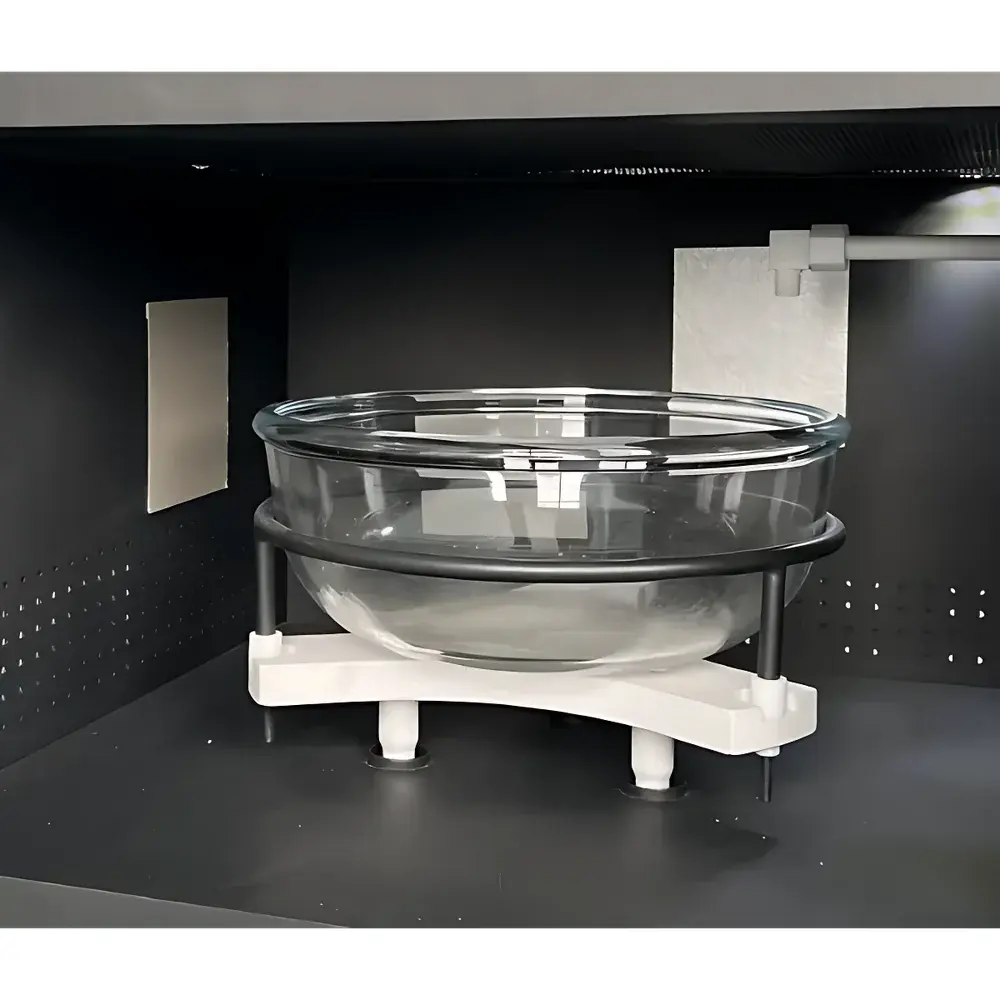
- 60-liter stainless-steel (304) cavity with multi-layer PTFE coating for corrosion resistance, thermal stability up to 100 °C, and simplified decontamination—critical for low-background radiometric workflows.
- Integrated continuous-feed architecture: 20 L external reservoir coupled via self-priming pump to a 5 L borosilicate glass evaporation dish, enabling dynamic replenishment during operation and eliminating manual intervention.
- Real-time process monitoring via infrared non-contact temperature sensing (top-down irradiation path), combined with capacitive liquid-level detection for automated volume tracking and dry-run prevention.
- PLC-controlled system with 10-inch HMI touchscreen interface supporting programmable ramp-hold profiles, power modulation feedback loops, and independent control of ventilation, illumination, and chamber exhaust.
- Comprehensive safety compliance: interlocked door mechanism with microwave cutoff, λ/4 choke structure ensuring leakage <5 mW/cm² (per GB 10436 and IEC 61000-3-2), and dual overtemperature/overcurrent protection circuits.
Sample Compatibility & Compliance
The HXN-W50L accommodates a broad range of aqueous sample types—including low-salinity potable water, high-TDS brines, and suspended particulate suspensions—without requiring acid digestion or carrier addition prior to concentration. Its open-vessel geometry and directional moisture extraction minimize aerosol carryover and radionuclide adsorption losses. The system meets essential regulatory prerequisites for environmental radiochemistry labs operating under ISO/IEC 17025:2017 accreditation, supporting traceability through timestamped operational logs and audit-ready parameter recording. While not FDA 21 CFR Part 11–certified out-of-the-box, its data export capability (CSV/Excel-compatible curves) facilitates integration into validated LIMS environments where electronic records are subject to ALCOA+ principles.
Software & Data Management
All operational parameters—including real-time temperature, cumulative evaporation time, microwave power duty cycle, chamber humidity trends, and estimated residual volume—are continuously logged and visualized on the embedded HMI. Historical sessions can be exported via USB interface in tabular format for post-processing in MATLAB, Python (Pandas), or laboratory-specific QA/QC software. The system does not include cloud connectivity or remote access; however, its deterministic PLC firmware ensures deterministic repeatability across shifts and operators—a prerequisite for inter-laboratory comparison studies coordinated by national metrology institutes or IAEA proficiency testing programs.
Applications
- Pre-concentration of 10–20 L environmental water samples for gamma spectrometry analysis of anthropogenic and natural radionuclides (e.g., 40K, 238U series, 137Cs).
- High-throughput processing in nuclear regulatory monitoring labs performing routine surveillance of effluent discharges or drinking water compliance testing.
- Radioecological research requiring quantitative recovery of particle-reactive isotopes (e.g., 239Pu, 241Am) from filtered and unfiltered fractions.
- Method development for accelerated evaporation protocols aligned with ASTM D5673 (Standard Test Method for Radionuclides in Water by Gamma Spectrometry).
- Supporting ISO 11704 (Environmental radioactivity — Measurement of radionuclides in water) sample preparation workflows where gravimetric yield verification is required.
FAQ
What sample matrices are compatible with the HXN-W50L?
Aqueous solutions only—including tap water, river water, seawater, and acidified preservation media (e.g., 1% HNO3). Organic solvents, oils, or viscous slurries are not supported due to microwave absorption and safety constraints.
Can the system operate unattended overnight?
Yes—fully autonomous operation is enabled via programmable shutdown triggers based on time, temperature threshold, or inferred dryness from level sensors. Safety interlocks remain active throughout.
Is calibration traceable to national standards?
Temperature sensing is factory-calibrated against NIST-traceable IR references; users may perform periodic verification using calibrated blackbody sources per ISO/IEC 17025 Clause 6.5.
How is residue recovery validated?
The system does not measure chemical yield directly; users must implement parallel gravimetric or tracer-based recovery checks (e.g., adding stable 133Cs spike) as part of their SOPs—consistent with IAEA guidance on analytical quality assurance.
Does the unit support GLP-compliant data archiving?
Raw session logs are exportable and timestamped, but long-term archival, user authentication, and electronic signature functionality require integration with external LIMS or ELN platforms.
Related Products



