
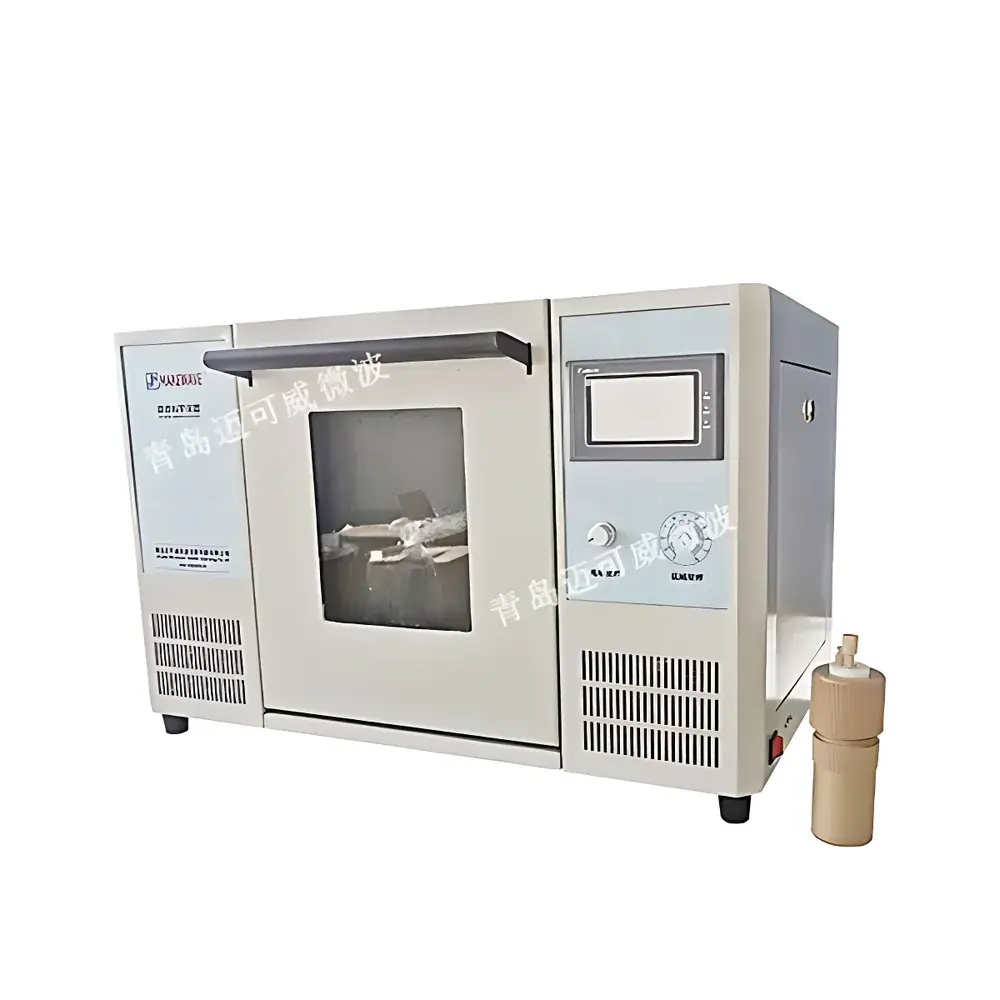
MakeWave MKX-H1G1A Microwave-Assisted Hydrothermal Synthesis Reactor
| Brand | MakeWave |
|---|---|
| Origin | Shandong, China |
| Manufacturer Type | Direct Manufacturer |
| Country of Origin | China |
| Model | MKX-H1G1A |
| Temperature Range | 0–260 °C |
| Temperature Control Accuracy | ±0.1 °C |
| Reaction Vessel Capacity | 80 mL |
| Number of Reaction Units | 1 |
| Microwave Frequency | 2450 MHz |
| Rated Microwave Power | 800 W (continuous, non-pulsed output) |
| Cavity Volume | ~20 L |
| Power Supply | 220 V AC / 50 Hz |
| Total Power Consumption | 1300 W |
| Net Weight | 65 kg |
| Dimensions (W×H×D) | 782 × 492 × 450 mm |
Overview
The MakeWave MKX-H1G1A is a benchtop microwave-assisted hydrothermal synthesis reactor engineered for precise, reproducible, and safe high-temperature/pressure chemical synthesis under aqueous conditions. It operates on the principle of dielectric heating via 2450 MHz continuous-wave microwave irradiation, enabling rapid and uniform volumetric heating of reaction mixtures—distinct from conventional conductive heating. Under hydrothermal conditions, water exhibits altered dielectric properties, reduced surface tension, and enhanced ion mobility near its critical point (~374 °C, 22.1 MPa), facilitating accelerated nucleation, crystallization, and phase transformation. The MKX-H1G1A maintains stable operation up to 260 °C and supports sealed-vessel reactions in an inert, corrosion-resistant PTFE-lined cavity, making it suitable for solvothermal synthesis, nanomaterial crystallization (e.g., metal oxides, perovskites, MOFs), and controlled dopant incorporation into inorganic lattices.
Key Features
- 20 L monolithic 304 stainless steel cavity with multi-layer PTFE interior coating—resistant to acidic, alkaline, and high-temperature environments; easy-clean surface finish.
- Integrated fiber-optic temperature sensor with direct insertion into the reaction vessel—ensuring real-time, non-invasive thermal monitoring with ±0.1 °C accuracy.
- Programmable magnetic stirring system with PTFE-coated stir bar; speed adjustable to maintain homogeneity during dynamic hydrothermal conditions.
- PLC-based control architecture with 7-inch color touchscreen interface—enabling simultaneous closed-loop regulation of temperature, pressure (via optional sensor), and microwave power.
- Real-time graphical display of time–temperature–power profiles; data logging in CSV format for post-experiment analysis and traceability.
- Multi-stage safety architecture: interlocked door mechanism (power cutoff upon opening), λ/4 choke design limiting microwave leakage to <5 mW/cm² (IEC 61000-3-2 compliant), and integrated exhaust fan for controlled venting of volatile byproducts.
Sample Compatibility & Compliance
The MKX-H1G1A accommodates standard 80 mL PTFE-lined hydrothermal autoclaves compatible with common inorganic precursors (e.g., nitrates, chlorides, acetates), organic ligands, and aqueous or mixed-solvent systems. Its design conforms to ISO 9001:2015 quality management requirements. While not certified for GLP or GMP environments out-of-the-box, the system supports audit-ready data export and programmable method storage—facilitating alignment with internal SOPs and regulatory documentation practices (e.g., FDA 21 CFR Part 11 when paired with validated software extensions). Pressure-rated vessels must be selected per ASTM E2913-22 guidelines for hydrothermal containment integrity.
Software & Data Management
The embedded HMI firmware provides intuitive method setup—including ramp-hold-cool sequences, power modulation profiles, and user-defined alarm thresholds. Up to 20 pre-programmed protocols can be stored, edited, duplicated, or erased directly via touchscreen. All operational parameters (timestamp, setpoint, actual temperature, applied power, elapsed time) are logged at 1-second intervals and exportable via USB port. No proprietary drivers or cloud dependency—raw CSV files integrate seamlessly with MATLAB, Python (pandas), or LabArchives for statistical process analysis and reporting. Optional video monitoring module (not included) enables visual validation of gel dissolution, precipitation onset, or phase separation events.
Applications
- Rapid synthesis of nanostructured metal oxides (TiO₂, ZnO, Fe₃O₄) with tunable crystallinity and particle size distribution.
- One-pot preparation of doped perovskite materials (e.g., CsPbBr₃: Mn²⁺) under subcritical water conditions to stabilize metastable oxidation states.
- Controlled hydrolysis and condensation of silica precursors for mesoporous SBA-15 or MCM-41 frameworks.
- Crystallization of coordination polymers and metal–organic frameworks (MOFs) with high phase purity and minimal solvent inclusion.
- Accelerated aging studies of battery cathode materials (e.g., NMC, LFP) under simulated hydrothermal stress conditions.
FAQ
What is the maximum allowable working pressure for the standard 80 mL reaction vessel?
The standard PTFE liner is rated for sustained operation up to 4 MPa at 220 °C. For higher-pressure applications (e.g., >260 °C), users must specify reinforced alloy vessels conforming to ASME BPVC Section VIII standards.
Can the MKX-H1G1A be integrated into an automated lab workflow?
Yes—the unit features RS-485 Modbus RTU communication capability for integration with central LIMS or SCADA platforms. Custom API support is available upon request for OEM-level automation.
Is fiber-optic temperature measurement validated per ISO/IEC 17025?
The fiber-optic probe is factory-calibrated against NIST-traceable reference standards. Full calibration certificates (including uncertainty budgets) are provided with each instrument shipment.
Does the system meet electromagnetic compatibility (EMC) requirements for laboratory use?
Yes—it complies with EN 61326-1:2013 for laboratory equipment immunity and emissions, verified through third-party testing at accredited facilities in Shanghai and Berlin.
What maintenance is required for long-term reliability?
Routine inspection of door gasket integrity, cavity coating adhesion, and stir motor coupling wear is recommended every 500 operating hours. No scheduled replacement of magnetron or waveguide components is required within the first 5,000 h of service life under normal load conditions.



