
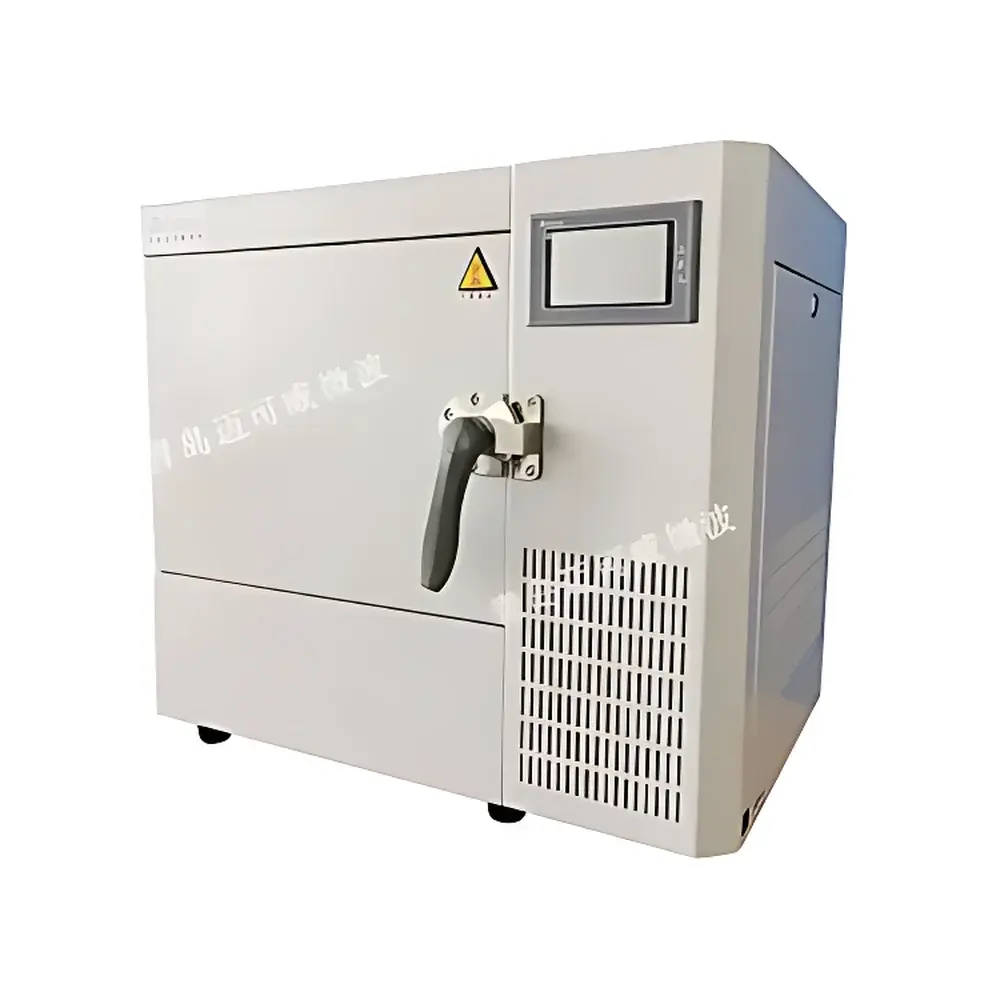
Desktop Microwave Rapid Ashing Furnace (5L) – MAKEWAVE MKX-R2HC Muffle Furnace
| Brand | MAKEWAVE |
|---|---|
| Origin | Shandong, China |
| Manufacturer Type | Direct Manufacturer |
| Product Category | Domestic |
| Model | MKX-R2HC |
| Instrument Type | Box-Type Muffle Furnace |
| Max Temperature | 1000 °C |
| Temperature Control Accuracy | ±1 °C |
| Max Power | 1600 W |
| Heating Method | Microwave (2450 MHz, Continuous Non-Pulsed Output) |
| Cavity Volume | 5 L |
| External Dimensions (W×H×D) | 745 × 680 × 595 mm |
| Internal Cavity | Quartz-lined 304 Stainless Steel Chamber with Multi-Layer Ceramic Fiber Insulation (Thermal Conductivity ≈ 0.226 W/m·K) |
| Atmosphere Control | Sealed Positive-Pressure System with Dual-Gas Inlet & Exhaust Port (Optional Scrubber Interface) |
| Safety Compliance | Microwave Leakage < 5 mW/cm² (IEC 61000-4-3 / GB 10436–2022 Equivalent) |
Overview
The MAKEWAVE MKX-R2HC Desktop Microwave Rapid Ashing Furnace is an engineered solution for high-efficiency thermal sample preparation in regulated laboratory environments. Unlike conventional resistance-heated muffle furnaces, this system employs 2450 MHz continuous-wave microwave energy to directly couple with polar molecules and ionic species within the sample matrix—enabling volumetric, non-contact heating. This mechanism eliminates reliance on conduction or convection, resulting in significantly accelerated thermal ramp rates (reaching 1000 °C in ≤10 minutes), reduced thermal inertia, and improved energy utilization. Designed specifically for ashing, carbonization, volatiles determination, and controlled oxidative/anaerobic decomposition, the MKX-R2HC complies with standard methodologies referenced in ASTM D3174, ISO 1171, USP <281>, and EPA Method 1631—where rapid, reproducible residue quantification is critical across food safety, pharmaceutical QC, petrochemical analysis, and environmental monitoring workflows.
Key Features
- 5 L Quartz-Lined Microwave Cavity: Constructed from seamless 304 stainless steel with integrated λ/4 choke suppression at the door interface; inner chamber lined with high-purity fused quartz to prevent cross-contamination and ensure trace-level analytical integrity.
- Precision Thermal Management: Integrated K-type thermocouple feedback loop coupled with PLC-based closed-loop power modulation delivers ±1 °C temperature stability across 0–900 °C operating range (1000 °C peak capability); real-time power and temperature profiles are logged and exportable.
- Controlled Atmosphere Flexibility: Fully sealed positive-pressure cavity supports programmable gas introduction (O2, N2, Ar, air mixtures) via dual mass-flow-controlled inlets; exhaust port accommodates optional catalytic scrubber or condensation trap modules for halogenated or sulfur-rich sample matrices.
- Multi-Sample Parallel Processing: Standard configuration supports up to twelve 50 mm-diameter crucibles; compatible with 15 mL, 50 mL, and 70 mL high-purity alumina or quartz crucible formats for batched ashing of heterogeneous feedstocks (e.g., biomass, polymer composites, feedstuffs).
- Energy-Efficient Thermal Architecture: Multi-tier ceramic fiber insulation (low εγ-loss formulation) minimizes radial heat loss (<0.226 W/m·K conductivity); combined with direct microwave coupling, typical specific energy consumption is ~40% lower than equivalent resistance-heated units per gram of ash residue.
- Regulatory-Ready Safety Framework: Interlocked door mechanism with automatic microwave cutoff, quarter-wavelength choke design, and certified leakage <5 mW/cm² (measured per IEC 61000-4-3 test protocol); top-mounted passive vent duct integrates seamlessly with laboratory fume hood infrastructure.
Sample Compatibility & Compliance
The MKX-R2HC is validated for use with organic matrices requiring precise oxidative decomposition—including foodstuffs (AOAC 942.05), pharmaceutical excipients (USP <281>), coal and coke (ASTM D3174), synthetic fibers (ISO 1887), and environmental solids (EPA SW-846 Method 3050B). Its ability to operate under oxygen-limited or inert atmospheres enables controlled charring prior to final ash oxidation—critical for minimizing volatile metal losses in trace elemental analysis (e.g., ICP-MS sample prep). The quartz-lined cavity meets GLP requirements for residue-free operation between runs, eliminating carryover risks common in refractory brick-lined furnaces. All firmware and data logging functions comply with FDA 21 CFR Part 11 audit trail requirements when paired with MAKEWAVE’s optional secure data module.
Software & Data Management
Operation is managed through a 7-inch industrial-grade resistive touchscreen HMI running embedded Linux OS. The control interface supports up to 99 programmable multi-step protocols—each storing time-temperature-power setpoints, gas flow parameters, and cooling ramp profiles. Real-time graphs display concurrent temperature, reflected power, and cavity pressure (when optional sensor installed). Data export is available via USB 2.0 (CSV format) or Ethernet (Modbus TCP) for integration into LIMS or ELN platforms. Optional software package includes automated report generation compliant with ISO/IEC 17025 documentation standards, including operator ID, timestamped calibration logs, and deviation alerts.
Applications
- Routine ash content determination in animal feed, cereals, and dairy products per AOAC and ISO protocols
- Volatiles and fixed carbon analysis in coal, coke, and biochar samples (ASTM D3172/D3175)
- Residue-on-ignition (ROI) testing of pharmaceutical APIs and excipients under GMP conditions
- Pre-concentration of environmental sediment and sludge for heavy metal quantification (EPA 6010D/6020B)
- Controlled pyrolysis of polymer composites and synthetic textiles for additive recovery studies
- High-throughput sample conditioning for XRF, AAS, and ICP-OES digestion workflows
FAQ
What types of crucibles are compatible with the MKX-R2HC?
Standard support is provided for 50 mm OD cylindrical crucibles (alumina, quartz, or silicon carbide); custom adapters accommodate 15 mL, 50 mL, and 70 mL formats. Graphite crucibles are not recommended due to microwave coupling instability.
Can the furnace be used under vacuum conditions?
No—the system is designed for positive-pressure atmosphere control only. Vacuum compatibility requires structural redesign and is not supported in this model.
Is calibration traceable to national standards?
Yes—factory calibration uses NIST-traceable thermocouples; users may perform in-house verification using reference materials (e.g., nickel oxide, ZnO) per ISO/IEC 17025 guidelines.
Does the system meet electromagnetic compatibility (EMC) requirements for lab installation?
Yes—it conforms to EN 61326-1:2013 for laboratory equipment and includes internal EMI filtering to prevent interference with adjacent instrumentation.
What maintenance is required for long-term reliability?
Quarterly inspection of door gasket integrity and choke geometry; annual verification of thermocouple drift and microwave output stability using calibrated power meter and thermal imaging.



