
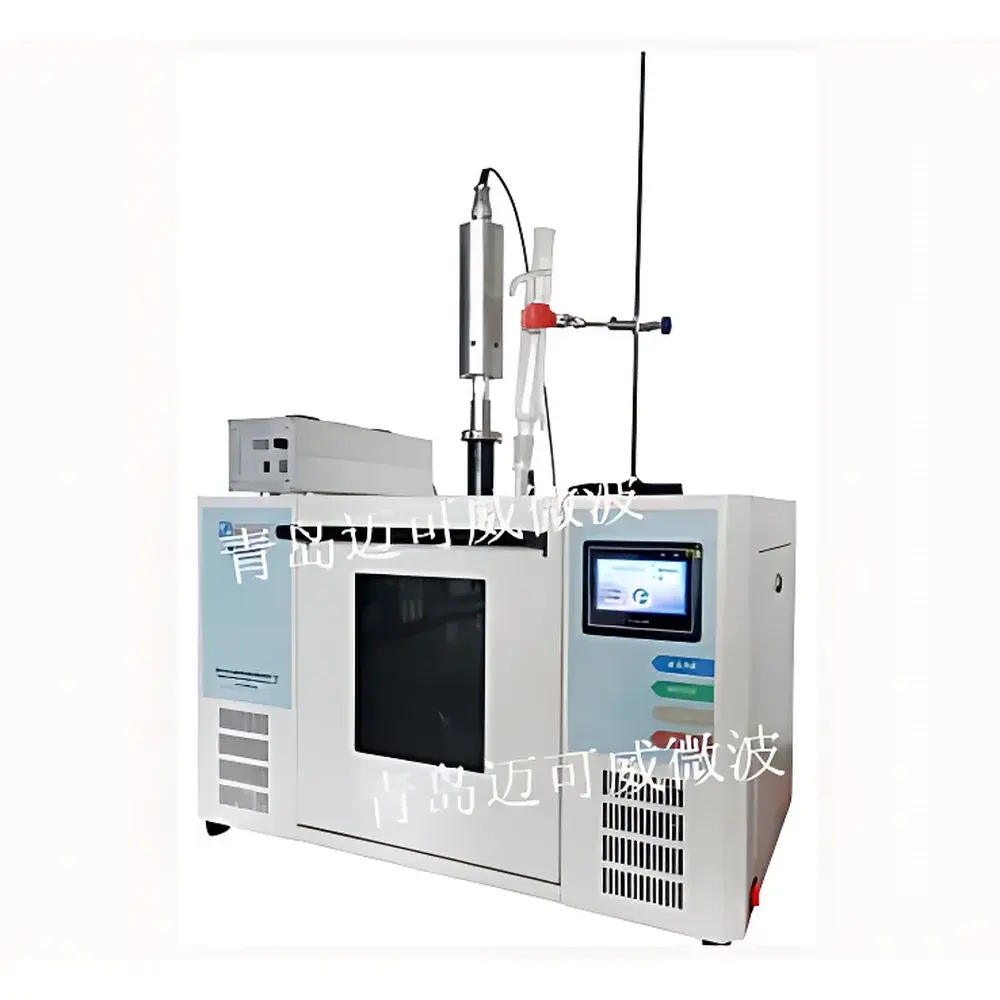
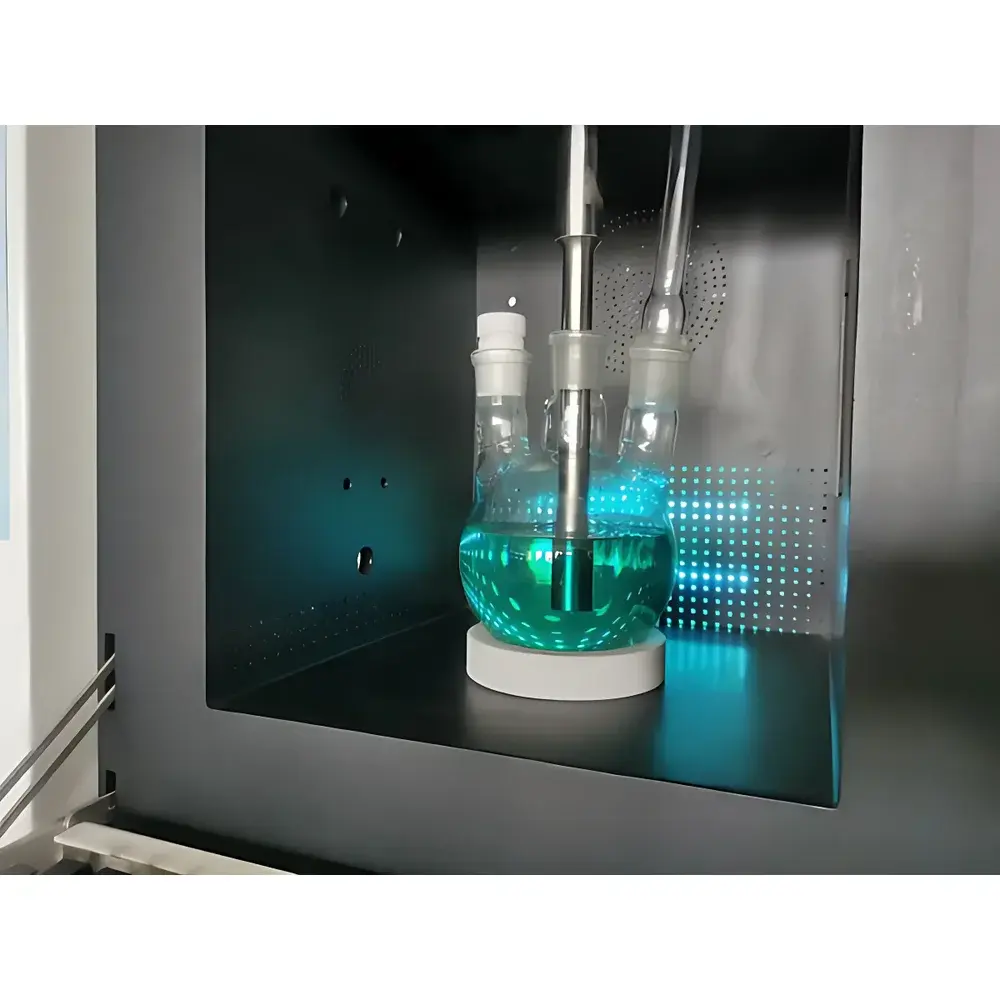
MakeWave MKX-H1C1UM Microwave-Ultrasound-UV Multimodal Synthesis System
| Brand | MakeWave |
|---|---|
| Origin | Shandong, China |
| Manufacturer Type | Direct Manufacturer |
| Country of Origin | China |
| Model | MKX-H1C1UM |
| Temperature Range | 0–300 °C |
| Pressure Condition | Ambient (Atmospheric) |
| Microwave Output Power | 900 W |
| Magnetron Frequency | 2450 MHz |
| Stirring Modes | Mechanical Stirring & Magnetic Stirring |
| Reaction Vessel Capacity | 500 mL |
| UV Wavelength Options | 254 nm and/or 365 nm (Selectable) |
Overview
The MakeWave MKX-H1C1UM Microwave-Ultrasound-UV Multimodal Synthesis System is an integrated laboratory platform engineered for advanced reaction engineering under controlled thermal, mechanical, and photochemical stimuli. It operates on three complementary energy transduction principles: microwave dielectric heating (2450 MHz, 900 W), ultrasonic cavitation (typically 20–40 kHz range, integrated transducer), and near-UV photon excitation (254 nm and/or 365 nm emission). Unlike single-mode reactors, this system enables simultaneous or sequential application of these modalities—allowing precise control over reaction kinetics, selectivity, and pathway divergence. The instrument is designed for open-vessel operation at ambient pressure, with temperature monitoring and regulation up to 300 °C via calibrated Pt100 sensor feedback. Its architecture supports reproducible scale-up from discovery-phase screening (50–500 mL volume range) to method development under GLP-aligned experimental conditions.
Key Features
- Triple-energy activation platform: Synchronized or independent control of microwave irradiation, ultrasonic acoustic energy, and UV photonic input.
- High-fidelity temperature management: Real-time PID-controlled heating with ±1 °C accuracy across 0–300 °C range; compatible with sealed and open-vessel configurations.
- Dual stirring capability: Integrated mechanical stirrer (adjustable speed, torque-sensing) and optional magnetic stirring for heterogeneous or viscous reaction mixtures.
- Modular UV source: Interchangeable low-pressure mercury lamps delivering defined irradiance at 254 nm (high-energy germicidal/UVC) or 365 nm (UVA), with quartz reaction window ensuring spectral transmission.
- Rugged stainless-steel cavity with RF shielding and interlocked safety door compliant with IEC 61000-6-3 (EMC) and IEC 60335-1 (safety).
- Intuitive touchscreen interface with programmable multi-step protocols, event-triggered parameter switching, and digital logging of time-stamped operational parameters.
Sample Compatibility & Compliance
The MKX-H1C1UM accommodates standard borosilicate glass and quartz reaction vessels (up to 500 mL nominal volume), including round-bottom flasks, jacketed reactors, and custom-fit UV-transparent cells. It supports catalytic, solvent-based, and solvent-free transformations involving organometallics, heterocycles, nanomaterial precursors, and polymerizable monomers. The system meets fundamental requirements for laboratory instrumentation per ISO/IEC 17025:2017 (clause 5.5.2 — equipment verification), and its operational logs support audit trails required under FDA 21 CFR Part 11 when paired with validated data acquisition software. While not certified for hazardous area use (ATEX/IECEx), it incorporates fail-safes including microwave leakage detection (<5 mW/cm² at 5 cm), overtemperature cutoff, and ultrasonic duty-cycle limiting.
Software & Data Management
The embedded control firmware records all active parameters—including microwave power output (%/W), real-time temperature, ultrasonic amplitude (if adjustable), UV lamp status, stirring RPM, and elapsed time—at user-defined intervals (1–60 s). Data export is supported via USB 2.0 to CSV format, enabling post-acquisition analysis in MATLAB, Python (Pandas), or OriginLab. Optional PC-based software provides remote monitoring, protocol library management, and comparative kinetic curve overlay. Audit trail functionality includes operator ID tagging, timestamped parameter changes, and immutable log files—aligning with GLP documentation expectations for synthetic methodology validation.
Applications
- Sustainable synthesis: Accelerated C–C coupling (Suzuki, Heck), esterifications, and condensation reactions under reduced thermal load.
- Photocatalysis development: Screening of TiO₂, g-C₃N₄, and organic photocatalysts under combined UV + ultrasound for enhanced charge separation.
- Nanomaterial preparation: Controlled nucleation of metal oxides (ZnO, Fe₃O₄) and quantum dots via sonochemical reduction under microwave-assisted aging.
- Pharmaceutical intermediate synthesis: Rapid optimization of API precursors where conventional heating yields side products; UV co-activation enables radical-initiated cyclizations.
- Green chemistry workflows: Solvent-free mechano-photo-thermal reactions minimizing waste generation and E-factor.
FAQ
Can the MKX-H1C1UM operate all three energy sources simultaneously?
Yes—microwave, ultrasonic, and UV irradiation can be activated concurrently or independently via the protocol editor, with interlocks preventing unsafe combinations (e.g., UV exposure during microwave-only mode without vessel cooling).
Is quartz required for UV experiments?
For full transmission at 254 nm, fused quartz or synthetic silica vessels are mandatory; standard borosilicate glass attenuates >90% of UVC. At 365 nm, borosilicate is acceptable but quartz offers superior durability under prolonged irradiation.
What safety certifications does the system hold?
It complies with IEC 61010-1 (Safety Requirements for Electrical Equipment for Measurement, Control, and Laboratory Use) and IEC 61000-6-3 (Emission Standard for Industrial Environments); CE marking is applied per EU Directive 2014/30/EU (EMC) and 2014/35/EU (LVD).
How is temperature measured during UV+microwave operation?
A shielded Pt100 probe inserted directly into the reaction mixture provides true bulk-phase temperature; IR pyrometry is avoided due to interference from UV fluorescence and microwave-induced emissivity shifts.
Does the system support external gas purging or inert atmosphere control?
Yes—the reactor chamber includes dedicated inlet/outlet ports compatible with Schlenk-line connections, allowing N₂ or Ar sparging during photochemical or air-sensitive syntheses.



