
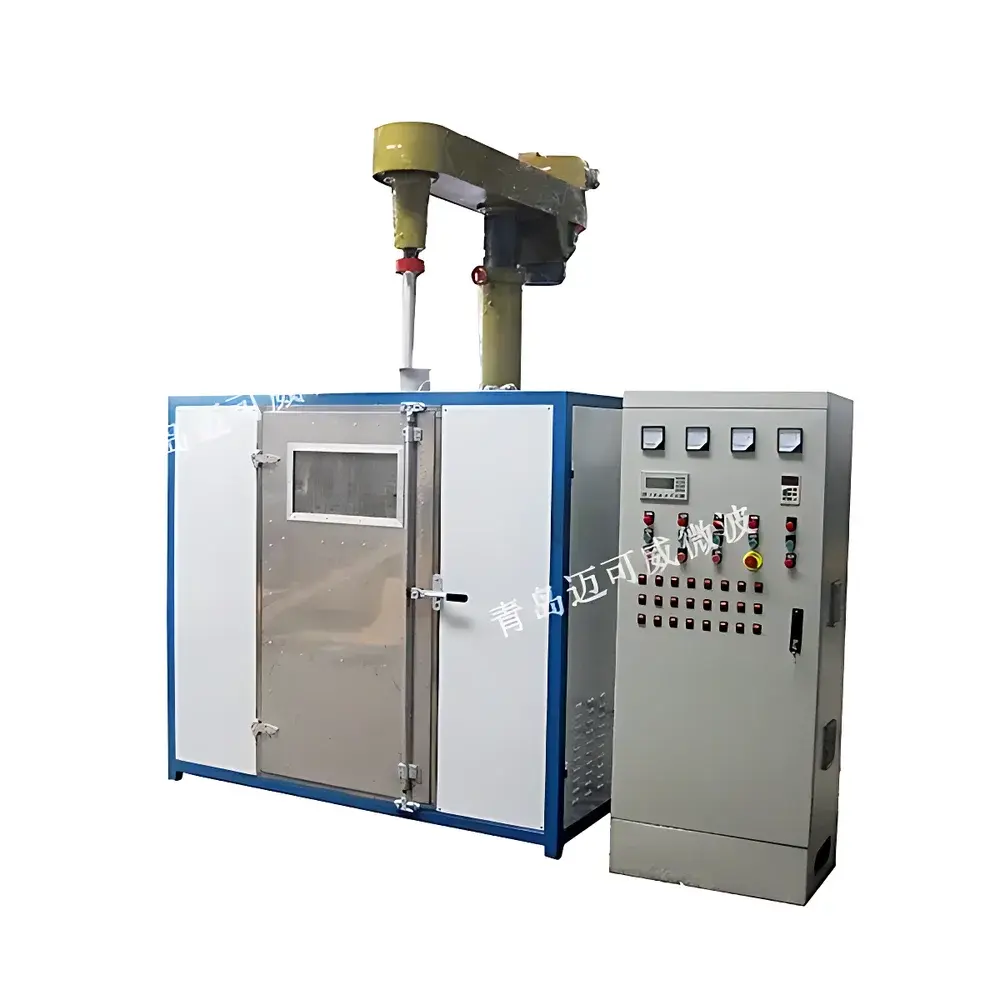
MakeWave MGX-J Microwave-Assisted High-Shear Stirring System
| Brand | MakeWave |
|---|---|
| Origin | Shandong, China |
| Manufacturer Type | Direct Manufacturer |
| Equipment Category | Domestic |
| Model | MGX-J |
| Price Range | USD 7,000 – 14,000 (FOB) |
| Instrument Type | Magnetic Stirrer with Integrated Microwave Heating |
| Temperature Control Range | 0–100°C (extendable to 150°C) |
| Microwave Frequency | 2450 MHz |
| Safety Compliance | GB 5959.6–2008 |
| Quality Certification | ISO 9001 |
Overview
The MakeWave MGX-J Microwave-Assisted High-Shear Stirring System is an integrated laboratory-scale processing platform engineered for controlled thermal and mechanical treatment of high-viscosity polymeric and composite materials. Unlike conventional microwave reactors or standalone stirrers, the MGX-J combines resonant 2450 MHz microwave energy delivery with in-situ high-speed rotational shear mixing—enabling uniform volumetric heating while simultaneously overcoming mass transfer limitations inherent in viscous media. Its design follows Couette-type shear dynamics within a sealed, shielded cavity, where microwave irradiation and mechanical agitation act synergistically to reduce thermal gradients, suppress localized overheating, and enhance reaction kinetics in thermoplastic melt processing, polymer grafting, nanocomposite dispersion, and solvent-free curing applications. The system operates under atmospheric pressure and is not intended for vacuum or pressurized synthesis.
Key Features
- Industrial-grade variable-frequency microwave power supply (rated output configurable per process requirement), optimized for continuous-duty operation with stable power modulation
- 304 stainless steel monolithic cavity with multi-port broadband microwave feed system—ensuring field homogeneity and minimizing standing-wave hotspots
- Integrated high-torque, frequency-controlled shear stirrer mounted coaxially within the cavity, compatible with standard engineering-grade plastic sample vessels (e.g., HDPE, PEEK-lined drums)
- Through-cavity forced-air ventilation with adjustable flow rate and directional exhaust—designed to evacuate volatile byproducts and maintain thermal stability during exothermic processing
- Real-time infrared temperature monitoring with closed-loop PID control of both microwave power and stirrer speed, synchronized via PLC-based architecture
- Front-mounted quartz observation window with internal LED illumination, enabling visual assessment of material state (melting, phase separation, dispersion homogeneity) without interrupting operation
- λ/4 choke-structured door seal meeting GB 5959.6–2008 safety limits: measured microwave leakage <5 mW/cm² at 5 cm distance (below national regulatory threshold)
Sample Compatibility & Compliance
The MGX-J accommodates non-metallic, microwave-transparent or semi-absorbing samples up to 5 L volume in standardized polymer containers. It supports thermally sensitive polymers (e.g., PLA, PCL, EVA), filled composites (carbon black, silica, clay), and reactive prepolymers requiring precise thermal ramping and shear history control. All electrical, thermal, and microwave subsystems conform to GB 5959.6–2008 for industrial microwave equipment safety. Structural integrity and electromagnetic shielding are verified per ISO/IEC 17025-aligned internal QA protocols. While not certified to UL/CSA or IEC 61000-4 series by default, the system’s modular architecture permits third-party validation for GLP-compliant laboratories upon request.
Software & Data Management
Control is executed via a 7-inch industrial touchscreen HMI running embedded Linux firmware. Parameters—including time, setpoint temperature, actual IR-measured temperature, microwave power (% of max), stirrer RPM, and airflow status—are logged at user-defined intervals (1–60 s) into timestamped CSV files stored on internal flash memory. Audit trails include operator ID input, parameter change logs, and alarm event records (e.g., door interlock breach, overtemperature, power fault). Optional Ethernet interface enables remote SCADA integration and supports Modbus TCP for centralized lab data aggregation. The system does not implement FDA 21 CFR Part 11 electronic signature functionality out-of-the-box but provides raw log export for external validation and traceability workflows.
Applications
- Rheological conditioning of thermoplastic melts prior to extrusion or injection molding trials
- In-situ dispersion of nanofillers (graphene oxide, CNTs, nano-CaCO₃) in viscous polymer matrices without solvent mediation
- Crosslinking acceleration of unsaturated polyester resins and epoxy-anhydride systems under controlled shear-thermal profiles
- Devolatilization studies of residual monomers or solvents from polymerization batches
- Process development for microwave-assisted reactive extrusion analogs in small-batch R&D environments
- Thermal stability screening of flame-retardant formulations under dynamic shear and radiant heating
FAQ
Is the MGX-J suitable for flammable solvent-based reactions?
No. The system is designed exclusively for solvent-free or low-volatility matrix processing. Flammable liquids are incompatible due to uncontrolled vapor accumulation risks and absence of explosion-proof certification.
Can the stirring speed and microwave power be independently controlled during a single run?
Yes. The PLC-based controller allows asynchronous programming of stirrer RPM and microwave power profiles over time, enabling staged processing (e.g., low-shear preheating followed by high-shear dispersion at target temperature).
What cooling infrastructure is required for extended operation?
For continuous operation >30 min at rated power, a closed-loop water chiller supplying softened water at ≤25°C and ≥2 bar pressure is recommended to maintain magnetron junction temperature within specification.
Does the system support automated feeding or discharge?
Liquid dosing is available as an optional add-on module (peristaltic pump + level sensor); solid charging requires manual loading through the top-access port. No integrated vacuum or pressure transfer is provided.
How is calibration traceability maintained for temperature measurement?
The infrared sensor is factory-calibrated against NIST-traceable blackbody sources. Users may perform field verification using calibrated immersion probes inserted through auxiliary ports—procedures documented in the supplied calibration manual.



