
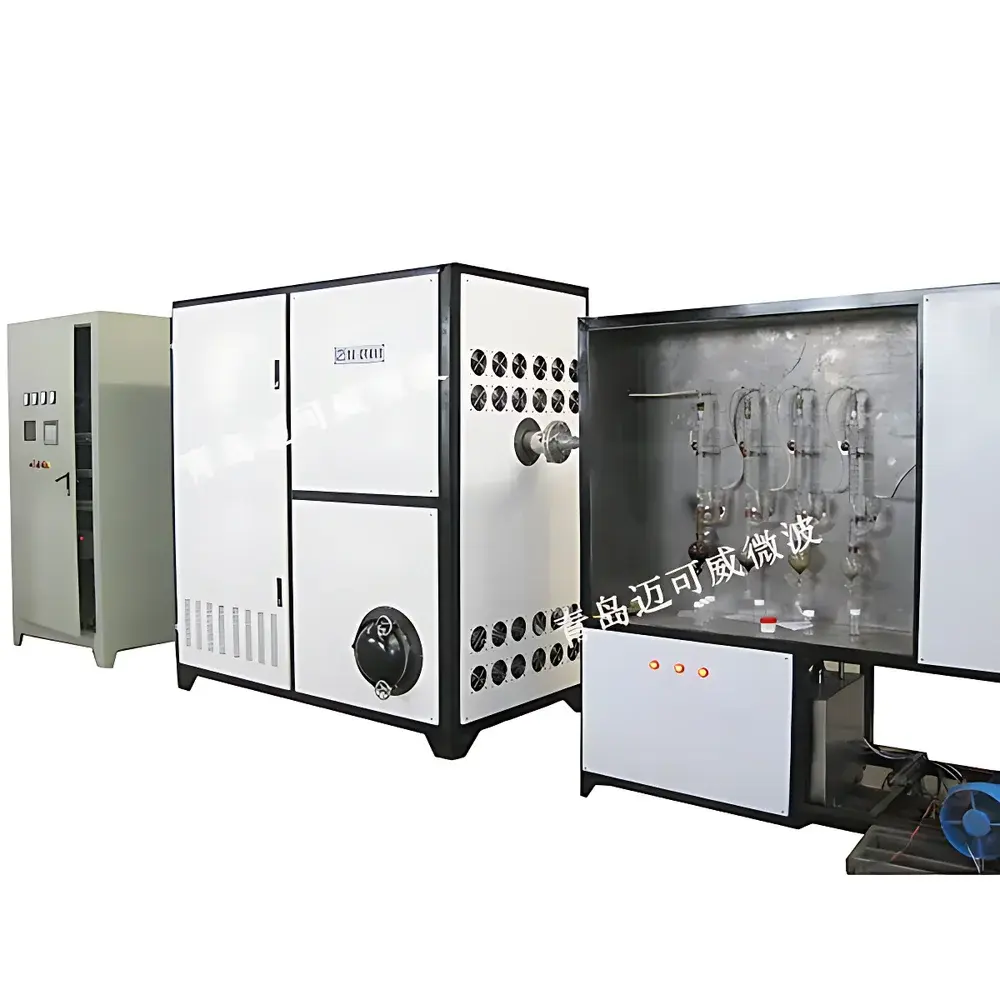
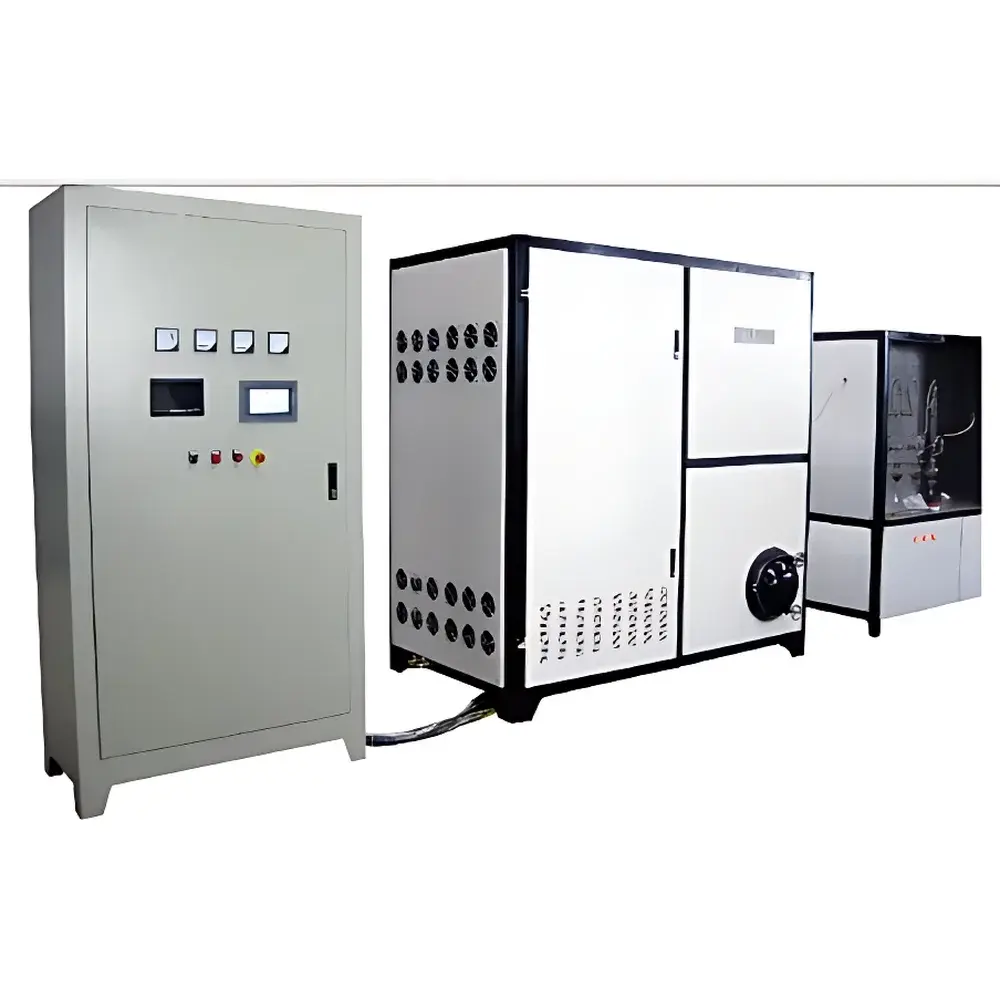
Continuous Spiral Microwave High-Temperature Kiln MKG-R11LC
| Brand | Makewave |
|---|---|
| Origin | Shandong, China |
| Manufacturer Type | Direct Manufacturer |
| Product Category | Domestic |
| Model | MKG-R11LC |
| Instrument Type | Tube Furnace |
| Max Operating Temperature | 900 °C |
| Temperature Control Accuracy | ±1 °C |
| Rated Power | 11 kW |
| Heating Rate to Max Temp | ≤20 min |
| Heating Method | Microwave (2450 ±50 MHz) |
| Internal Chamber Diameter | 80 mm |
| Microwave Output Power | ≤8 kW (Continuously Adjustable) |
| Pressure Rating | ≤0.3 MPa |
| Microwave Leakage | ≤5 mW/cm² (Compliant with IEC 61000-3-2 & EN 55011 Class B) |
Overview
The Makewave MKG-R11LC Continuous Spiral Microwave High-Temperature Kiln is an engineered solution for controlled, rapid thermal processing of organic and carbonaceous feedstocks under inert or reactive atmospheres. Unlike conventional resistive tube furnaces relying on conductive/convective heat transfer, this system employs 2450 MHz microwave energy to directly couple with polar molecules and conductive phases—enabling volumetric, non-contact heating with minimal thermal inertia. Its core architecture integrates a rotating spiral feed mechanism with a sealed, corrosion-resistant microwave cavity, supporting continuous throughput at temperatures up to 900 °C. Designed specifically for thermochemical conversion research—including biomass pyrolysis, waste polymer devolatilization, and low-rank coal upgrading—the MKG-R11LC delivers reproducible thermal profiles essential for kinetic studies, product yield optimization, and material structure–property correlation.
Key Features
- Continuous-feed spiral transport system with frequency-controlled dosing (up to 10 kg/h), ensuring uniform residence time distribution and minimizing thermal segregation.
- Integrated microwave generator (≤8 kW, continuously adjustable) operating at 2450 ±50 MHz, compliant with industrial ISM band regulations and equipped with real-time power modulation based on in-cavity temperature feedback.
- Corrosion-resistant reaction chamber with dual-layer insulation and pressure-rated sealing (≤0.3 MPa), suitable for operation under N₂, Ar, CO₂, or reducing gas environments.
- PLC-based control architecture with 7-inch HMI touchscreen interface; supports programmable multi-stage thermal ramps, data logging (≥1 Hz sampling), and alarm-triggered safety shutdowns (over-temperature, over-pressure, microwave arcing).
- Multi-path product recovery system: solid char collected in insulated storage bin; vapors routed through heated transfer lines (≥200 °C) to staged condensation units (ice-water + dry-ice traps) and calibrated gas bags for compositional analysis (GC-TCD/FID, FTIR).
- Comprehensive microwave shielding: cavity door interlock, waveguide choke joints, and RF-absorbing gaskets ensure leakage ≤5 mW/cm² at 5 cm distance—meeting IEC 62493 and EN 50664 safety standards.
Sample Compatibility & Compliance
The MKG-R11LC accommodates heterogeneous particulate feedstocks ranging from 0.1–10 mm in size, including lignocellulosic biomass (wood chips, rice straw, macroalgae), low-rank coals (lignite, peat), end-of-life polymers (PET, PP, rubber tires), and municipal solid waste fractions. All wetted surfaces are constructed from acid-resistant stainless steel (AISI 316L) or quartz-lined components where required. The system conforms to GLP-aligned operational documentation protocols, supports 21 CFR Part 11-compliant audit trails via optional software module, and meets ISO/IEC 17025 calibration traceability requirements when paired with NIST-traceable thermocouples (Type K, Class 1). Pressure and temperature sensors are certified to EN 61508 SIL 2 functional safety levels.
Software & Data Management
The embedded control firmware records timestamped process variables—including cavity temperature (dual-point measurement), microwave forward/reflected power, mass flow rate, and system pressure—at ≥1 Hz resolution. Export formats include CSV and HDF5, compatible with MATLAB, Python (Pandas), and commercial data analytics platforms. Optional Makewave PyroLink™ software provides advanced features: real-time thermal imaging overlay (via external IR camera integration), kinetic modeling (distributed activation energy model fitting), and automated report generation aligned with ASTM E2890 (Standard Guide for Biomass Thermal Conversion Process Development). All configuration changes and operator actions are logged with user ID, timestamp, and parameter delta—supporting full traceability per FDA and EU GMP Annex 11 expectations.
Applications
- Biomass fast pyrolysis for bio-oil production and catalytic upgrading studies.
- Carbon-rich char synthesis with tailored porosity (BET surface area >300 m²/g) and functional group retention for electrochemical or adsorption applications.
- Thermal recycling of waste plastics and rubbers into syngas and recovered carbon black.
- Kinetic parameter determination (activation energy, pre-exponential factor) using isoconversional methods (Friedman, Ozawa-Flynn-Wall).
- Process intensification evaluation versus conventional fixed-bed or fluidized-bed reactors—particularly for feedstocks exhibiting strong microwave coupling (e.g., moist biomass, metal-loaded sludges).
FAQ
What atmosphere options are supported during operation?
The system supports inert (N₂, Ar), reducing (H₂/N₂ mixtures), and oxidizing (air, O₂-diluted) atmospheres via integrated mass flow controllers and gas purging sequences. Vacuum operation down to 10⁻² mbar is achievable with optional turbomolecular pumping.
Can the MKG-R11LC be integrated into an existing pilot-scale biorefinery workflow?
Yes—standard 4–20 mA analog I/O and Modbus TCP interfaces enable seamless integration with DCS or SCADA systems. Mechanical mounting dimensions and utility connections (380 V/50 Hz, cooling water inlet ≤30 °C) follow ISO 14644-1 cleanroom-compatible design principles.
Is calibration certification included with delivery?
Each unit ships with factory calibration certificates for temperature (per ASTM E220), pressure (EN 837-1), and microwave power (IEC 61222), all traceable to national metrology institutes. On-site verification and IQ/OQ documentation packages are available as optional services.
How is residence time controlled and verified?
Residence time is governed by screw rotation speed, feedstock bulk density, and cavity geometry. It is empirically validated using inert tracer particles (Al₂O₃ beads) and confirmed via post-run TGA-MS analysis of axial temperature–conversion gradients along the reaction zone.



