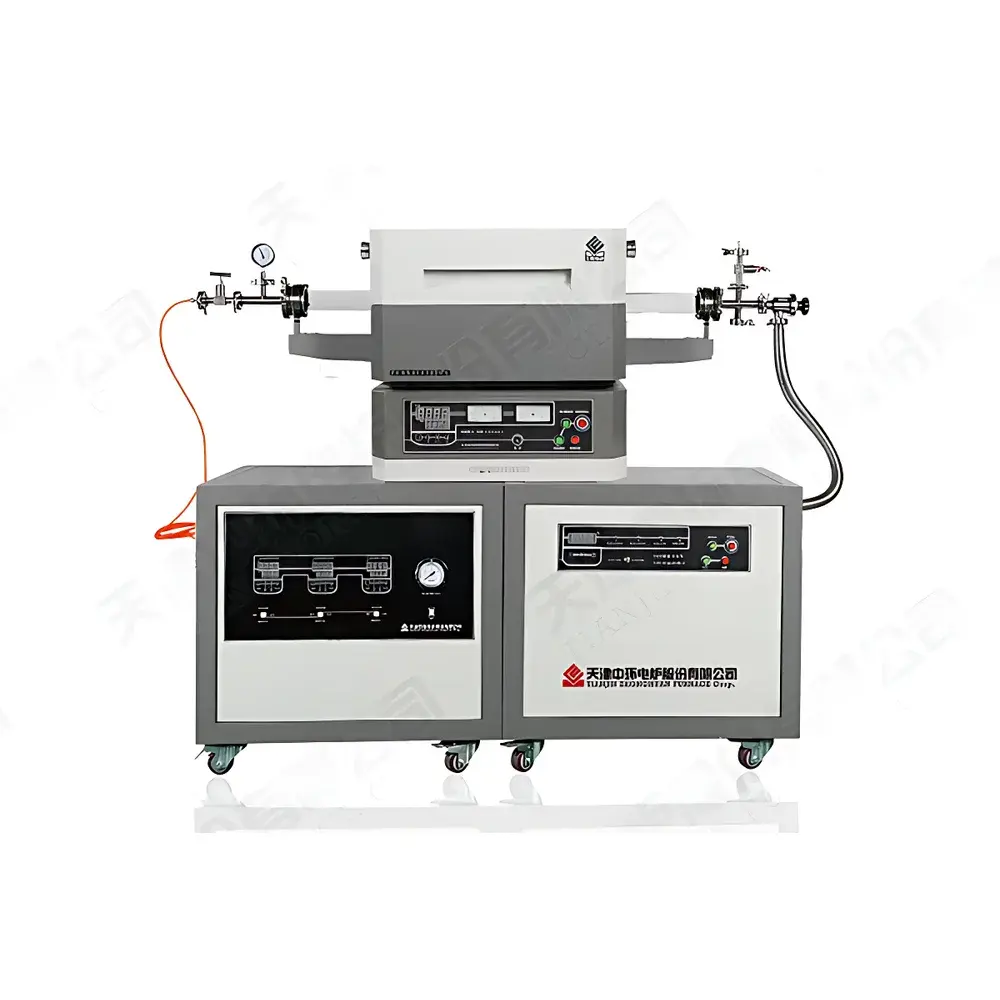
Zhonghuan Furnace CVD-12II-3Z/G Dual-Zone Chemical Vapor Deposition System with 1200°C Vacuum Tube Furnace
| Brand | Zhonghuan Furnace |
|---|---|
| Origin | Tianjin, China |
| Model | CVD-12II-3Z/G |
| Max Temperature | 1200°C |
| Heating Zone | Dual-zone |
| Tube Diameter | Φ50/Φ60/Φ80 mm or Φ80/Φ100 mm |
| Heating Length | 420 mm / 600 mm |
| Uniform Zone Length | 280 mm / 390 mm |
| Rated Power | 3.2 kW / 4.8 kW |
| Voltage | 220 V AC |
| Temp Control | 50-segment programmable PID controller, ±1°C accuracy |
| Gas Channels | 3 (expandable) |
| Mass Flow Range | 0–500 sccm (N₂-calibrated, ±1% F.S.) |
| Response Time | ≤4 s |
| Inlet Pressure | 0.05–0.3 MPa (gauge) |
| Vacuum System | High-vacuum option with turbomolecular pump (1200 L/s or 1600 L/s, base pressure ≤5×10⁻⁶ Pa) |
| Connection | KF-flanged stainless steel bellows, manual high-vacuum gate valve, digital vacuum gauge |
| Overall Dimensions (w/o HV) | 530 × 1440 × 750 mm |
| Weight | 330 kg |
Overview
The Zhonghuan Furnace CVD-12II-3Z/G is a dual-zone, high-temperature vacuum chemical vapor deposition system engineered for precise thermal control and reproducible thin-film synthesis under controlled reactive atmospheres. Designed around a horizontally oriented, split-body quartz tube furnace, the system operates up to 1200°C with independent temperature regulation across two heating zones—enabling axial thermal gradients essential for vapor transport, precursor decomposition, and spatially resolved film growth. Its core architecture integrates a programmable fuzzy-PID temperature controller (50-segment ramp/soak profiles, ±1°C stability), multi-channel mass flow-controlled gas delivery, and configurable vacuum infrastructure—from medium vacuum (10⁻¹ Pa range) to high vacuum (≤5×10⁻⁶ Pa via 1200 L/s or 1600 L/s turbomolecular pumping). This configuration supports fundamental research and process development in semiconductor materials science, including SiC epitaxy, ZnO nanowire array synthesis, dielectric layer formation for MLCCs, and conductive ceramic sintering under tailored gas chemistries (e.g., NH₃, H₂, O₂, Ar, C₂H₄).
Key Features
- Dual-zone furnace design with independently controllable heating sections (420 mm or 600 mm total heating length; uniform zone ≥280 mm), facilitating gradient-driven CVD processes such as sublimation transport and zone refining.
- Fuzzy logic-enhanced PID temperature control system ensures minimal thermal overshoot, rapid stabilization (<4 sec response), and long-term repeatability—critical for nucleation-sensitive depositions like graphene or transition metal dichalcogenides.
- Robust KF-flanged vacuum interface using multi-ring compression sealing technology: maintains integrity even with quartz tube diameter tolerances up to ±0.5 mm, eliminating reliance on perfect dimensional matching during installation or tube replacement.
- Three-channel mass flow controller (MFC) system calibrated to N₂, expandable to six channels; each MFC offers full-scale accuracy of ±1%, linearized output, and integrated pressure compensation for stable delivery across varying backpressure conditions.
- High-vacuum option features a 220 V AC turbomolecular pump with active overpressure protection—automatically throttling inlet flow upon sudden air ingress to prevent rotor damage and extend service life beyond 15,000 operating hours.
- Integrated digital vacuum measurement with analog output and RS485 interface enables real-time logging and closed-loop pressure modulation when paired with optional feedback-controlled throttle valves.
Sample Compatibility & Compliance
The CVD-12II-3Z/G accommodates standard cylindrical substrates up to Φ100 mm × 20 mm height within its quartz reaction tube (available in Φ50, Φ60, Φ80, or Φ100 mm diameters). Compatible substrate materials include silicon wafers, sapphire, alumina, quartz, graphite, and metallic foils—provided they remain dimensionally stable below 1200°C. The system meets mechanical safety requirements per IEC 61000-6-2 (immunity) and IEC 61000-6-4 (emission), and its electrical insulation complies with EN 61010-1 for laboratory equipment. While not pre-certified for GMP or FDA 21 CFR Part 11 compliance, the programmable controller supports audit-trail-capable data export (CSV/TXT) and time-stamped parameter logging—facilitating GLP-aligned documentation workflows in R&D and pilot-scale fabrication environments.
Software & Data Management
Temperature profiles are configured via an embedded 7-inch color touchscreen HMI running a deterministic real-time OS. All 50-segment programs—including ramp rates (0.1–30°C/min), dwell times (1 s–99 h 59 min), and event-triggered gas switching—are stored in non-volatile memory with password-protected access levels. Process data (temperature, pressure, MFC setpoints/actuals) is logged at user-defined intervals (1 s–600 s) to internal flash storage (≥16 GB) and exportable via USB 2.0. Optional Ethernet module enables remote monitoring through Modbus TCP or HTTP-based REST API endpoints, supporting integration into centralized lab management systems (e.g., LabVantage, Thermo Fisher SampleManager). No proprietary cloud platform is required; raw logs retain SI-unit metadata and UTC timestamps for traceability.
Applications
- Growth of wide-bandgap semiconductor layers (SiC, GaN) via halide or chlorosilane-based CVD under inert or reducing atmospheres.
- Controlled synthesis of 1D metal oxide nanostructures—including ZnO nanorods, SnO₂ nanowires, and VO₂ thermochromic films—using vapor-solid or vapor-liquid-solid mechanisms.
- Atmospheric and low-pressure sintering of multilayer ceramic capacitors (MLCCs), where oxygen partial pressure and ramp rate directly influence grain boundary resistivity and dielectric loss tangent.
- Thermal annealing and dopant activation of spin-coated or sputtered precursors (e.g., TiO₂, NiO, LiCoO₂) for solid-state battery electrode development.
- Graphene and h-BN monolayer growth on catalytic Cu/Ni foils using CH₄/H₂ mixtures at 1000–1100°C with precise thermal gradient control across the substrate zone.
FAQ
What is the maximum recommended operating temperature for continuous use?
The furnace is rated for sustained operation at 1150°C; 1200°C is specified as the short-term limit (≤2 hours per cycle) to preserve quartz tube integrity and heater element longevity.
Can the system be upgraded from medium vacuum to high vacuum post-purchase?
Yes—the base frame includes standardized KF-40 and KF-50 ports; retrofitting requires only the turbomolecular pump assembly, vacuum gauge upgrade, and revised interlock wiring harness—no structural modification.
Is quartz tube replacement supported in-house, and what tolerances apply?
Replacement tubes are available in all standard diameters (Φ50–Φ100 mm) with OD tolerance ±0.3 mm; the multi-ring flange design accommodates up to ±0.5 mm variance without seal compromise.
Does the MFC support reactive gases like NH₃ or Cl₂?
Standard stainless steel MFCs are compatible with NH₃, H₂, Ar, N₂, O₂, and CO; for Cl₂, HF, or Br₂, Hastelloy C-276 wetted parts and fluoropolymer seals must be specified at order entry.
How is temperature uniformity validated across the dual-zone configuration?
Uniformity is verified using three-point thermocouple mapping (center + ±100 mm) per ASTM E220-19; typical deviation within the stated uniform zone is ≤±3°C at 1000°C under static argon purge.