
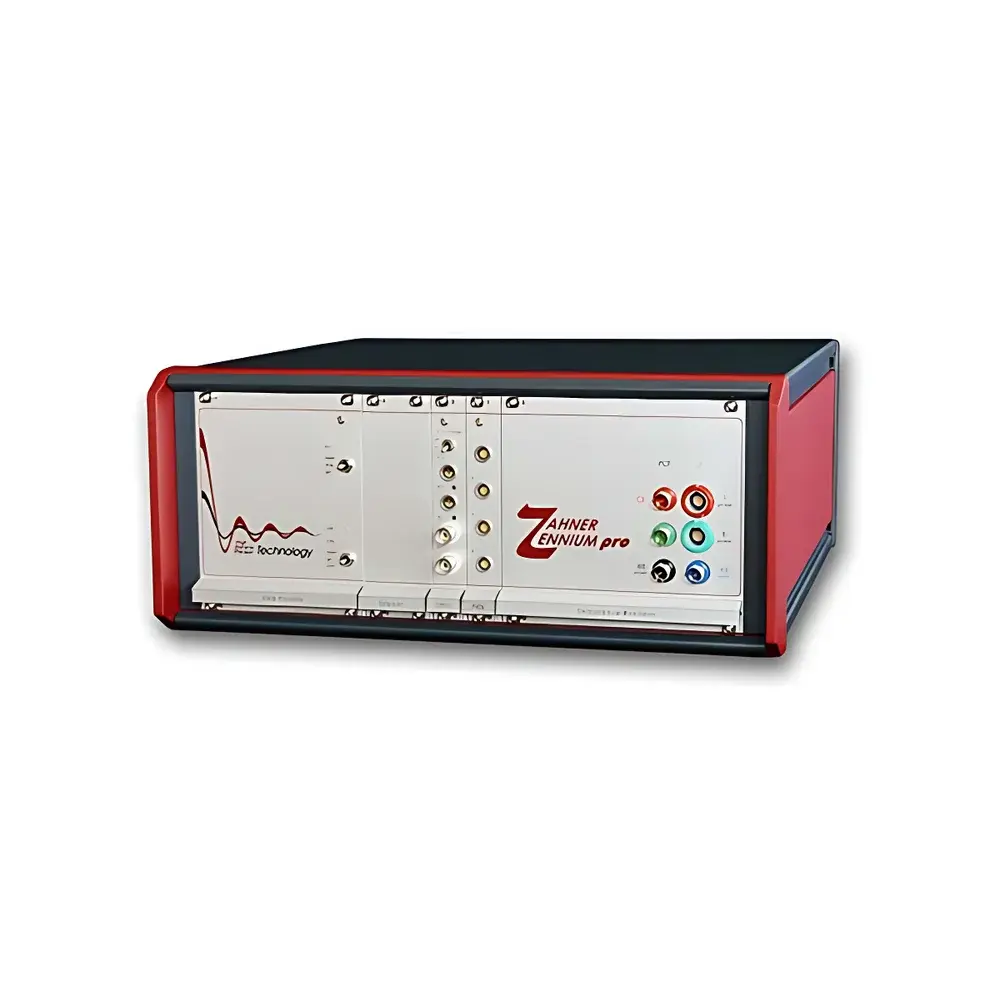
German Zahner Zennium Pro Electrochemical Workstation
| [Origin | Germany |
|---|---|
| Model | Zennium Pro |
| Potentiostat/Galvanostat Bandwidth | 10 MHz |
| ADC Resolution | 32 bit |
| EIS Frequency Range | 10 µHz – 8 MHz |
| Frequency Accuracy | ±0.0025% |
| Frequency Resolution | 10,000 steps/decade |
| AC Amplitude Range | 0–6 V |
| Impedance Measurement Range | 1 mΩ – 10 GΩ (±2%), 100 mΩ – 10 MΩ (±0.2% for POT mode), 10 µΩ – 1 GΩ (±2% for GAL mode), 100 mΩ – 100 GΩ (±2% with HIZ probe) |
| Max Current Output | ±3 A |
| Applied Potential Range | ±15 V |
| Cell Voltage Range | ±28 V |
| Voltage Resolution | 3 nV |
| Current Resolution | ±5 aA |
| Small-Signal Rise Time | 150 ns – 200 µs (5-step auto-ranging) |
| Input Impedance | >10 TΩ |
| Grounding Modes | Switchable floating/grounded configuration |
| IR Compensation | Real-time automatic iR compensation |
| Software Platform | Thales XT with Zahner SIM, Z-HIT, EIS time-series analysis, equivalent circuit fitting, GITT/PITT, RDE/RRDE, battery cycling, electrochemical noise, and photoelectrochemical modules] |
Overview
The German Zahner Zennium Pro Electrochemical Workstation is a high-precision, modular potentiostat/galvanostat/frequency response analyzer engineered for advanced electrochemical research and industrial R&D. Built upon Zahner’s legacy of metrological rigor, the Zennium Pro operates on a dual-channel, 32-bit high-dynamic-range (HDP) analog-to-digital architecture, delivering exceptional signal fidelity across DC and AC domains. Its core measurement principle relies on four-terminal sensing with real-time digital feedback control, enabling stable potential/current regulation under highly resistive or capacitive load conditions. The system supports both grounded and floating cell configurations—critical for corrosion studies in buried pipelines, high-pressure autoclaves, or galvanic coupling experiments where ground-loop interference must be eliminated. With a 10 MHz potentiostatic bandwidth and sub-attoampere current resolution, it meets stringent requirements for low-noise interfacial characterization, including double-layer capacitance mapping, semiconductor electrochemistry (Mott-Schottky), and ultra-low-current sensor development.
Key Features
- Modular hardware architecture supporting field-upgradable functionality: external potentiostats, electronic loads, CIMPS photoelectrochemical modules, and multi-channel impedance expansion
- True 32-bit ADC/DAC with 10,000 frequency points per decade and ±0.0025% frequency accuracy—compliant with ISO 17025 traceability standards for impedance calibration
- Wide dynamic range: ±3 A current output, ±15 V applied potential, ±28 V cell voltage limit, and input impedance exceeding 10 TΩ
- Sub-nanosecond timing resolution and 150 ns–200 µs programmable rise time—optimized for transient techniques such as pulse voltammetry, chronoamperometry, and GITT/PITT
- Real-time, adaptive iR compensation using current-interrupt or EIS-based algorithms—validated per ASTM G102 and ASTM G59 for corrosion rate quantification
- Switchable grounding topology (floating/grounded) with galvanically isolated power supply—enabling safe operation in high-voltage or earth-referenced systems
Sample Compatibility & Compliance
The Zennium Pro accommodates diverse electrochemical cells—from microelectrodes and rotating disk electrodes (RDE/RRDE) to large-format battery pouch cells and pressurized electrochemical reactors. Its high-input-impedance design ensures minimal loading error during measurements of insulating coatings, polymer electrolytes, or bio-interfaces. All hardware and firmware comply with IEC 61010-1 (safety) and EN 61326-1 (EMC) standards. When operated with Thales XT software under audit-enabled mode, the system supports 21 CFR Part 11-compliant electronic records—including user authentication, change tracking, and immutable data archiving—making it suitable for GLP/GMP-regulated environments such as battery quality assurance or pharmaceutical electroanalysis.
Software & Data Management
Thales XT is a platform-independent, scriptable electrochemical software suite developed exclusively for Zahner instruments. It provides synchronized online visualization across multiple parameter axes (e.g., Nyquist + Bode + time-domain traces), real-time data streaming to disk without loss, and native support for HDF5 binary storage. Offline analysis includes Z-HIT validation for EIS data stability assessment, non-linear least-squares fitting using Zahner SIM (with >50 built-in equivalent circuits), and automated Mott-Schottky slope extraction. The software integrates with MATLAB and Python via COM/ActiveX and REST APIs, facilitating custom algorithm deployment and machine learning–driven feature extraction. All experimental metadata—including instrument configuration, environmental logs, and operator credentials—are embedded directly into each dataset file.
Applications
- Fuel cell catalyst layer characterization (ORR kinetics, mass transport resistance)
- Lithium-ion and solid-state battery interface evolution (SEI growth, Li plating detection)
- Photoelectrochemical water splitting efficiency mapping (IPCE, ABPE)
- Corrosion science: localized pitting monitoring, coating delamination kinetics, inhibitor adsorption isotherms
- Supercapacitor electrode charge storage mechanisms (EDLC vs pseudocapacitance deconvolution)
- Electrochemical biosensor development (label-free DNA hybridization, enzymatic turnover kinetics)
- Electrodeposition process optimization (nucleation overpotential, grain size control)
FAQ
Does the Zennium Pro support true four-electrode (working, counter, reference, sense) measurements?
Yes—it features dedicated high-impedance sense terminals for remote potential monitoring, eliminating lead resistance errors in high-current or long-cable applications.
Can Thales XT perform automated EIS equivalence circuit fitting with confidence intervals?
Yes—Zahner SIM implements Levenberg-Marquardt optimization with covariance matrix estimation, reporting parameter uncertainties at 95% confidence level per ISO/IEC Guide 98-3.
Is the ±3 A current range usable simultaneously with the full ±15 V potential window?
Yes—the power stage maintains rated output across the entire operating quadrant, verified by continuous duty-cycle testing per IEC 60068-2-64.
How does the Zennium Pro handle unstable or drifting systems during long-term EIS acquisition?
Z-HIT transforms raw impedance spectra into time-domain causality functions, identifying drift artifacts and enabling post-acquisition correction without re-measurement.
Are firmware updates provided free of charge during the warranty period?
Yes—Zahner offers lifetime firmware updates at no cost, including new method implementations, security patches, and regulatory compliance enhancements.



