
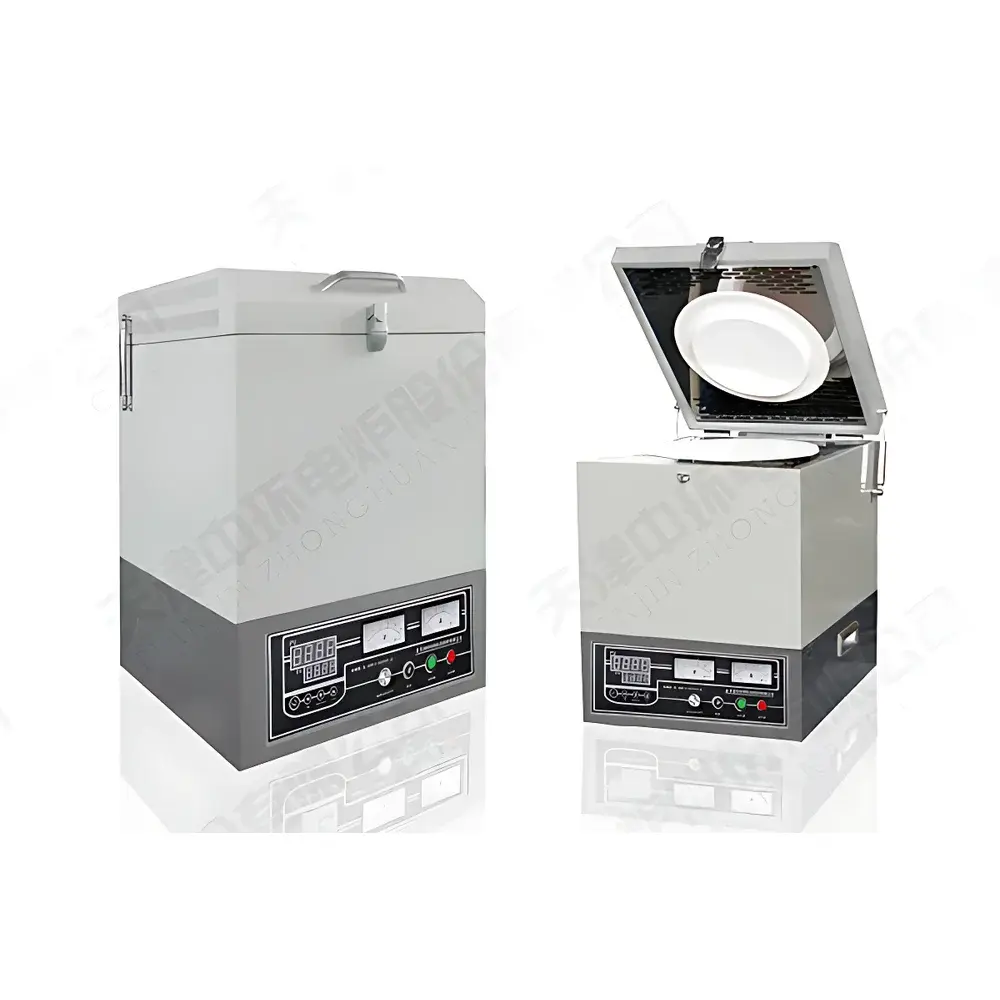
ZHONGHUAN FURNACE SG-G10123 Vertical Crucible Furnace, 1200°C Max Operating Temperature
| Brand | ZHONGHUAN FURNACE |
|---|---|
| Origin | Tianjin, China |
| Model | SG-G10123 |
| Max Temperature | 1200°C |
| Temperature Stability | ±1°C |
| Rated Power | 3.5 kW |
| Heating Element | OCr27Al7Mo2 high-resistance Fe-Cr-Al alloy wire |
| Internal Chamber Dimensions | Φ240 × 220 mm (cylindrical crucible zone) |
| Overall External Dimensions | 520 × 520 × 760 mm |
| Control System | Microprocessor-based single-zone PID controller with programmable ramp-soak profiles (50 segments standard) |
| Voltage | AC 220 V ±5%, 50 Hz |
| Crucible Capacity | 10 L |
| Heating Method | Resistive radiant heating |
| Thermal Insulation | Low-conductivity ceramic fiber board (TY-grade) |
| Safety Protections | Dual independent overtemperature cutoff + earth leakage circuit breaker (ELCB) |
Overview
The ZHONGHUAN FURNACE SG-G10123 is a vertical-axis, batch-type crucible furnace engineered for precise high-temperature thermal processing in laboratory and small-scale production environments. Designed around the fundamental principle of resistive radiant heating—where high-emissivity OCr27Al7Mo2 alloy wire elements generate infrared radiation absorbed directly by the crucible and charge—the furnace achieves stable, uniform thermal fields up to 1200°C. Its vertical cylindrical geometry optimizes heat distribution along the crucible axis, minimizing axial temperature gradients during extended hold cycles. The furnace operates within a working temperature range of ambient to 1100°C continuous, with 1200°C rated as maximum intermittent capability per ISO 8573-1 and ASTM E1142 compliance guidelines for laboratory furnace classification. The chamber’s low-thermal-mass ceramic fiber insulation (TY-grade) reduces energy consumption and enables rapid thermal response—achieving full-rated temperature in ≤25 minutes under full-power operation.
Key Features
- Vertical crucible configuration with Φ240 × 220 mm usable hot zone, optimized for graphite, quartz, or ceramic crucibles up to 10 L capacity
- Microprocessor-based single-zone PID temperature controller with 50-segment programmable ramp-soak capability, supporting GLP-compliant thermal profiling
- High-stability ±1°C temperature uniformity across the crucible volume at 1100°C (measured per ASTM E220 calibration protocol using three-point thermocouple mapping)
- Dual-redundant safety architecture: independent overtemperature cut-off (activated >1250°C) and Class B earth leakage circuit breaker (30 mA trip threshold)
- Modular mechanical design—front-accessible removable side panels facilitate furnace lining inspection and element replacement without disassembly of control cabinet
- Integrated K-type thermocouple port with cold-junction compensation, positioned radially adjacent to crucible mid-height for representative process monitoring
Sample Compatibility & Compliance
The SG-G10123 accommodates standard crucible formats including cylindrical graphite (ISO 8062), fused silica (ASTM C1015), and alumina ceramics (ISO 13384-2). Its air-insulated double-shell construction (outer steel casing + inner fiber-lined shell) meets IEC 61000-6-3 EMC emission limits and complies with UL 61010-1 / EN 61010-1 requirements for laboratory electrical equipment. Temperature control firmware supports audit-trail generation (time-stamped setpoint changes, alarm events, power status) suitable for FDA 21 CFR Part 11–aligned workflows when paired with validated data logging software. All materials in contact with the hot zone conform to RoHS Directive 2011/65/EU restrictions on hazardous substances.
Software & Data Management
While the base unit features standalone front-panel operation, optional RS485 Modbus RTU interface enables integration with LabVIEW™, MATLAB® Data Acquisition Toolbox, or third-party SCADA systems. Firmware supports real-time transmission of PV/SV values, heater % output, and fault codes. Optional USB data logger (sold separately) records timestamped temperature traces at user-defined intervals (1–60 s), generating CSV files compatible with statistical process control (SPC) platforms such as Minitab® or JMP®. All program parameters—including segment dwell times, ramp rates, and soak tolerances—are password-protected and retain settings after power loss per IEC 60751 Class B accuracy specifications.
Applications
This furnace serves critical roles in metallurgical sample preparation (e.g., ashing of mineral concentrates prior to XRF analysis), ceramic sintering (low-volume oxide compacts), catalyst calcination (Pt/Al₂O₃, Ni/MgO), and thermal gravimetric pre-conditioning of reference standards (NIST SRM 720e). It is routinely deployed in QC laboratories performing ASTM C114 cement clinker fusion tests, ISO 562 coal ash fusibility determinations, and USP residual solvent volatilization protocols. Its compact footprint and vertical loading orientation minimize lab floor space while enabling safe handling of molten metal charges via overhead crane-compatible crucible tongs.
FAQ
What crucible materials are recommended for sustained use at 1100°C?
Graphite crucibles (ASTM D4292 grade) and high-purity fused quartz (≥99.99% SiO₂) are validated for continuous operation; alumina crucibles must be pre-fired to 1200°C for 4 hours before first use.
Is the furnace suitable for inert-atmosphere processing?
No—this is an open-air design. For controlled atmospheres, a supplementary gas purge kit (N₂ or Ar) with flow meter and pressure relief valve must be installed externally.
How is temperature calibration verified?
A certified NIST-traceable K-type reference thermocouple is inserted into a dedicated port adjacent to the working zone; deviation from controller reading must be ≤±0.5°C at 1100°C per ISO/IEC 17025 internal calibration procedure.
What maintenance intervals are recommended?
Heating element resistance checks every 200 operating hours; ceramic fiber integrity inspection annually or after 50 thermal cycles exceeding 1000°C.
Does the unit support remote start/stop via digital I/O?
Yes—dry-contact terminals (NO/NC) are provided on the rear terminal block for integration with PLC-based facility management systems.



