
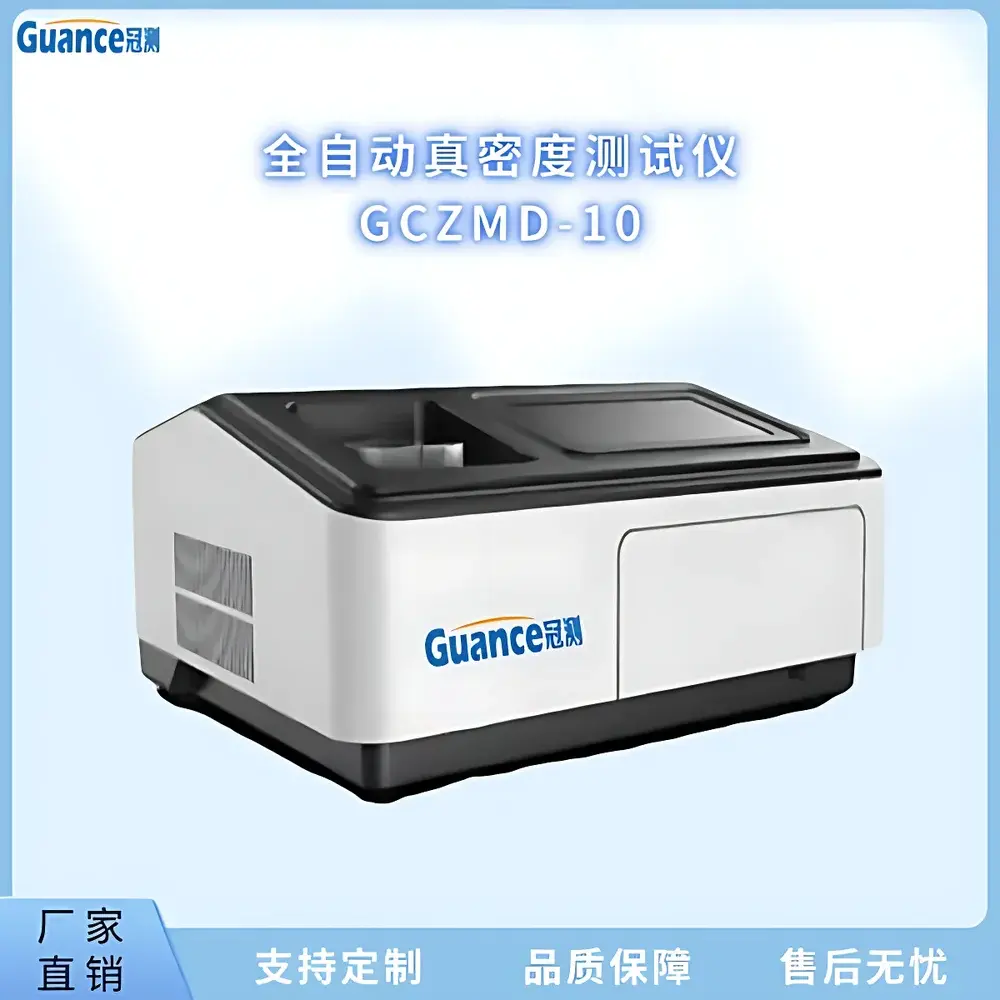
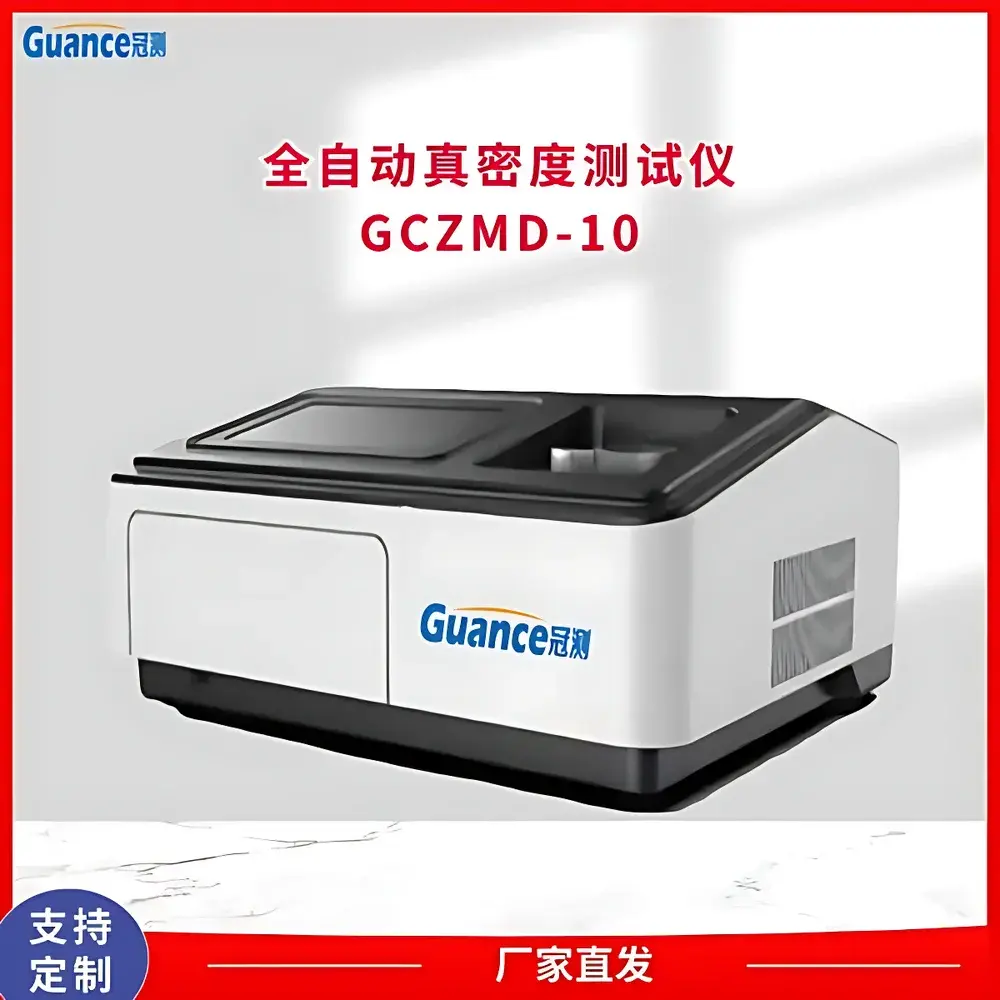
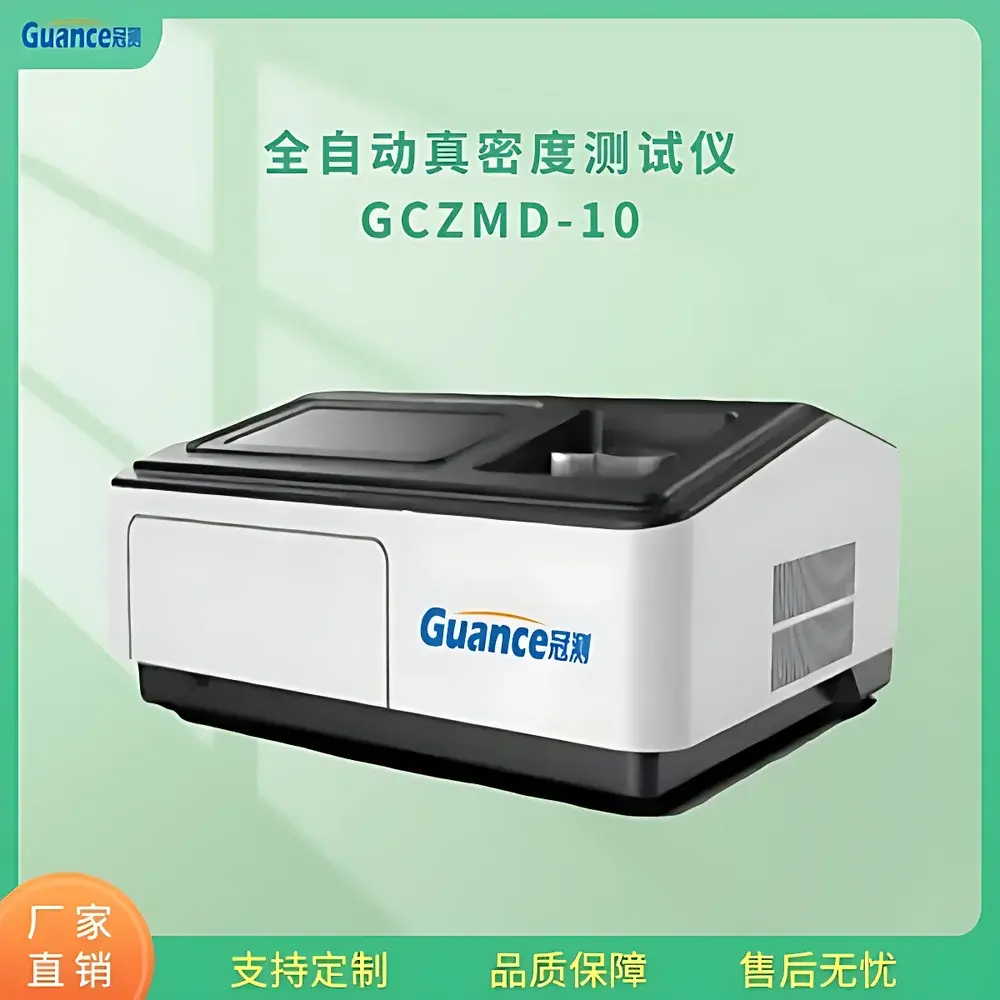
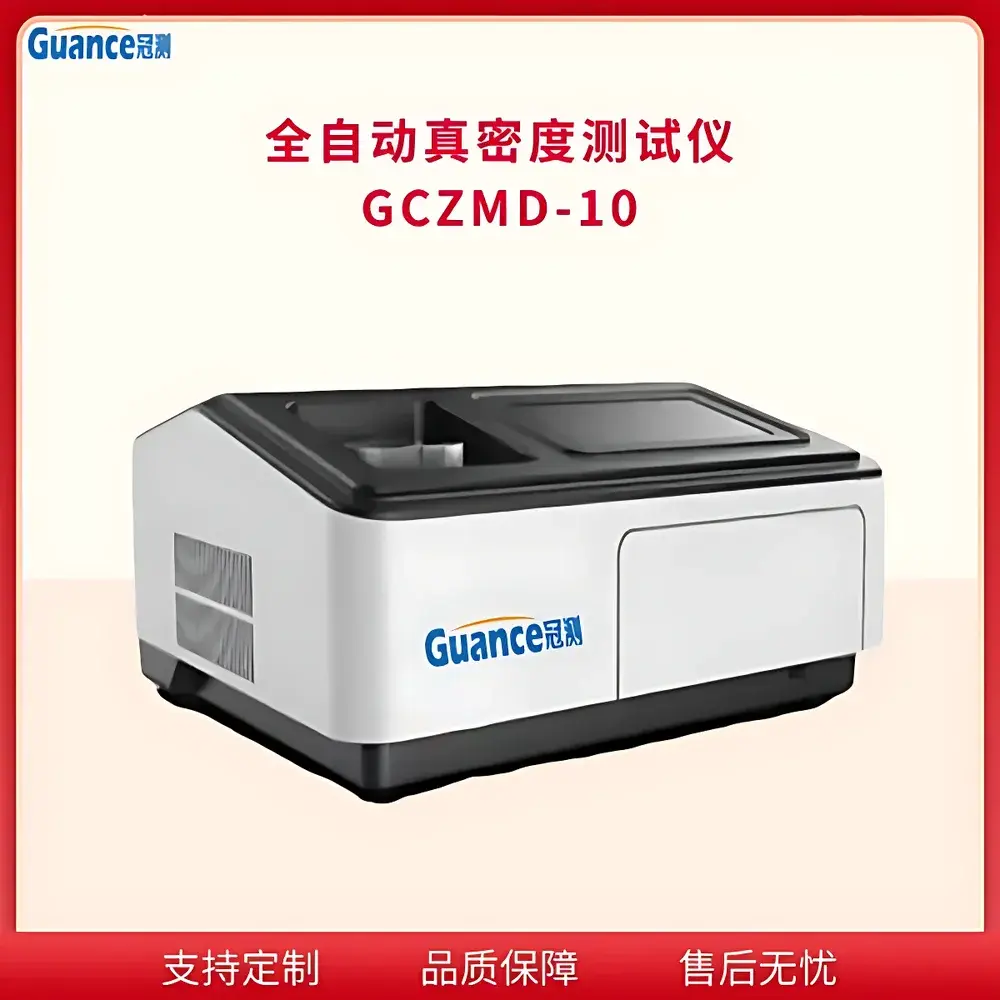
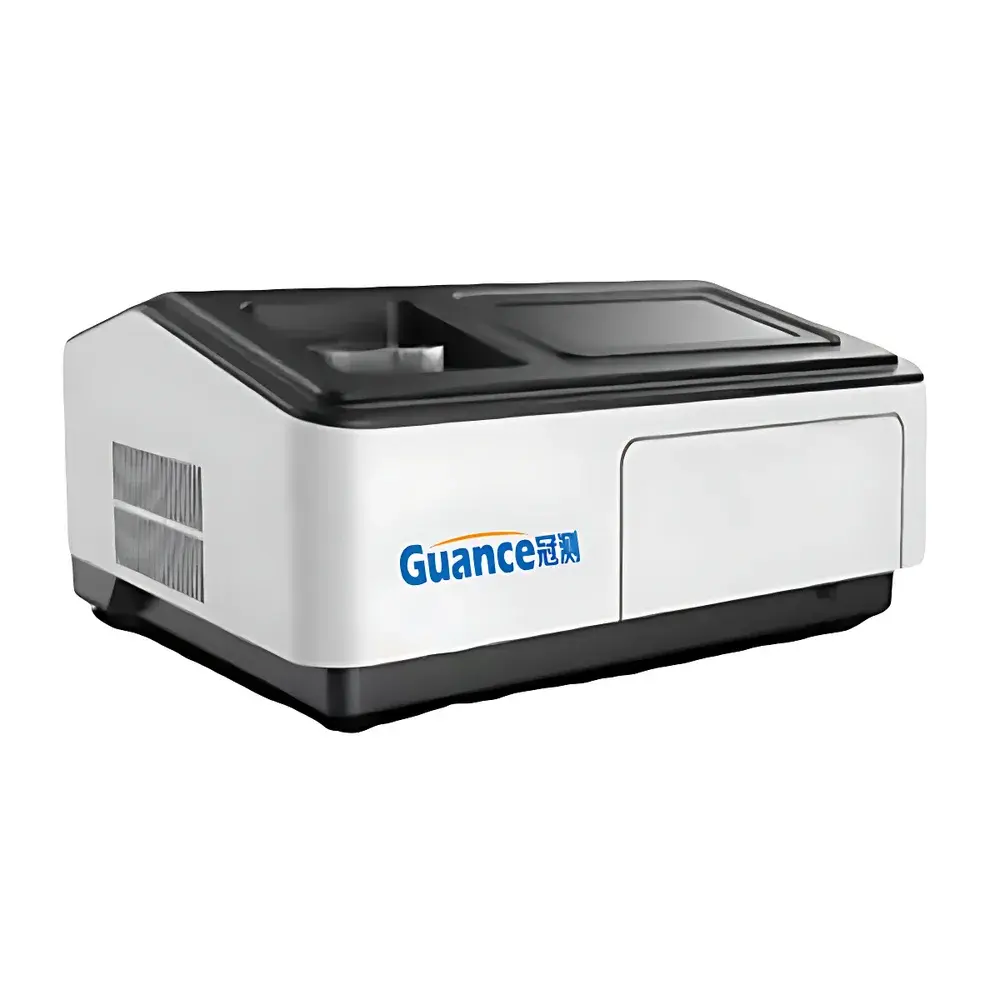
GuanCe Instruments GCZMD-10 True Density Analyzer
| Brand | GuanCe Instruments |
|---|---|
| Origin | Beijing, China |
| Manufacturer Type | Authorized Distributor |
| Regional Classification | Domestic (China) |
| Model | GCZMD-10 |
| Instrument Type | True Density Analyzer |
| Form Factor | Benchtop (Compact) |
| Sample Types | Solids (bulk, granular, powdered) & Liquids |
| Density Range | 0–20 g/cm³ |
| Maximum Sample Weight | 5 g |
| Density Resolution | 0.01 g/cm³ |
| Density Accuracy | ±0.1% (relative), <0.5% RSD per ASTM D5550 |
| Repeatability | ≤0.01 g/cm³ (standard deviation over ≥5 replicates) |
| Minimum Sample Volume | 0.1 mL (liquids) / 0.1 g (solids) |
| Temperature Operating Range | 0–40 °C |
| Display | High-contrast 7-inch capacitive touchscreen |
| Data Interface | RS-485, RJ45 Ethernet, USB host (for U-disk logging), built-in thermal printer (TMS variant) |
| Pressure Control | Dual-stage precision pressure regulation (max. 2.0 bar) |
| Sample Chamber Volume | 10 mL ±0.2 mL |
| Cycle Time | ~4 min per analysis (configurable via embedded script) |
| Power Supply | AC 220 V / 50 Hz |
| Rated Power | 28 W |
| Dimensions (W×D×H) | 410 × 320 × 155 mm |
| Net Weight | 4.6 kg |
| Pressure Sensors | 24-bit ADC acquisition, calibrated transducers |
| Compliance | Designed to support GLP/GMP data integrity requirements (audit trail enabled in PNS firmware version) |
Overview
The GuanCe Instruments GCZMD-10 True Density Analyzer is a benchtop gas pycnometer engineered for high-reproducibility measurement of true (skeletal) density of solid and liquid materials. It operates on the fundamental principle of gas expansion displacement—applying Archimedes’ principle via helium (or nitrogen) gas compression and expansion within a sealed, temperature-stabilized sample chamber. By precisely quantifying the pressure differential before and after sample introduction—governed by the ideal gas law (PV = nRT)—the instrument calculates the volume occupied exclusively by the solid matrix or liquid phase, excluding all interstitial voids and open porosity. This enables determination of true density (ρ = m/Vtrue) with metrological traceability suitable for R&D laboratories, QC/QA environments, and regulatory submissions where material-specific density serves as a critical quality attribute.
Key Features
- Integrated modular architecture: Co-located solenoid valves (imported Japanese CFVB25-Z-O-B2C-3), pressure transducers, and 10 mL sample chamber minimize dead volume and enhance sealing reliability.
- Thermal field uniformity: Tubeless, monolithic thermal module ensures rapid equilibration between ambient and chamber temperature—reducing thermal lag and improving gas law compliance (ISO 12156-1 Annex B).
- Intelligent pressure control: Adaptive algorithm dynamically adjusts fill/evacuation rates to compensate for upstream cylinder pressure fluctuations—maintaining stable measurement conditions without external regulators.
- Scriptable operation: Embedded C-based firmware supports user-defined test protocols—including variable cycle counts, custom pressure hold durations, and automated purge sequences—enabling method transfer across instruments.
- High-fidelity data acquisition: 24-bit analog-to-digital conversion captures sub-millibar pressure shifts with sub-0.01 mL volumetric resolution, supporting statistical evaluation per ISO 5725.
- Dual output capability: Real-time display + simultaneous export to internal thermal printer (TMS model) or network-connected PC (PNS model) with timestamped .csv logs and U-disk backup.
- Calibration-ready design: Includes reference standards (PVC, Al, Cu) traceable to NIST SRMs; calibration verification mode supports routine performance qualification.
Sample Compatibility & Compliance
The GCZMD-10 accommodates heterogeneous sample morphologies—including irregular solids (ceramics, catalyst pellets), fine powders (metal oxides, pharmaceutical actives), granular media (soils, fertilizers), and low-viscosity liquids (solvents, monomers)—without requiring shape modification or compaction. Its 10 mL chamber accepts samples up to 5 g mass while maintaining optimal gas flow dynamics. The system complies with core methodology standards including ASTM D5550 (Standard Test Method for True Density of Solid Materials by Gas Pycnometry), ISO 12156-1 (Petroleum products — Determination of true density of petroleum coke and carbon materials), and aligns with data integrity expectations under FDA 21 CFR Part 11 when deployed with PNS firmware (electronic signatures, audit trails, and immutable record retention). All pressure components meet CE/IEC 61000-6-3 EMC requirements.
Software & Data Management
The embedded Linux-based interface features a responsive 7-inch capacitive touchscreen with hand-written input support. Measurement workflows are stored as editable scripts (.pyc files), permitting advanced users to define multi-step sequences—e.g., pre-conditioning purges, multi-point pressure equilibration, and conditional pass/fail logic. Raw pressure-time datasets are logged at ≥10 Hz and archived with metadata (operator ID, sample ID, ambient T/P, calibration status). Export formats include CSV (with ISO 8601 timestamps), PDF reports (TMS), and encrypted U-disk dumps. Network-enabled models (PNS) support remote monitoring via HTTP API and integration into LIMS environments using standard RESTful endpoints.
Applications
This analyzer serves as a primary metrology tool in sectors where skeletal density directly correlates with functional performance: catalyst activity prediction (surface area estimation via density-porosity correlation), ceramic sintering quality control, battery electrode density mapping, polymer filler loading verification, pharmaceutical blend uniformity assessment (via density shift detection), and geological core sample characterization. It is routinely deployed in accreditation-critical workflows for ISO/IEC 17025 testing labs evaluating materials such as activated carbon, zeolites, metal injection molding feedstocks, ion-exchange resins, and aerogel composites.
FAQ
What gases are compatible with the GCZMD-10, and why is helium preferred?
Helium is the recommended analysis gas due to its small molecular diameter (2.6 Å), enabling full intraparticle pore access in microporous materials. Nitrogen may be used for non-critical applications but yields slightly higher apparent densities in sub-2 nm pore systems per IUPAC technical guidance.
Can the instrument measure closed-pore density of foamed polymers?
Yes—the GCZMD-10 determines true density inclusive of closed-cell voids, making it suitable for rigid foam characterization per ASTM D2856.
Is method validation documentation available?
GuanCe provides a comprehensive IQ/OQ protocol package—including blank runs, repeatability studies, linearity verification across 0.5–19.3 g/cm³, and temperature stability profiling—aligned with ISO/IEC 17025 clause 7.7.
How is data integrity ensured during electronic reporting?
PNS firmware implements role-based access control, electronic signatures, and tamper-evident audit logs compliant with FDA 21 CFR Part 11 Subpart B requirements.
What maintenance intervals are recommended for long-term accuracy?
Annual recalibration of pressure sensors and chamber volume verification using certified reference materials (CRM) is advised; valve service is recommended every 24 months under continuous operation.



