
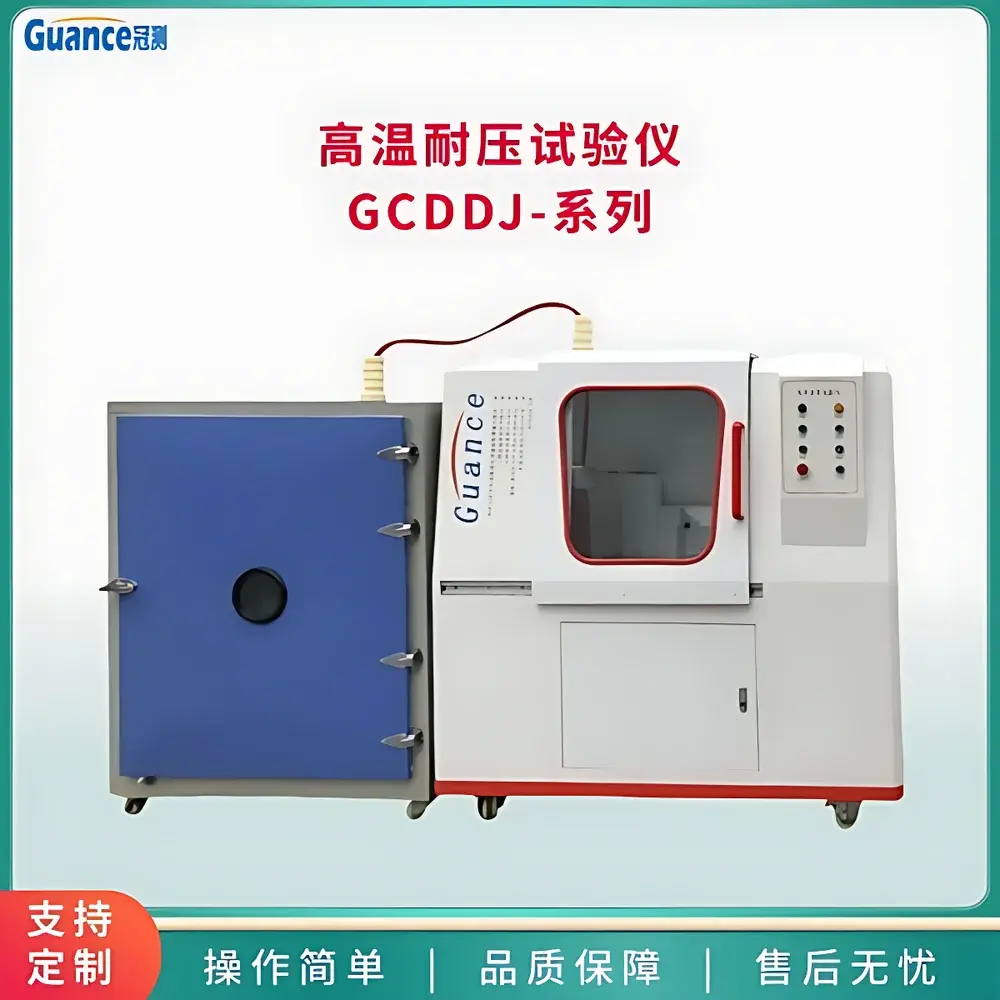
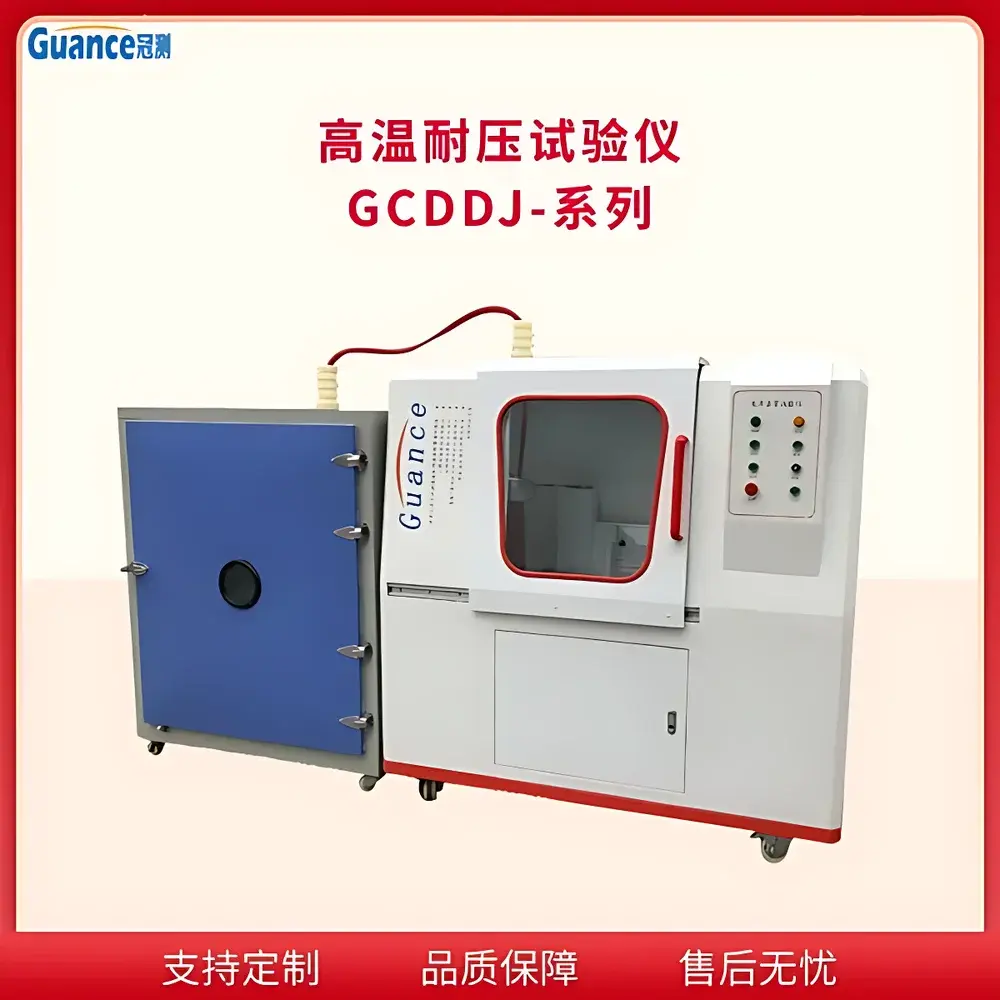
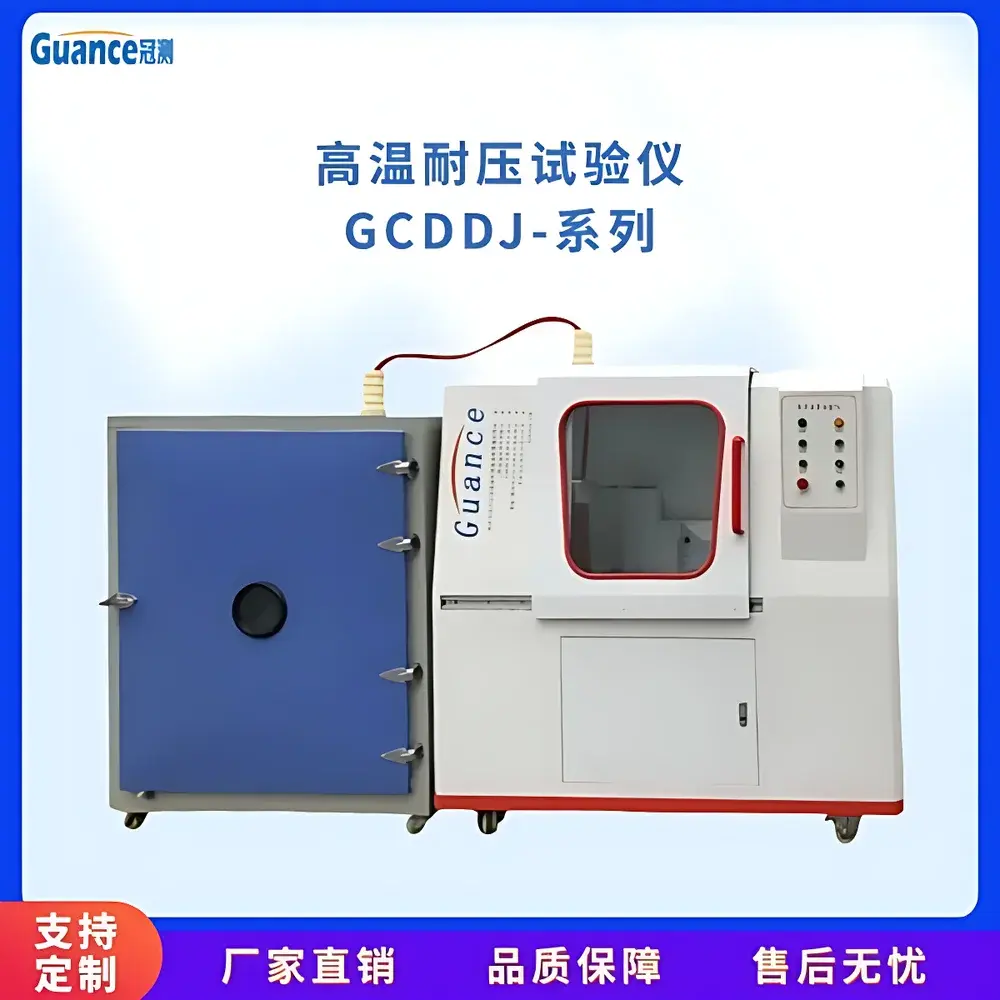
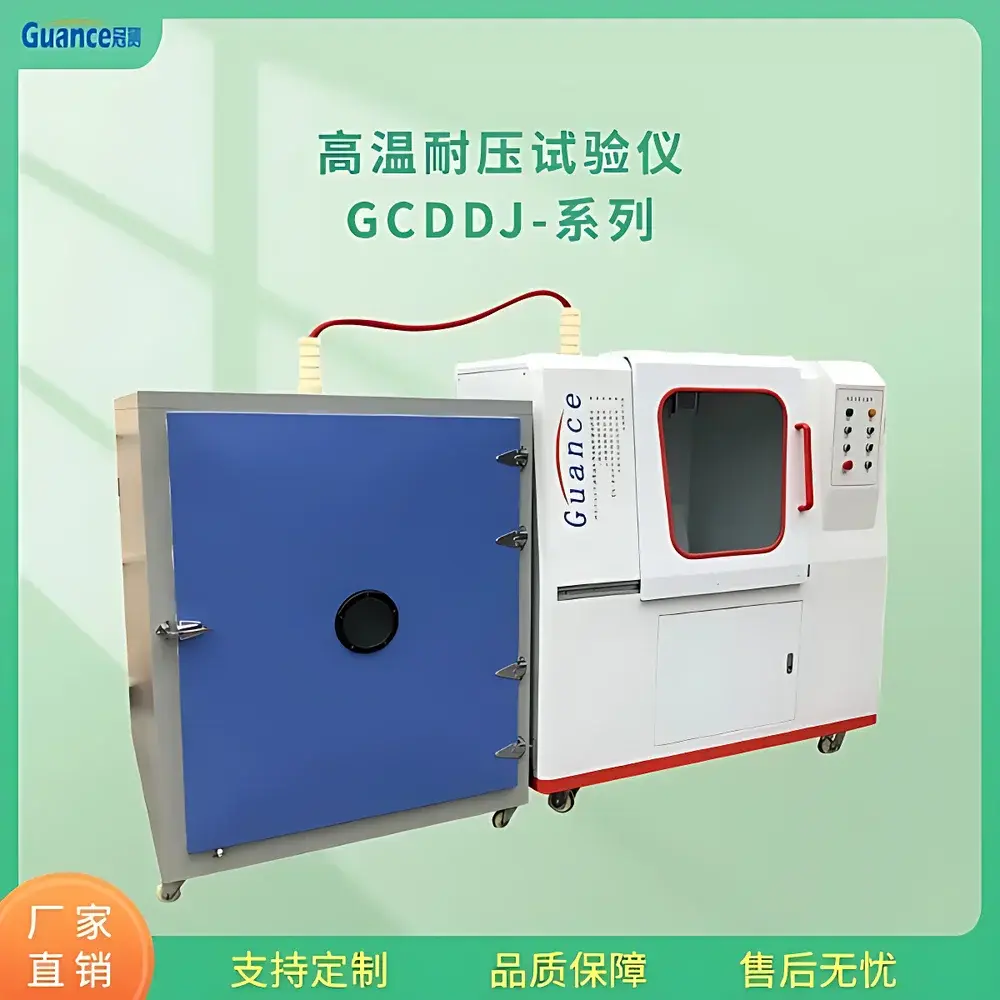
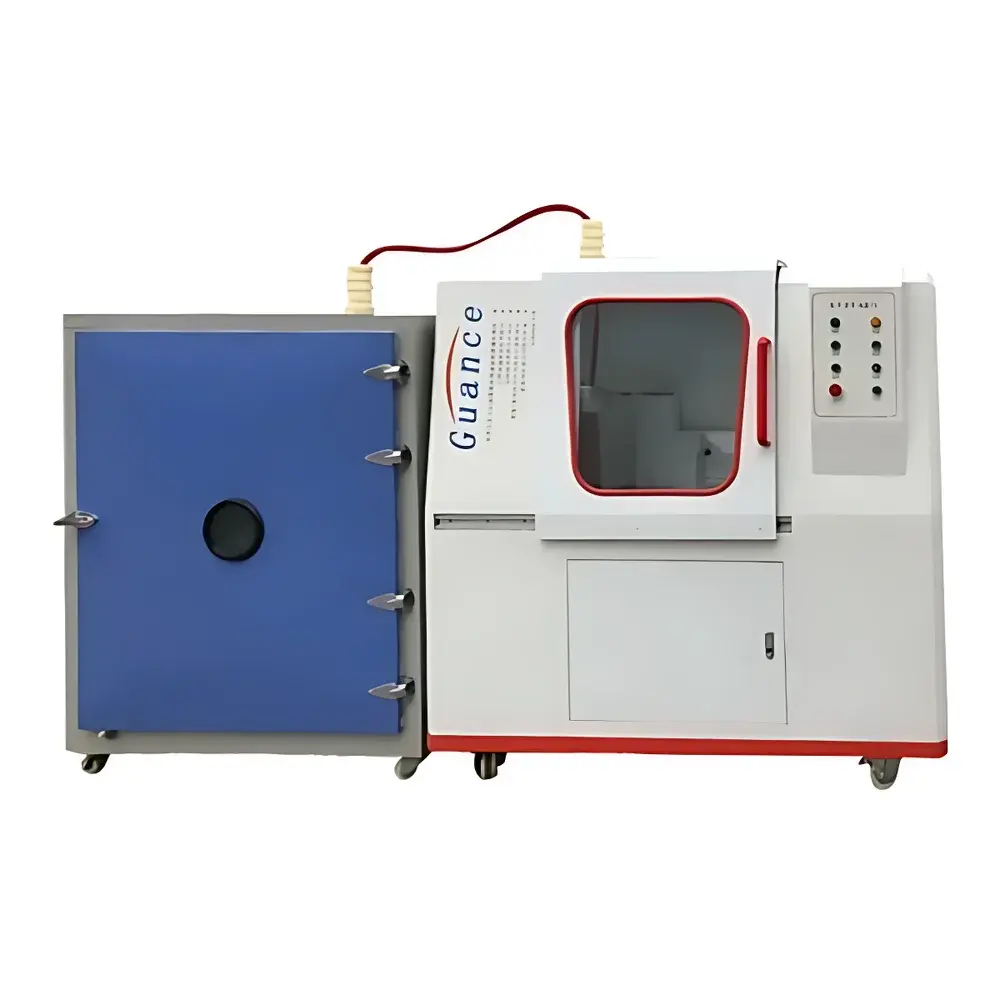
Guance GCDDJ Series High-Temperature Dielectric Strength Tester
| Brand | Guance |
|---|---|
| Origin | Beijing, China |
| Manufacturer Type | Authorized Distributor |
| Product Origin | Domestic (China) |
| Model | GCDDJ Series |
| Price | USD 1,980 (approx.) |
| Dielectric Breakdown Voltage | 100 kV |
Overview
The Guance GCDDJ Series High-Temperature Dielectric Strength Tester is an industrial-grade voltage breakdown testing system engineered for precise evaluation of dielectric strength and withstand voltage performance of solid insulating materials under controlled thermal and electrical stress conditions. Operating on the principle of controlled voltage ramping—either AC (50/60 Hz) or DC—the instrument applies a continuously increasing electric field across a standardized electrode configuration until electrical breakdown occurs. The system integrates high-voltage generation, real-time current monitoring, and programmable ramp-rate control to comply with internationally recognized test methodologies for insulation integrity assessment. Designed specifically for elevated-temperature environments (optional high-temperature test chamber integration), it enables reliable characterization of thermal-electrical aging behavior in polymers, elastomers, ceramics, laminates, and coated substrates—critical for R&D validation, quality assurance, and regulatory conformance in power electronics, aerospace composites, and high-voltage component manufacturing.
Key Features
- Full-range adjustable breakdown voltage up to 100 kV with ±1.5% measurement accuracy (per IEC 60270 reference calibration traceability)
- Programmable voltage ramp rate from 0.1 to 5.0 kV/s (AC) or 0.05 to 2.0 kV/s (DC), continuously variable via software interface
- Integrated Siemens S7-1200 PLC-based control architecture with optical-isolated communication bus for electromagnetic interference (EMI) immunity during high-voltage transients
- Dual-channel high-fidelity sensing: 16-bit resolution voltage transducer (0–100 kV) and wide-bandwidth leakage current monitor (1 µA–20 mA full scale)
- Automated post-breakdown sequence: immediate voltage cutoff, arc suppression, data timestamping, and pass/fail flagging based on user-defined criteria
- Modular high-temperature test station support (up to 200 °C), including ceramic-insulated electrodes, silicone oil bath (ASTM D877-compliant), and thermally stable sample holders
- Comprehensive safety interlocks: door position sensing, ground fault detection, overcurrent trip, and hardware-enforced zero-voltage start requirement
Sample Compatibility & Compliance
The GCDDJ Series accommodates standardized flat-sheet, disc, and rod specimens per ASTM D149, IEC 60243-1, GB/T 1408.1–2016, GB/T 1695–2005, and GB/T 12656. Compatible material classes include thermoplastics (e.g., PEEK, PI), thermosets (epoxy, phenolic), elastomers (silicone rubber, EPDM), inorganic dielectrics (alumina, glass), and functional composites (fiber-reinforced laminates, nanofilled films). All test configurations conform to electrode geometry requirements specified in ISO 2577 and UL 746C. The system supports both short-time (ramp-to-failure) and step-stress (voltage endurance) protocols, enabling determination of dielectric strength (kV/mm), time-lag breakdown characteristics, and comparative tracking index (CTI)-related failure thresholds. Full audit trail functionality—including operator ID, environmental temperature/humidity logs, and calibration certificate references—ensures alignment with GLP, ISO/IEC 17025, and internal QA documentation requirements.
Software & Data Management
The Windows-based GCDDJ Control Suite (v4.2+) provides intuitive graphical workflow management without requiring scripting expertise. Real-time dual-axis plotting displays voltage vs. time and leakage current vs. time synchronously, with auto-scaling and zoom capabilities. Test parameters—including waveform type (AC/DC), ramp profile, hold duration, electrode gap, ambient temperature setpoint, and pass/fail thresholds—are stored in XML-configurable templates. All raw acquisition data (2 kHz sampling rate) and metadata are saved in .CSV and proprietary .GCDT binary formats, supporting export to Excel, MATLAB, or LIMS via ODBC drivers. Electronic signatures, 21 CFR Part 11-compliant audit trails (user actions, parameter changes, result modifications), and PDF report generation with embedded digital signatures satisfy pharmaceutical, medical device, and defense-sector documentation mandates. Remote diagnostics and firmware updates are supported via encrypted HTTPS API endpoints.
Applications
- Qualification testing of polymer encapsulants used in EV battery modules under thermal cycling + HV stress
- Comparative dielectric endurance analysis of SiC and GaN power module substrates at 150 °C
- QC release testing of transformer board (pressboard) and cable insulation paper per IEC 60851-5
- Development of high-k dielectric thin films for flexible electronics, including breakdown mapping across wafer batches
- Evaluation of surface contamination effects on ceramic insulator flashover performance in humid environments
- Accelerated life modeling of motor winding varnishes using step-stress voltage profiles per IEEE 930
FAQ
Does the GCDDJ Series support both AC and DC breakdown testing?
Yes—software-selectable AC (50/60 Hz sinusoidal) or DC polarity modes, each with independent ramp rate, hold, and termination logic.
Is high-temperature operation integrated or optional?
High-temperature capability (up to 200 °C) is available as a factory-installed option, including heated oil bath, thermocouple-integrated electrodes, and thermal shielding.
How is calibration maintained and verified?
The system includes NIST-traceable voltage divider calibration certificates; annual recalibration is recommended and supported by Guance-certified service centers globally.
Can test sequences be automated for unattended operation?
Yes—batch-mode execution with up to 99 sequential tests, automatic specimen indexing (with optional robotic handler interface), and email/SNMP alert on completion or fault.
What safety certifications does the instrument carry?
CE marking per EN 61010-1:2019, RoHS 2011/65/EU compliance, and UL 61010-1 recognition pending third-party verification (available upon request).



