
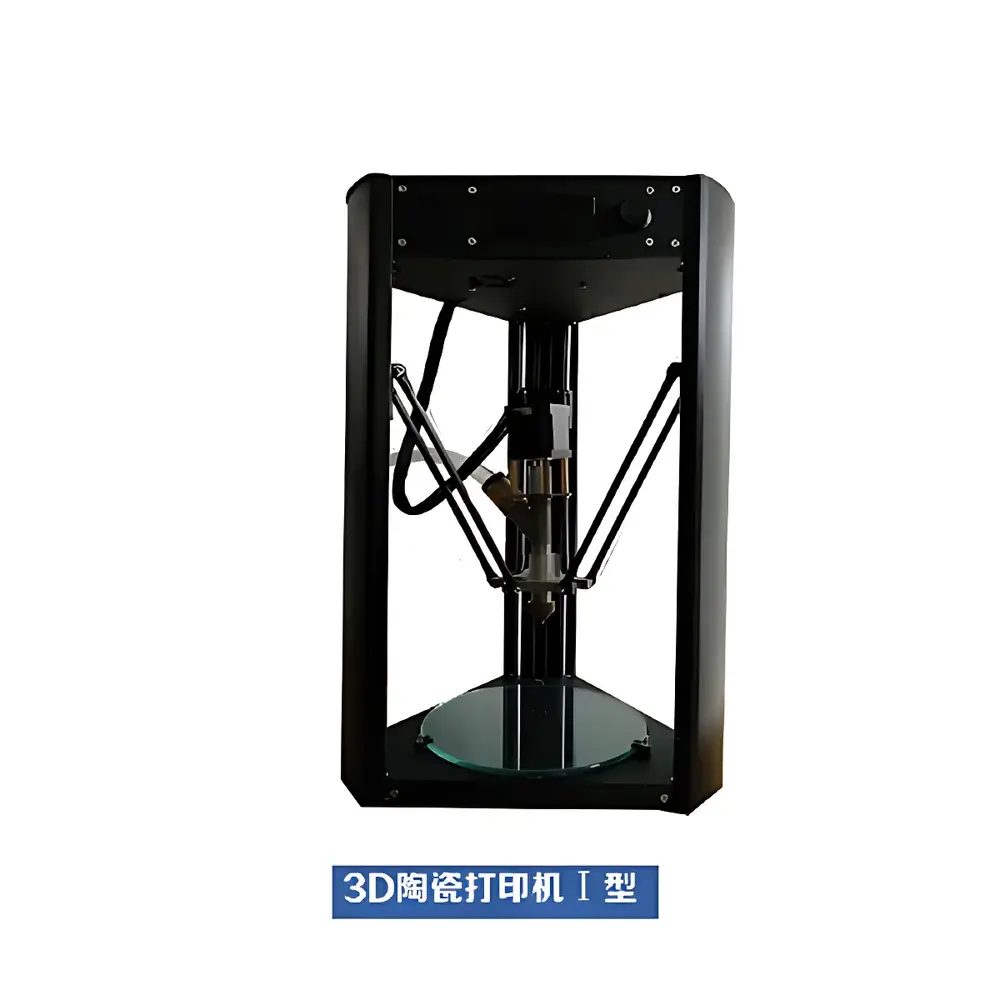
Zhonghuan Furnace ZH-3D-CERAM I Ceramic 3D Printer
| Brand | Zhonghuan Furnace |
|---|---|
| Origin | Tianjin, China |
| Manufacturer Type | Authorized Distributor |
| Country of Origin | China |
| Model | ZH-3D-CERAM I |
| Voltage | 100–250 V AC, 50 Hz |
| Power Consumption | 120 W |
| Dimensions (W×D×H) | 283 × 258 × 468 mm |
| Net Weight | 4.5 kg |
| Maximum Build Volume | Ø150 × 145 mm |
| Nozzle Diameters | 1.0, 1.5, 2.0, 3.0 mm |
| Material Feed Capacity | 3 L |
| Print Speed | 20–120 mm/s |
| Compatible Materials | Plasticized ceramic pastes (e.g., kaolin-based, ball-clay-rich, porcelain, stoneware, and earthenware slips with 22–35% moisture content) |
| Control Interface | Integrated LCD + USB/SD card offline operation |
| Supported File Formats | STL, OBJ, AMF |
| Post-Processing | Conventional drying, binder burnout, and sintering (shrinkage ≈ 30% linear |
Overview
The Zhonghuan Furnace ZH-3D-CERAM I is a desktop-scale extrusion-based ceramic 3D printer engineered for rapid prototyping and low-volume production of functional ceramic components. It operates on the principle of robotic deposition of plasticized ceramic pastes—rheologically tuned aqueous suspensions containing >60 wt% solid loading—through precision-controlled pneumatic-electric hybrid extrusion. Unlike laser sintering or binder jetting systems, this platform eliminates the need for expensive powder handling infrastructure, inert gas environments, or proprietary consumables. Instead, it leverages widely available industrial ceramic raw materials (e.g., standard commercial porcelain, stoneware, and alumina-rich plastic clays), enabling direct translation from CAD design to green-body fabrication in ambient conditions. The system is calibrated for reproducible extrusion fidelity at layer heights between 0.3–1.2 mm, supporting geometries with overhangs up to 45° without support structures—critical for fluidic manifolds, catalytic substrates, and bio-inspired lattice architectures.
Key Features
- Modular dual-drive extrusion system: Combines electric stepper motor precision with pneumatic pressure modulation for consistent paste flow across variable viscosities (20–200 Pa·s, measured per ASTM D2196)
- Interchangeable nozzle set: Four calibrated stainless-steel nozzles (1.0, 1.5, 2.0, and 3.0 mm ID) allow resolution–speed trade-off optimization without hardware recalibration
- Integrated environmental control: Sealed feed reservoir (3 L capacity) with humidity-stabilized lid minimizes surface skinning during extended print jobs
- Multi-mode operation: Supports both real-time USB-connected slicing (via open-source G-code generators) and fully autonomous SD-card-based printing with onboard LCD navigation
- Thermally stable build platform: Aluminum heated bed (ambient–60 °C, ±1.5 °C uniformity) reduces warpage in high-shrinkage formulations
- CE-compliant electrical architecture: Dual-insulated power supply (100–250 V AC, 50 Hz) with thermal cutoff and current-limiting protection circuits
Sample Compatibility & Compliance
The ZH-3D-CERAM I accepts any water-based ceramic slip exhibiting Bingham plastic rheology and extrudability index ≥0.8 (per ISO 18757). Validated feedstocks include commercial art-grade porcelain (e.g., Standard Ceramic #127), technical-grade alumina pastes (≤10 µm median particle size), and silicon carbide–clay composites. All printed green bodies comply with ISO 10545-13 for dimensional stability prior to firing. Final sintered parts meet ASTM C20 density requirements (>95% theoretical for alumina, >92% for porcelain) when processed per manufacturer-recommended thermal profiles (dwell time ≥2 h at peak temperature). The system supports GLP-aligned documentation workflows: timestamped G-code logs, batch-specific parameter export (nozzle ID, speed, layer height), and optional integration with LIMS via serial output.
Software & Data Management
No proprietary software lock-in is required. Users may employ open-source slicers (e.g., Cura 5.7+, PrusaSlicer 2.7+) configured with custom start/end G-code for ceramic-specific purge routines and bed leveling sequences. The onboard firmware stores up to 20 print jobs locally and exports full process metadata (extrusion volume, total print time, pause/resume events) as CSV. For regulated environments, optional RS-232 or Ethernet modules enable audit-trail generation compliant with FDA 21 CFR Part 11 (electronic signatures, operator ID logging, immutable event timestamps). Firmware updates are delivered via signed .bin files verified through SHA-256 checksum validation.
Applications
This system serves laboratories and pilot lines requiring functional ceramic prototypes with minimal capital expenditure. Key use cases include: catalytic monoliths for lab-scale reaction engineering (e.g., microchannel reformers); custom dielectric resonators for RF testing; anatomically accurate bioceramic scaffolds (hydroxyapatite–tricalcium phosphate blends); lightweight thermal barrier inserts for aerospace mockups; and bespoke kiln furniture with optimized thermal mass distribution. In academic settings, it supports curriculum-integrated projects on colloidal processing, sintering kinetics, and digital manufacturing of refractory components.
FAQ
What post-processing steps are mandatory after printing?
All printed green parts require controlled air-drying (48–72 h at 25 °C, 40–50% RH), followed by debinding (slow ramp to 600 °C @ 0.5 °C/min in air or N₂), then sintering per material-specific soak profiles.
Can the printer handle highly abrasive ceramics like silicon carbide or zirconia?
Yes—provided the paste formulation includes ≤15 vol% submicron abrasive phase and uses hardened tungsten-carbide nozzle inserts (available as optional accessories).
Is calibration required before each print job?
No. The system employs factory-calibrated extrusion factor mapping per nozzle diameter; only initial Z-offset adjustment is needed after nozzle replacement.
Does the printer support multi-material deposition?
Not natively. Single-nozzle architecture limits sequential material switching; however, dual-reservoir retrofit kits are under development (ETA Q3 2025).
How is dimensional accuracy verified?
Each unit ships with NIST-traceable ceramic gauge blocks. Users perform weekly verification using coordinate measuring machine (CMM) or optical profilometry per ISO 10360-2 protocols.



