
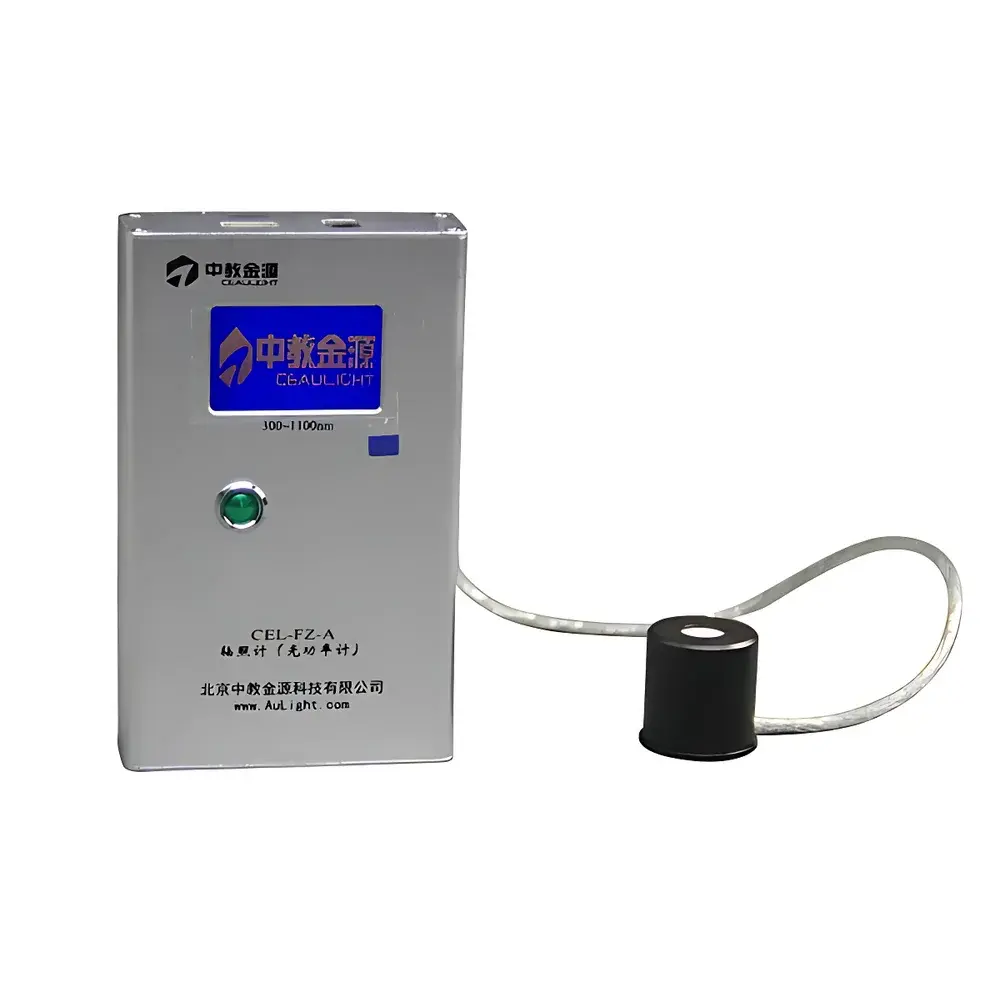
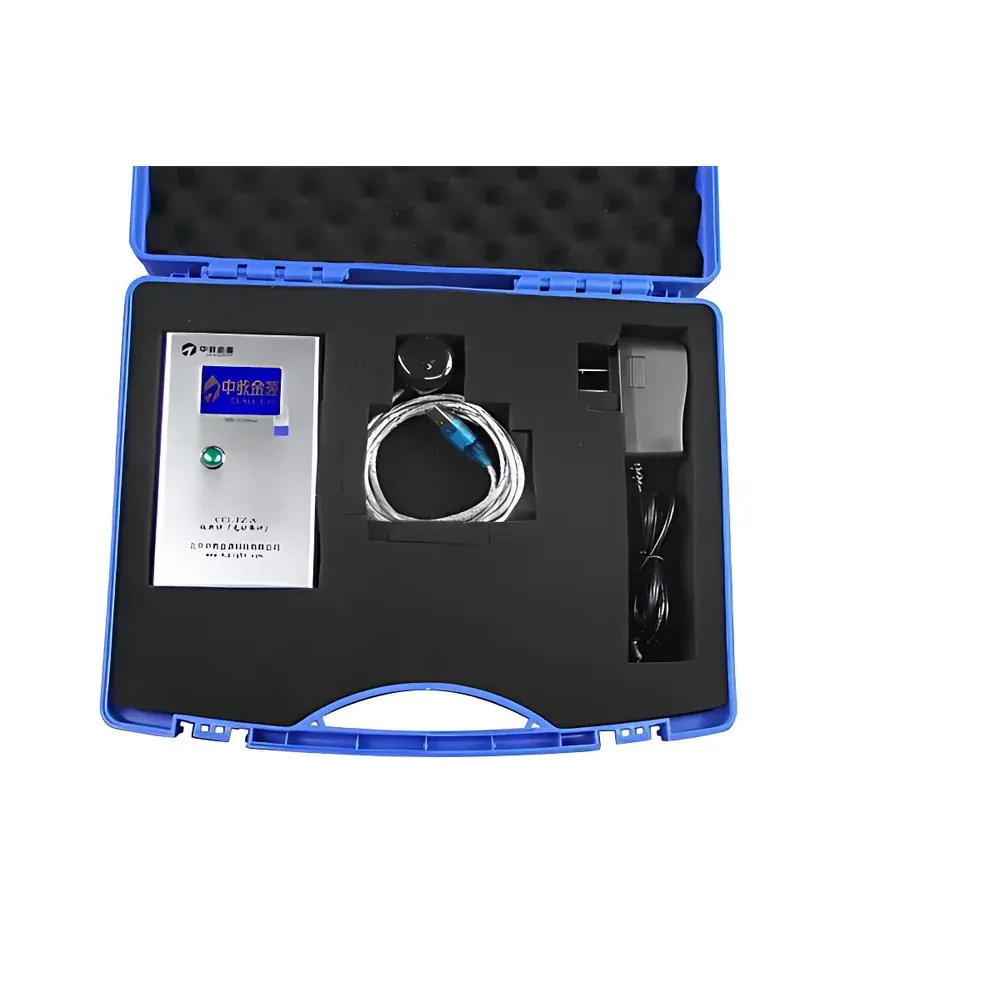
CEL-FZ-A Portable Radiometer (Optical Power Meter)
| Brand | CEL |
|---|---|
| Origin | Beijing, China |
| Manufacturer Type | Direct Manufacturer |
| Product Category | Domestic |
| Model | CEL-FZ-A |
| Price Range | USD 0–720 |
| Optical Design | Single-Beam |
| Detector Type | Silicon Photocell |
| Wavelength Range | 300 nm–1100 nm |
| Automation Level | Automatic Wavelength Compensation |
| Measurement Range | 0–300.0 mW/cm² |
| Spectral Responsivity Calibration | NIM-traceable |
| Cosine Error | ±4% |
| Temperature Compensation Range | 15–35 °C |
| Resolution | 0.1 µW |
| Measurement Accuracy | < ±5% (at 25 °C, 50% RH) |
| Response Time | < 0.4 s |
| Operating Ambient | 0–40 °C, <85% RH |
| Power Supply | Rechargeable Lithium-ion Battery (AC Adapter: 220 V, 50 Hz) |
| Display | Digital LCD with Real-time Readout |
| Interface | Digital Output (USB or TTL-compatible, configurable) |
Overview
The CEL-FZ-A Portable Radiometer is a precision optical power meter engineered for quantitative irradiance measurement across the ultraviolet–visible–near-infrared spectrum (300–1100 nm). It operates on the principle of calibrated photometric detection using a silicon photocell whose spectral responsivity has been rigorously characterized and corrected against National Institute of Metrology (NIM, China) reference standards. Unlike broadband thermal sensors, the CEL-FZ-A employs a spectrally weighted photodiode architecture optimized for solar-weighted irradiance (e.g., AM1.5G), enabling accurate quantification of photon flux density in units of mW/cm². Its single-beam optical path minimizes stray light interference and supports rapid, stable readings under dynamic illumination conditions—critical for photovoltaic testing, photochemical reactor monitoring, and artificial light source validation. The instrument is not a spectroradiometer; it delivers integrated irradiance values without spectral decomposition, making it ideal for routine process control and QA/QC applications where absolute radiometric traceability—not spectral resolution—is required.
Key Features
- Factory-calibrated silicon photocell with NIM-traceable spectral responsivity correction across 300–1100 nm
- Integrated temperature compensation algorithm (15–35 °C) to mitigate thermal drift in detector quantum efficiency
- Automatic ranging circuitry enables seamless transition between µW/cm² and mW/cm² scales without manual gain adjustment
- Cosine-corrected diffuser with ≤±4% angular response error—compliant with ISO/CIE requirements for planar irradiance measurement
- High-resolution digital LCD display (0.1 µW resolution) with real-time readout and unit auto-scaling
- Rechargeable lithium-ion battery system supporting >8 hours continuous operation; AC adapter included (220 V, 50 Hz)
- Digital output interface (TTL-level or USB-configurable) for integration into automated data acquisition systems
- Rugged handheld enclosure rated for field use; operating ambient: 0–40 °C, <85% RH non-condensing
Sample Compatibility & Compliance
The CEL-FZ-A is validated for irradiance measurement of broadband and quasi-monochromatic sources including xenon arc lamps (with AM1.5G filters), LED arrays (UV to NIR), halogen lamps, tungsten-halogen simulators, and natural sunlight. It meets functional equivalency to ASTM E892 (Standard Test Method for Spectral Match of Solar Simulators) for integrated irradiance verification and aligns with ISO 9050 (Glass in building — Determination of light transmittance) for daylight-weighted transmission assessment. While not certified to IEC 61215 or IEC 60904-9 for PV calibration, its NIM-traceable calibration enables use as a secondary standard in GLP-compliant laboratories when operated within specified environmental limits (25 ±2 °C, 50% RH). Device firmware logs timestamped measurements with internal temperature metadata—supporting audit-ready records per FDA 21 CFR Part 11 when paired with compliant data capture software.
Software & Data Management
The CEL-FZ-A supports direct serial or USB communication via ASCII-based command protocol (e.g., “READ?” returns “245.67 mW/cm2”). Optional PC software (Windows/macOS/Linux compatible) provides time-series logging, statistical analysis (min/max/avg/stdev), CSV export, and calibration certificate management. All measurement sessions include embedded environmental metadata (detector temperature, battery voltage, UTC timestamp), ensuring reproducibility in regulated environments. Raw output is unencrypted and human-readable—facilitating integration with LabVIEW, Python (pySerial), or MATLAB for custom automation. No cloud dependency or vendor-locked firmware updates; calibration coefficients are stored in non-volatile memory and preserved during battery replacement.
Applications
- Photocatalytic reactor monitoring: Quantifying incident photon flux on TiO₂, g-C₃N₄, or perovskite-based systems
- Solar simulator validation: Verifying total irradiance compliance with AM1.5G (1000 W/m²) prior to J-V curve measurement
- LED lighting QA: Batch-testing luminous efficacy consistency across UV-C germicidal, horticultural PAR, and white-light modules
- Material aging studies: Controlling dose (J/cm²) in accelerated weathering chambers per ISO 4892-2
- Educational labs: Hands-on radiometry training with traceable, low-cost instrumentation
- Field-deployable solar resource assessment: Supporting off-grid PV system commissioning in distributed energy projects
FAQ
Is the CEL-FZ-A calibrated to international standards?
Yes—its spectral responsivity is corrected against NIM (China National Institute of Metrology) reference detectors, with calibration certificates traceable to CIPM MRA signatory laboratories.
Can it measure pulsed light sources?
It is optimized for continuous-wave (CW) or slowly varying irradiance; pulse widths <10 ms may exceed its <0.4 s electrical response time and require averaging or external triggering.
Does it support spectral irradiance measurement?
No—it reports total integrated irradiance only. For wavelength-resolved data, a spectroradiometer (e.g., Ocean Insight QE Pro) is required.
How often should recalibration be performed?
Annual recalibration is recommended for GLP/GMP environments; biennial verification suffices for academic or industrial R&D under stable storage conditions.
Is the cosine diffuser replaceable?
Yes—the diffuser is a field-serviceable component; replacement kits include pre-characterized angular correction profiles loaded via firmware update.




