
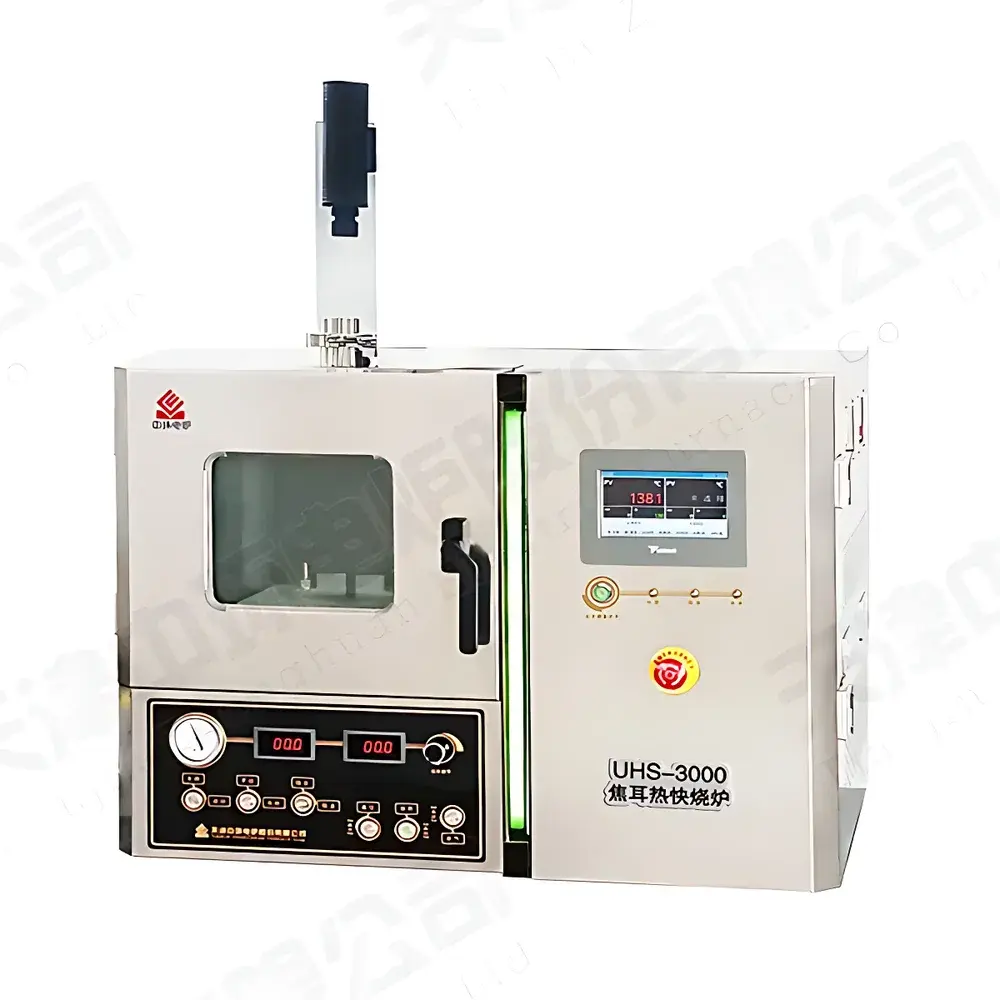
ZHONGHUAN FURNACE UHS-3000Plus Joule Heating Furnace
| Brand | ZHONGHUAN FURNACE |
|---|---|
| Origin | Tianjin, China |
| Manufacturer Type | Authorized Distributor |
| Product Category | Domestic |
| Model | UHS-3000Plus |
| Instrument Type | Box-Type High-Temperature Furnace |
| Maximum Temperature | 3000 °C |
| Temperature Control Accuracy | ±2 °C |
| Rated Power | 20 kW |
| Heating Rate (to Max Temp) | 10–500 °C/s |
| Heating Element | Graphite Foil, Graphite Boat, Graphite Tube |
| Cooling Method | Recirculating Water Cooling |
| Vacuum Chamber Material | 304 Stainless Steel with Radiation-Shielded Viewport |
| Ultimate Vacuum | ≤10 Pa (with Dual-Stage Pump) |
| Gas Control | Three-Channel (Inlet, Exhaust, Vacuum) |
| Voltage/Current Output | 0–50 V / 0–380 A |
| Temperature Measurement | Infrared Pyrometer (20 ms Sampling Interval) |
Overview
The ZHONGHUAN FURNACE UHS-3000Plus Joule Heating Furnace is an advanced resistive thermal processing system engineered for ultrafast, high-precision high-temperature synthesis and sintering. Unlike conventional radiation- or convection-based furnaces, it employs direct Joule heating of conductive carbon-based elements—such as graphite foils, boats, or tubes—to generate highly localized, transient thermal fields. This principle enables rapid energy delivery directly into the sample or its immediate support structure, minimizing thermal lag and enabling precise temporal control over thermal profiles. Designed for materials science research laboratories, the UHS-3000Plus delivers stable operation up to 3000 °C with millisecond-scale thermal response, making it ideal for non-equilibrium processing routes where kinetic suppression of volatile loss, interdiffusion, or grain coarsening is critical.
Key Features
- Ultra-high temperature capability: Stable operation at up to 3000 °C, verified via calibrated infrared pyrometry with 20 ms sampling resolution.
- Programmable thermal kinetics: Adjustable heating rates from 10 to 500 °C/s, supporting both continuous ramping and discrete pulse-mode operation with configurable pulse width down to 20 ms.
- Integrated water-cooled 304 stainless steel vacuum chamber with radiation-shielded quartz viewport, rated for ultimate vacuum ≤10 Pa using dual-stage rotary vane pumping.
- Three-channel gas management system (inlet, exhaust, vacuum line) compatible with inert (Ar, N₂), reducing (H₂/Ar), or reactive (O₂-diluted) atmospheres under controlled flow and pressure regulation.
- Touchscreen-based control interface with multi-segment programmable temperature profiles, real-time data logging, and manual override functionality.
- Robust electrical architecture: 3-phase 380 V input, 20 kW output capacity, delivering up to 380 A at ≤50 V for low-impedance graphite loads.
Sample Compatibility & Compliance
The UHS-3000Plus accommodates solid-state samples in powder, pellet, thin-film, or bulk geometries—typically mounted on or embedded within graphite substrates. Its fast thermal transients are especially suited for air-sensitive or vapor-pressure-limited systems, including lithium-containing solid electrolytes (e.g., garnet-type LLZO), refractory ceramics (e.g., ZrB₂–SiC composites), transition-metal oxide catalysts, and graphene-derived architectures. The furnace meets general laboratory safety standards for high-current resistive heating equipment (IEC 61000-6-4 EMC, IEC 61000-6-2 immunity) and supports GLP-compliant workflows through timestamped, audit-trail-enabled temperature logging. While not pre-certified to ISO/IEC 17025, its measurement traceability aligns with ASTM E230/E230M practices for high-temperature thermometry when paired with NIST-traceable infrared calibration sources.
Software & Data Management
The embedded control firmware records all operational parameters—including voltage, current, chamber pressure, gas flow rates, and pyrometer output—at user-defined intervals (default: 100 ms). Exportable CSV datasets include absolute timestamps synchronized to internal RTC, enabling post-hoc correlation with ex-situ characterization (XRD, SEM, EIS). Optional Ethernet or RS-485 interfaces allow integration into centralized lab automation platforms. Data files are stored locally on industrial-grade SD card with write-protection and automatic rollover; no cloud dependency or proprietary binary formats are used. Audit trails retain operator ID, parameter modifications, and emergency stop events per FDA 21 CFR Part 11 guidance for regulated environments requiring electronic record integrity.
Applications
- Ceramic densification: Achieves >95% theoretical density in sub-10-second cycles at 3000 °C, significantly reducing volatilization of alkali or rare-earth dopants in functional oxides.
- Solid-state electrolyte synthesis: Enables 1773 K hold for 10 s followed by rapid quenching—demonstrated to yield Li₇La₃Zr₂O₁₂ with ~92% relative density and minimal Li loss, preserving stoichiometry and ionic conductivity.
- Nanocatalyst fabrication: Facilitates 2-second thermal spikes to 1074 K on CNT-supported precursors, yielding phase-pure Pt-Co-Cu trimetallic nanoparticles with controlled surface segregation for ethanol oxidation electrocatalysis.
- Refractory intermetallic processing: Supports flash sintering of MoSi₂–Al₂O₃ composites without crucible contamination, leveraging self-heating of conductive green bodies.
FAQ
What types of graphite heating elements are compatible with the UHS-3000Plus?
Graphite foil (thickness 0.5–2 mm), graphite boat (5–20 mm width), and graphite tube configurations are supported; dimensional limits apply—maximum element footprint is 100 × 20 mm.
Can the furnace operate under dynamic gas flow during pulsed heating?
Yes—the three-channel mass flow controller system allows simultaneous inlet, exhaust, and vacuum line actuation, enabling reactive sintering or in-situ reduction under programmable partial pressures.
Is temperature uniformity characterized across the heating zone?
Uniformity depends on sample geometry and mounting configuration; typical radial gradients are ≤±15 °C over a 10 mm diameter zone at 2500 °C, measured via multi-point pyrometry.
Does the system support remote monitoring or API integration?
Standard Ethernet port enables Modbus TCP communication for external SCADA or LabVIEW integration; optional OEM SDK available upon request.
What maintenance intervals are recommended for the water cooling circuit?
Deionized water must be replaced every 6 months; filter cartridges and pump seals require inspection every 12 months or after 500 operational hours—whichever occurs first.
Related Products



