
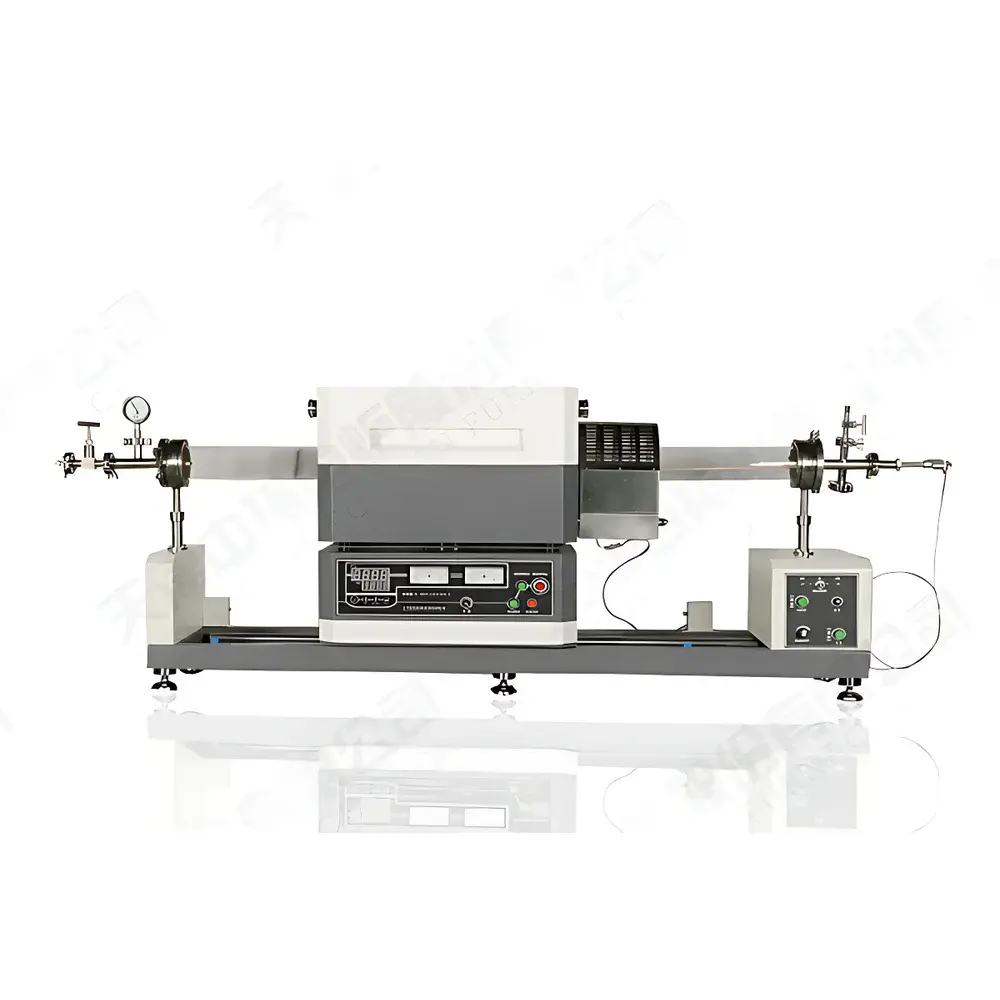
ZHONGHUAN FURNACE SK-G03123K-HD / SK-G04123K-HD 1200°C Sliding Tube Furnace
| Brand | ZHONGHUAN FURNACE |
|---|---|
| Origin | Tianjin, China |
| Model | SK-G03123K-HD / SK-G04123K-HD |
| Max Temperature | 1200°C |
| Control Accuracy | ±1°C |
| Rated Power | 1.2 kW |
| Heating Element | 0Cr27Al7Mo2 high-resistance alloy wire |
| Internal Dimensions (L×W×H) | 1400×290×670 mm |
| Heating Zone Length | 210 mm |
| Uniform Temperature Zone Length | 100 mm |
| Tube ID Options | Φ30 mm or Φ40 mm quartz |
| Sliding Distance | 300 mm |
| Sliding Mode | Motor-driven automatic sliding (temperature-programmable) or manual |
| Empty-Furnace Ramp Time to 1200°C | <15 min |
| Ramp Rates | ≤5°C/min (≤500°C), ≤10°C/min (500–800°C), ≤5°C/min (800–1000°C), ≤2°C/min (1000–1200°C) |
| Weight | 35 kg |
| Voltage | 220 V AC |
Overview
The ZHONGHUAN FURNACE SK-G03123K-HD and SK-G04123K-HD are precision-engineered horizontal sliding tube furnaces designed for controlled-atmosphere and vacuum thermal processing in research and development laboratories. Operating up to 1200°C, these furnaces utilize a dual-zone mechanical architecture—comprising a fixed left heating section and a right-side furnace chamber that pivots up to 110°—to enable unobstructed access to the quartz reaction tube without compromising thermal integrity. The core heating mechanism employs high-stability 0Cr27Al7Mo2 resistance wire wound on ceramic formers, delivering uniform radial heat distribution across a 210 mm heating zone, with a certified isothermal region of 100 mm (±1°C). Integrated air-gap insulation and multi-layer polycrystalline mullite fiber lining reduce surface temperature rise and improve energy efficiency by ~50% compared to conventional refractory brick designs. Thermal safety is enforced via redundant hardware interlocks—including door-open power cutoff, independent over-temperature cutout, and ground-fault detection—ensuring compliance with IEC 61000-6-2 (EMC) and IEC 61010-1 (safety for laboratory equipment).
Key Features
- Motorized programmable sliding mechanism (300 mm travel) synchronized with temperature ramp profiles—enables automated sample insertion/extraction at predefined temperatures without manual intervention.
- Quick-connect dual-ring flange system eliminates traditional bolted法兰 assembly; single clamp secures gas-tight seal (leak rate <1×10⁻⁴ mbar·L/s helium) at both tube ends.
- Modular gas handling interface supports optional integration of mass flow controllers (MFCs), vacuum pumps (down to 10⁻³ mbar), and pressure regulation modules (0–1 bar gauge).
- Intelligent temperature control architecture featuring dual-mode PID + fuzzy logic auto-tuning, supporting up to 50 programmable segments (domestic controller) or 40 segments (imported Eurotherm/OMRON-compatible unit).
- Active surface cooling: integrated thermal sensor triggers variable-speed exhaust fan when external casing exceeds 50°C—maintaining operator-safe surface temperatures during extended high-T operation.
- RS-485 communication port compliant with Modbus RTU protocol enables centralized monitoring and control of up to 200 units via SCADA or custom LabVIEW/Python interfaces.
Sample Compatibility & Compliance
These furnaces accommodate standard fused silica quartz tubes (Φ30 mm or Φ40 mm ID), rated for continuous operation below 1200°C in inert, reducing, or vacuum environments. The 100 mm uniform temperature zone ensures reproducible thermal treatment of catalysts, thin-film precursors, carbon nanomaterials, and semiconductor dopants. Structural design conforms to ISO 17025 requirements for thermal calibration traceability, and all electrical subsystems meet CE marking directives (2014/35/EU Low Voltage Directive and 2014/30/EU EMC Directive). Optional vacuum configurations comply with ASTM E595 outgassing specifications for space-grade materials testing. Gas inlet/outlet ports accept standard Swagelok®-type fittings, facilitating seamless integration into GLP/GMP-compliant process workflows.
Software & Data Management
The embedded controller provides real-time temperature logging at 1-second intervals, with onboard storage for ≥30 days of operational history. Data export is supported via USB flash drive (CSV format) or RS-485 network streaming. When connected to host software (e.g., ZHONGHUAN’s FurnaceLink™ or third-party platforms), users gain access to full audit trail functionality—including user login timestamps, parameter change logs, and alarm event records—meeting FDA 21 CFR Part 11 requirements for electronic records and signatures. Remote firmware updates and configuration backup/restore are supported without hardware disassembly.
Applications
- Controlled-atmosphere annealing of graphene oxide and transition metal dichalcogenides (TMDs) for electronic device fabrication.
- Carbothermal reduction synthesis of SiC nanowires and TiN nanoparticles under N₂/H₂ mixtures.
- Thermal gravimetric analysis (TGA) coupling with FTIR or MS gas-phase product detection.
- Precursor pyrolysis for carbon fiber precursor stabilization (e.g., PAN oxidation at 200–300°C followed by high-T carbonization).
- Low-pressure chemical vapor deposition (LPCVD) of SiO₂ and Si₃N₄ thin films using organosilicon precursors.
- Calibration of thermocouples (Type S, R, B) and radiation pyrometers per ASTM E230/E1137 standards.
FAQ
What quartz tube dimensions are supported?
Standard configurations include Φ30 mm and Φ40 mm inner diameter fused silica tubes, each rated for ≤1200°C continuous use in non-corrosive atmospheres.
Can this furnace operate under high vacuum?
Yes—when equipped with optional turbomolecular pumping systems and metal-sealed CF flanges, base pressures down to 1×10⁻⁶ mbar are achievable.
Is remote programming possible without proprietary software?
Yes—Modbus RTU register mapping documentation is provided, enabling integration with open-source Python (pymodbus), MATLAB, or LabVIEW via standard RS-485-to-USB adapters.
How is temperature uniformity validated?
Each unit undergoes factory calibration using three calibrated Type S thermocouples positioned at center, +50 mm, and –50 mm along the tube axis, confirming ≤±1°C deviation across the 100 mm uniform zone.
What maintenance is required for long-term reliability?
Annual inspection of heating element tension, flange gasket integrity, and fan filter cleaning is recommended; no routine replacement parts are required within first 5,000 operating hours.



