
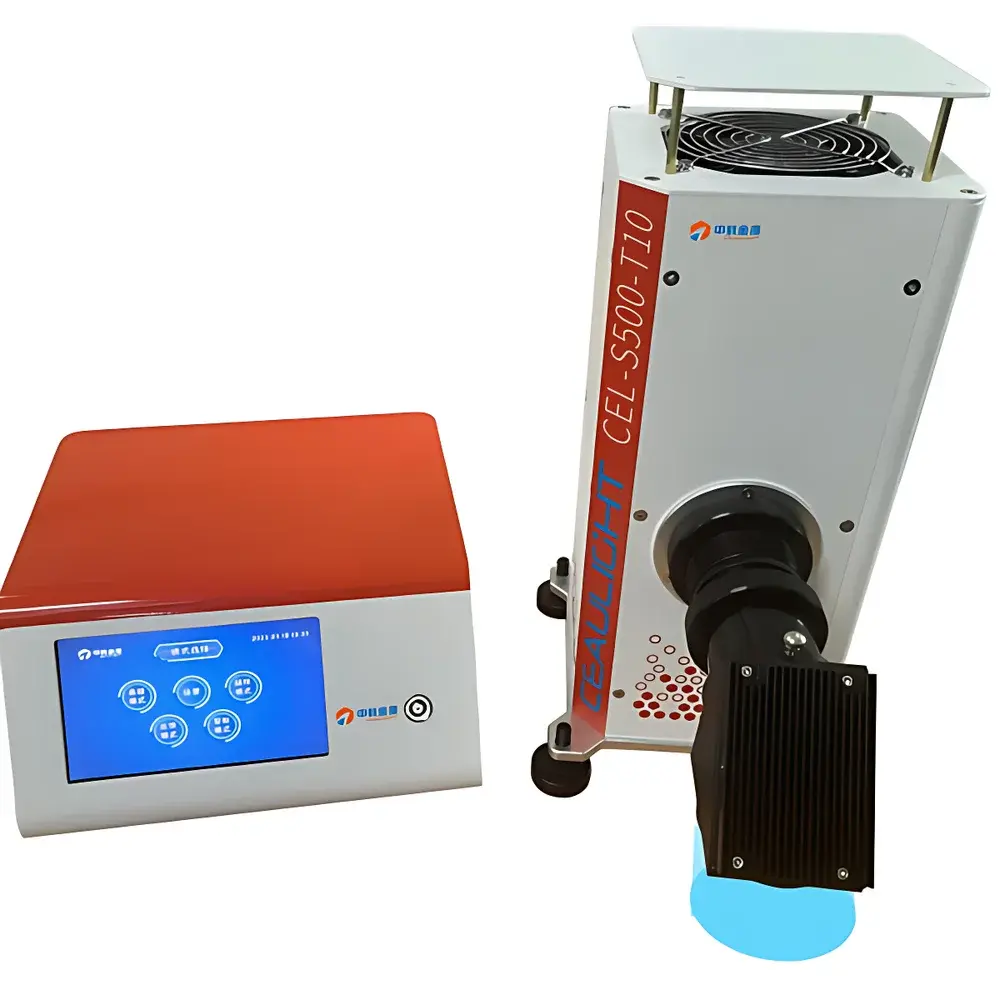
CEL-S500-T10 Intelligent Solar-Simulating Xenon Light Source
| Brand | CEAULIGHT |
|---|---|
| Origin | Beijing, China |
| Manufacturer Type | OEM Manufacturer |
| Product Category | Domestic |
| Model | CEL-S500-T10 Intelligent Solar-Simulating Xenon Light Source |
| Quotation | Upon Request |
| Light Stability (Fiber-Optic Feedback) | <±0.5% |
| Spectral Range | 300–2500 nm |
| Output Power Range | 300–500 W |
| Irradiance Range | 10–500 mW/cm² (0.1–5 Sun, where 1 Sun = 100 mW/cm²) |
| Current Adjustment Range | 15–25 A |
| Power Supply Stability | ±0.01% |
| Collimated Beam Diameter | 50–60 mm |
| Point Source Output Diameter | 2–3 mm |
| Adjustable Spot Size | 3–50 mm (via iris diaphragm) |
| Lamp Lifetime | 500–1000 h |
| Control Interface | 7-inch TFT touch screen with programmable logic |
| Operating Modes | Standard, Fiber-Feedback Stabilized, Irradiance-Controlled, and Time-Programmed Auto-Modulation |
Overview
The CEL-S500-T10 Intelligent Solar-Simulating Xenon Light Source is an engineered optical instrument designed for high-fidelity solar simulation in controlled laboratory environments. It employs a high-pressure short-arc spherical xenon lamp—characterized by a sub-millimeter arc size—as the primary radiant emitter. This geometry enables near-point-source behavior, facilitating efficient collimation, fiber coupling, and uniform irradiance distribution. The lamp emits a continuous spectrum spanning 300–2500 nm, closely approximating the spectral power distribution (SPD) of natural sunlight under AM1.5G conditions when paired with certified quartz-based AM1.5G filter assemblies. Unlike pulsed or LED-based simulators, the CEL-S500-T10 delivers steady-state irradiance essential for photovoltaic quantum efficiency mapping, photocatalytic reaction kinetics, photoelectrochemical (PEC) cell characterization, and long-duration light-driven thermal processes such as solar-driven interfacial evaporation.
Key Features
- Integrated fiber-optic photometric feedback loop using a Hamamatsu photodiode sensor—optically decoupled from thermal drift via remote fiber coupling—to maintain irradiance stability better than ±0.5% over extended operation.
- Intelligent 7-inch capacitive touchscreen interface supporting multi-mode operation: standard constant-current mode, closed-loop irradiance stabilization, time-programmed irradiance modulation (e.g., simulating diurnal solar intensity variation), and user-defined on/off cycling protocols.
- Thermally robust mechanical architecture featuring optimized air-flow routing, real-time multi-point temperature monitoring (lamp housing, power supply, sensor mount), and automatic post-power-down cooling delay to extend xenon lamp service life to 500–1000 hours.
- Modular optical design compatible with industry-standard mounting interfaces (M52, M62, 25.4 mm, and 50.8 mm) for seamless integration of external filters (e.g., AM1.5G, UV-cut, VIS-bandpass), reflectors, and focusing optics.
- Adjustable irradiation geometry: collimated output (50–60 mm diameter), focused point source (2–3 mm), and continuously variable spot size (3–50 mm diameter) via motorized iris diaphragm—enabling precise spatial control for micro-scale photoresponse testing or macro-area illumination.
Sample Compatibility & Compliance
The CEL-S500-T10 is routinely deployed in ISO/IEC 17025-accredited laboratories conducting photovoltaic device certification per IEC 60904-9 and ASTM E927-22 standards. Its spectral match to AM1.5G (when equipped with traceable NIST-calibrated filters) supports compliance with IEC 61215 for PV module qualification and USP guidance for analytical instrument qualification in regulated photobiological studies. The system’s digital logging capability—including timestamped irradiance values, lamp-on hours, thermal status, and operational mode history—supports GLP/GMP audit trails. All electrical components conform to IEC 61000-6-3 (EMC emissions) and IEC 61000-6-2 (immunity), with CE marking applied for EU market deployment.
Software & Data Management
The embedded firmware provides native data acquisition and export functionality without requiring third-party software. Real-time irradiance (mW/cm²), elapsed lamp time, and thermal sensor readings are displayed and logged at user-configurable intervals (1 s to 10 min). Export formats include CSV and Excel-compatible .xlsx files, suitable for import into MATLAB, Python (pandas), or LabVIEW for downstream statistical analysis. Optional RS-232/USB-C communication enables remote triggering and parameter synchronization with external equipment (e.g., source meters, potentiostats, environmental chambers). Audit-ready event logs record all mode transitions, manual overrides, and fault conditions—fully compliant with FDA 21 CFR Part 11 requirements for electronic records and signatures when operated within validated SOPs.
Applications
- Photovoltaic research: J-V curve measurement, external quantum efficiency (EQE) mapping, and stability testing of perovskite, organic, and tandem solar cells under standardized illumination.
- Photoelectrochemistry: Controlled irradiation for water-splitting half-reaction quantification, Faradaic efficiency determination, and in situ spectroelectrochemical monitoring.
- Heterogeneous photocatalysis: Kinetic evaluation of TiO₂, g-C₃N₄, MOFs, and covalent organic frameworks under reproducible solar-spectrum excitation.
- Photobiology and circadian studies: Tunable irradiance profiles mimicking natural daylight cycles for plant photomorphogenesis, microbial growth assays, and non-visual photoreceptor activation.
- Solar-thermal conversion: High-flux irradiation for interfacial evaporation rate quantification, localized steam generation, and photothermal material screening.
FAQ
What spectral filters are recommended for AM1.5G compliance?
We recommend fused-silica-based AM1.5G reference filters calibrated per ASTM G173-03, with certified transmittance data traceable to NIST SRM 2241. Custom bandpass filters (e.g., UV-A, VIS-only, NIR-enhanced) are available upon request.
Can the CEL-S500-T10 be integrated with automated stage systems?
Yes—the unit supports TTL-level trigger input for synchronized shutter control and provides analog voltage output (0–5 V) proportional to real-time irradiance, enabling closed-loop coordination with XYZ translation stages and spectroradiometers.
Is lamp replacement a field-serviceable procedure?
Yes—lamp exchange requires only standard hex tools and alignment verification using the built-in collimation target; full recalibration is optional and can be performed using the onboard self-test routine and factory-provided calibration certificate.
Does the system support irradiance mapping across the beam profile?
While the CEL-S500-T10 does not include an integrated scanning radiometer, its uniform collimated output (±3% spatial homogeneity over central 80% area, verified per IEC 60904-9 Annex D) is compatible with external beam profilers (e.g., Ophir Pyrocam III, Thorlabs BP109) for quantitative irradiance mapping.
What maintenance schedule is advised for long-term stability?
We recommend quarterly inspection of air filters and cooling ducts, biannual verification of fiber-optic coupling alignment, and annual recalibration of the Hamamatsu sensor against a NIST-traceable reference detector—documented in the system’s maintenance log.




