
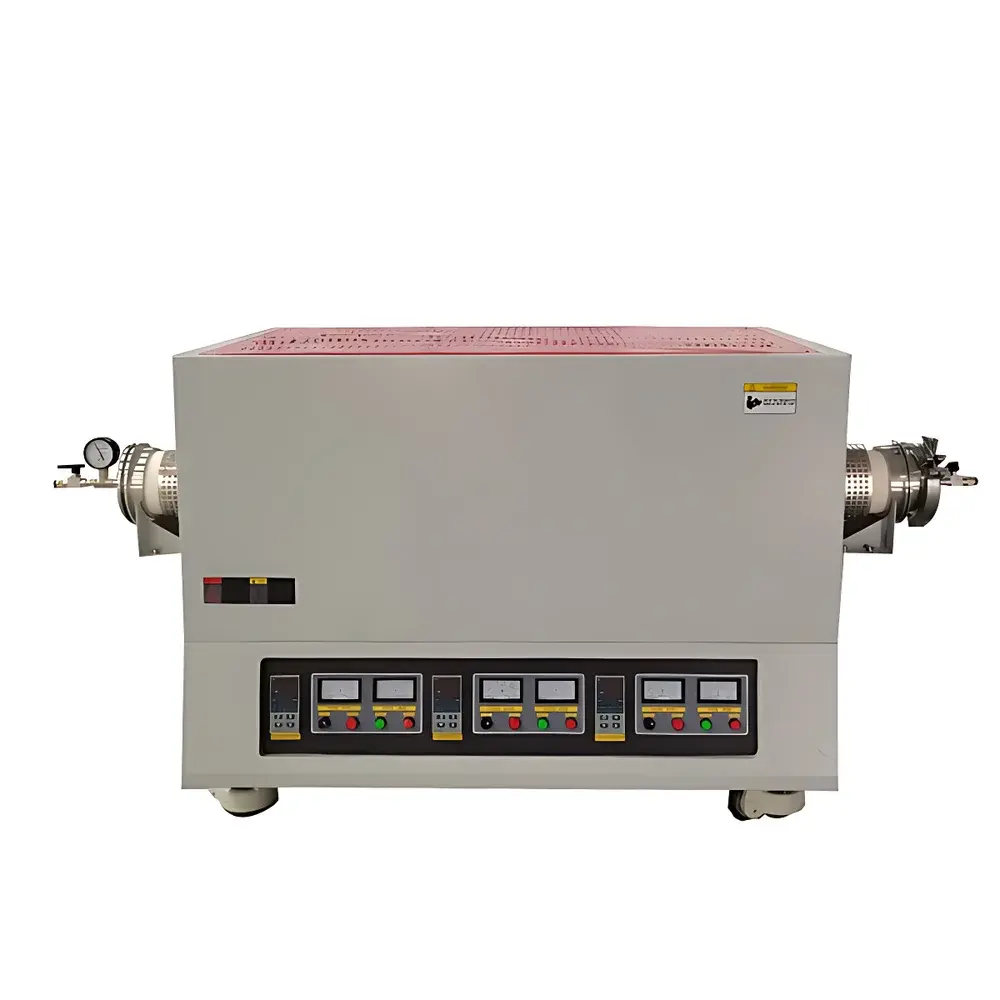
Zhongke Aobo GL0814 Multi-Zone Vacuum & Controlled-Atmosphere Tube Furnace
| Brand | Zhongke Aobo |
|---|---|
| Origin | Beijing, China |
| Model | GL0814 |
| Max Temperature | 1300 °C |
| Control Accuracy | ±1 °C |
| Max Power | 3 kW |
| Heating Rate (to Max Temp) | 50 °C/min |
| Heating Method | Resistance Wire |
| Internal Chamber Dimensions | 300 × 200 × 150 mm |
| Furnace Type | Box-Type Tube Furnace |
| Compliance | CE-marked design principles, compatible with ISO/IEC 17025 laboratory environmental control requirements |
Overview
The Zhongke Aobo GL0814 Multi-Zone Vacuum & Controlled-Atmosphere Tube Furnace is an engineered thermal processing system designed for precise high-temperature experimentation under vacuum or programmable gas atmospheres. Unlike conventional muffle furnaces, this unit integrates a horizontal tube configuration with independently controllable heating zones—enabling axial thermal gradient establishment, uniform temperature distribution across extended sample lengths, and reproducible thermal profiles essential for materials synthesis, annealing, and sintering. Its operational envelope spans up to 1300 °C (rated), supported by S-type thermocouples and dual-layer insulation architecture. The furnace meets the functional expectations of research laboratories requiring traceable thermal history, atmosphere integrity, and repeatable ramp/soak cycles—particularly in applications demanding strict oxygen partial pressure control or inert environment stability during phase transformation studies.
Key Features
- Multi-zone thermal architecture with independent PID-controlled heating segments, supporting axial temperature gradients and extended uniformity zones (≥120 mm at ±1 °C)
- Vacuum-compatible chamber rated to ≤10⁻³ mbar, equipped with KF-25 stainless steel quick-connect flanges and dual silicone/Viton O-ring sealing for leak-tight operation under dynamic pressure differentials
- Optimized thermal insulation using high-purity alumina polycrystalline fiber modules—low thermal mass, thermal shock resistant, and achieving >60% energy efficiency versus traditional refractory brick designs
- Intelligent 30-segment programmable controller with auto-tuning PID, power-up recovery memory, and real-time deviation alarm thresholds
- Dual-shell cooling system with ambient-temperature-sensing fan activation (triggered at surface ≥45 °C), ensuring operator safety and structural longevity
- Modular gas handling interface with precision micro-flow regulators, digital pressure display (0–100 kPa range), and chemically resistant 304 stainless steel manifolds for N₂, Ar, O₂, CO₂, and forming gas (non-toxic/non-flammable only)
Sample Compatibility & Compliance
The GL0814 accommodates cylindrical quartz or high-purity alumina ceramic tubes (standard ID: Φ80 mm, L: 1000 mm), enabling compatibility with powder, pellet, thin-film, and fiber samples up to 200 mm in length. Its internal dimensions (300 × 200 × 150 mm) support custom fixture integration for multi-sample holders or thermocouple feedthroughs. From a regulatory standpoint, the furnace’s control architecture supports audit-ready data logging when paired with optional RS485/Modbus-enabled recorders—facilitating alignment with GLP documentation standards and 21 CFR Part 11-compliant electronic records (when deployed with validated software). It conforms to IEC 61000-6-3 (EMC emissions) and IEC 61000-6-2 (immunity) specifications, and its mechanical design adheres to ISO 12100 principles for machinery safety.
Software & Data Management
While the base unit features a standalone 7-inch TFT touchscreen controller with embedded firmware, optional PC connectivity via RS485 enables integration into centralized lab management systems. Third-party SCADA platforms (e.g., LabVIEW, Ignition) can acquire real-time temperature, pressure, and power consumption data at 1 Hz resolution. All program sequences—including ramp rates, dwell times, and atmosphere switching logic—are exportable as CSV files for traceability. Firmware updates maintain backward compatibility with existing calibration certificates, and event logs (including over-temperature alarms, door interlock status, and power interruptions) are timestamped and stored onboard for ≥30 days. For regulated environments, optional validation packages include IQ/OQ documentation templates aligned with ASTM E2877-22 (Standard Guide for Thermal Validation of Laboratory Ovens and Furnaces).
Applications
This furnace serves as a core platform in advanced materials development workflows: vacuum annealing of transition metal dichalcogenides (TMDs); controlled-atmosphere carburization of cemented carbides; solid-state synthesis of perovskite oxides under low-oxygen conditions; thermal reduction of metal oxide precursors for battery cathode materials; and graphitization of carbon nanofibers under argon flow. Its multi-zone capability supports zone-melting experiments, directional solidification trials, and differential thermal analysis (DTA)-coupled heating protocols. Academic users leverage its programmability for kinetic studies requiring precise thermal histories (e.g., Avrami exponent determination), while industrial QC labs apply it for ASTM C1171-20-compliant refractory densification testing.
FAQ
What vacuum level can the GL0814 achieve with standard pumping configuration?
With a single-stage rotary vane pump, the system typically reaches 1×10⁻² mbar; integration with a turbomolecular pump enables operation down to 1×10⁻⁵ mbar.
Is the furnace compatible with hydrogen-containing atmospheres?
No—hydrogen and other flammable gases (e.g., CH₄, H₂S) are strictly prohibited due to explosion risk and material compatibility limitations of standard seals and heating elements.
Can the heating zones be operated independently for gradient thermal processing?
Yes—each zone has discrete thermocouple feedback and power modulation, allowing simultaneous ramping at different rates or holding at distinct setpoints within the same run.
What maintenance intervals are recommended for the heating elements and insulation?
Under normal use (≤1200 °C, <5 cycles/week), resistance wire elements require inspection every 500 operating hours; polycrystalline fiber insulation retains structural integrity beyond 2000 h at rated temperature.
Does the unit support third-party calibration certification?
Yes—NIST-traceable calibration services are available through authorized partners, including as-found/as-left reports and uncertainty budgets per ISO/IEC 17025 requirements.



