
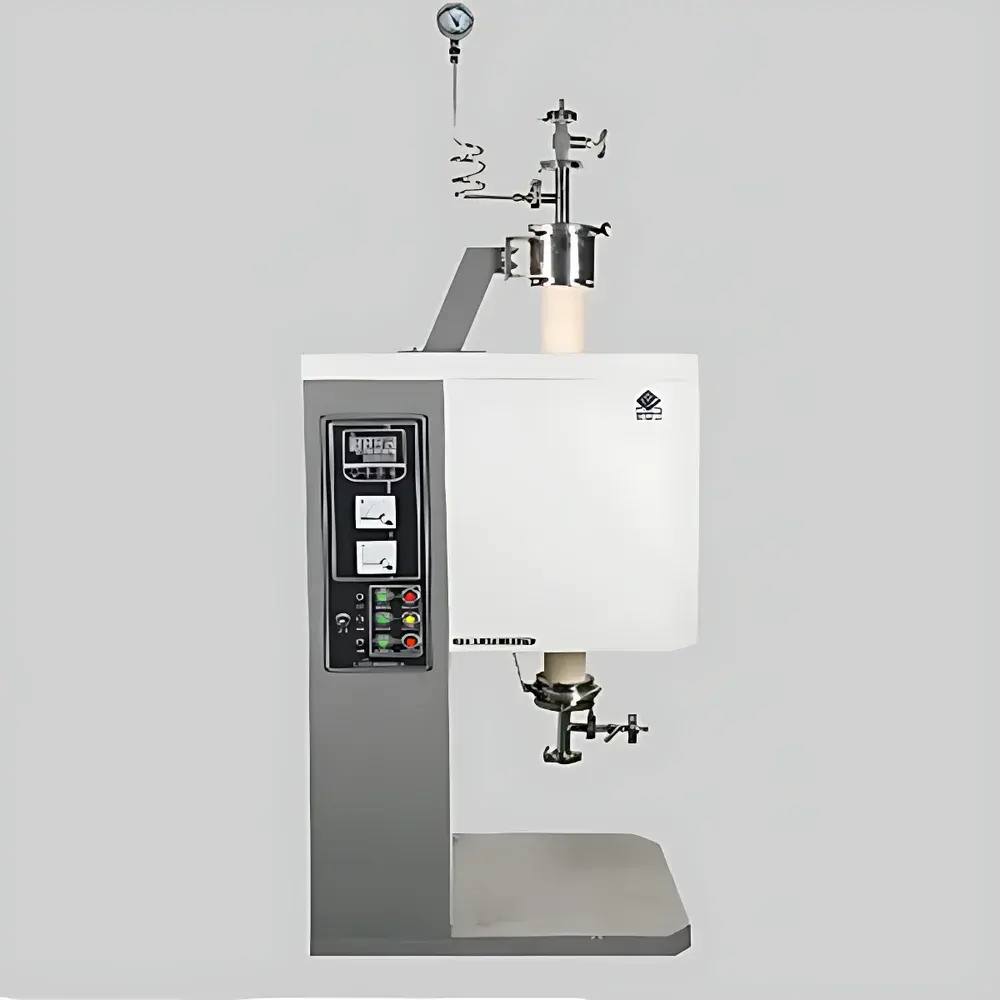
ZHONGHUAN FURNACE VT-1200V Vertical Single-Zone Tube Furnace
| Brand | ZHONGHUAN FURNACE |
|---|---|
| Origin | Tianjin, China |
| Model | VT-1200V |
| Max Temperature | 1200 °C |
| Temperature Control Accuracy | ±1 °C |
| Max Power | 3 kW |
| Heating Rate | ≤5 °C/min (≤500 °C), ≤10 °C/min (500–800 °C), ≤5 °C/min (800–1000 °C), ≤3 °C/min (1000–1200 °C) |
| Heating Element | OCr27Al7Mo2 high-resistance alloy wire |
| Internal Chamber Dimensions | 590 × 420 × 1130 mm (L × W × H) |
| Sealing | Dual-ring flange with adjustable gas inlet/outlet |
| Safety Features | Automatic power cutoff upon door opening, overtemperature cut-off with audible alarm, earth leakage protection |
| Control System | AI-based PID controller with self-tuning, programmable up to 50 segments (domestic version), RS-485 interface for PC connectivity and multi-furnace supervision |
Overview
The ZHONGHUAN FURNACE VT-1200V is a vertically oriented, single-zone tube furnace engineered for precise thermal processing of materials under controlled atmospheres—ranging from inert and reducing gases to vacuum environments. Its design centers on the Couette-type axial heating geometry inherent to vertical tube furnaces, where uniform radial heat distribution and minimized thermal gradient along the sample axis are achieved through optimized placement of OCr27Al7Mo2 resistance heating elements embedded within a high-efficiency multi-crystalline mullite fiber insulation chamber. Unlike horizontal configurations, the vertical orientation enables gravity-assisted sample loading/unloading and facilitates real-time visual monitoring of reactions without compromising seal integrity or thermal stability. The furnace operates at a maximum continuous temperature of 1200 °C with ±1 °C steady-state control accuracy—meeting ASTM E220 calibration traceability requirements for laboratory-grade thermal processing equipment.
Key Features
- Vertical hinge-mounted furnace body with 110° right-side swing-open mechanism for unobstructed access to the reaction zone and direct line-of-sight observation of samples during operation.
- Dual-ring flange sealing system ensuring leak rates <1×10⁻³ mbar·L/s under vacuum and maintaining pressure differentials up to 0.1 MPa in pressurized gas environments.
- Modular gas manifold with micro-adjustable needle valves for independent inlet/outlet flow regulation; compatible with mass flow controllers (MFCs) and vacuum pumps via standardized KF-25/CF-35 ports.
- Active surface-cooling architecture: integrated thermal sensor triggers automatic centrifugal fan activation when external casing temperature exceeds 50 °C, limiting operator contact surface temperature to <60 °C per IEC 61000-3-2 safety thresholds.
- Intelligent temperature management: AI-enhanced PID algorithm with auto-tuning, ramp-soak programming (up to 50 segments), and real-time deviation compensation based on thermocouple feedback from multiple internal zones.
- Electrical safety compliance: built-in residual-current device (RCD), door-interlocked main contactor, and independent overtemperature cut-off circuit meeting EN 61000-6-2 and UL 61010-1 Class I requirements.
Sample Compatibility & Compliance
The VT-1200V accommodates quartz, alumina, and silicon carbide tubes with outer diameters up to 120 mm and lengths up to 1000 mm. Its internal cavity (590 × 420 × 1130 mm) permits upright positioning of crucibles, boat fixtures, or custom reactor inserts. The furnace supports GLP/GMP-aligned workflows through optional RS-485-enabled data logging—capturing timestamped temperature, power draw, and alarm events with audit-trail capability compliant with FDA 21 CFR Part 11 when paired with validated software. All structural ceramics meet ISO 13384-1 thermal shock resistance classification, while the furnace housing conforms to IP20 ingress protection standards for indoor laboratory use.
Software & Data Management
Equipped with an RS-485 serial interface (Modbus RTU protocol), the VT-1200V integrates seamlessly into centralized lab automation networks. Optional ZHONGHUAN LabControl Suite enables remote supervision of up to 200 units simultaneously, supporting scheduled start/stop, live parameter visualization, historical trend analysis, and PDF/CSV report generation. Data export includes full thermal profiles with metadata (operator ID, batch number, ambient conditions), satisfying ISO/IEC 17025 clause 7.5.2 record retention mandates. Firmware updates are performed via secure USB interface with cryptographic signature verification to prevent unauthorized modification.
Applications
- Thermal annealing of thin-film photovoltaic stacks (CIGS, perovskite precursors) under nitrogen or forming gas.
- Controlled oxidation/reduction of transition metal oxides for battery cathode material synthesis (e.g., LiCoO₂, NMC).
- Graphitization and heteroatom doping of carbon nanomaterials using CH₄/NH₃/H₂ carrier gas mixtures.
- Pre-sintering of ceramic green bodies prior to hot isostatic pressing (HIP), minimizing binder burnout defects.
- In situ XRD-compatible heating stage integration (with optional water-cooled flanges and beryllium windows).
- Calibration reference source for thermocouple verification per ASTM E230/E220 protocols.
FAQ
What tube materials are compatible with the VT-1200V at maximum operating temperature?
Quartz tubes (up to 1100 °C continuous), high-purity alumina (Al₂O₃, up to 1600 °C), and silicon carbide (SiC, up to 1400 °C) are supported—selection depends on required atmosphere compatibility and thermal expansion matching.
Can the furnace be operated under high vacuum conditions?
Yes—when coupled with a turbomolecular pump and appropriate CF flanges, the dual-ring seal achieves base pressures below 1×10⁻⁵ mbar; optional cold traps mitigate hydrocarbon backstreaming during extended holds.
Is the temperature controller compliant with regulatory data integrity standards?
The RS-485 interface supports electronic signatures, user-level access control, and immutable event logs—fully configurable to meet 21 CFR Part 11 Annex 11 and EU GMP Annex 11 requirements when deployed with validated third-party SCADA platforms.
How is thermal uniformity verified across the working zone?
Uniformity is characterized per ASTM E220 using a 5-point thermocouple mapping procedure at 800 °C and 1200 °C; typical radial deviation is ±3 °C over a 100 mm length, axial gradient <±5 °C/m.
Does the furnace support automated gas switching during a temperature program?
Yes—via optional MFC integration and LabControl Suite scripting, gas composition can be dynamically altered at predefined temperature thresholds or time intervals, enabling multi-step reactive sintering protocols.



