
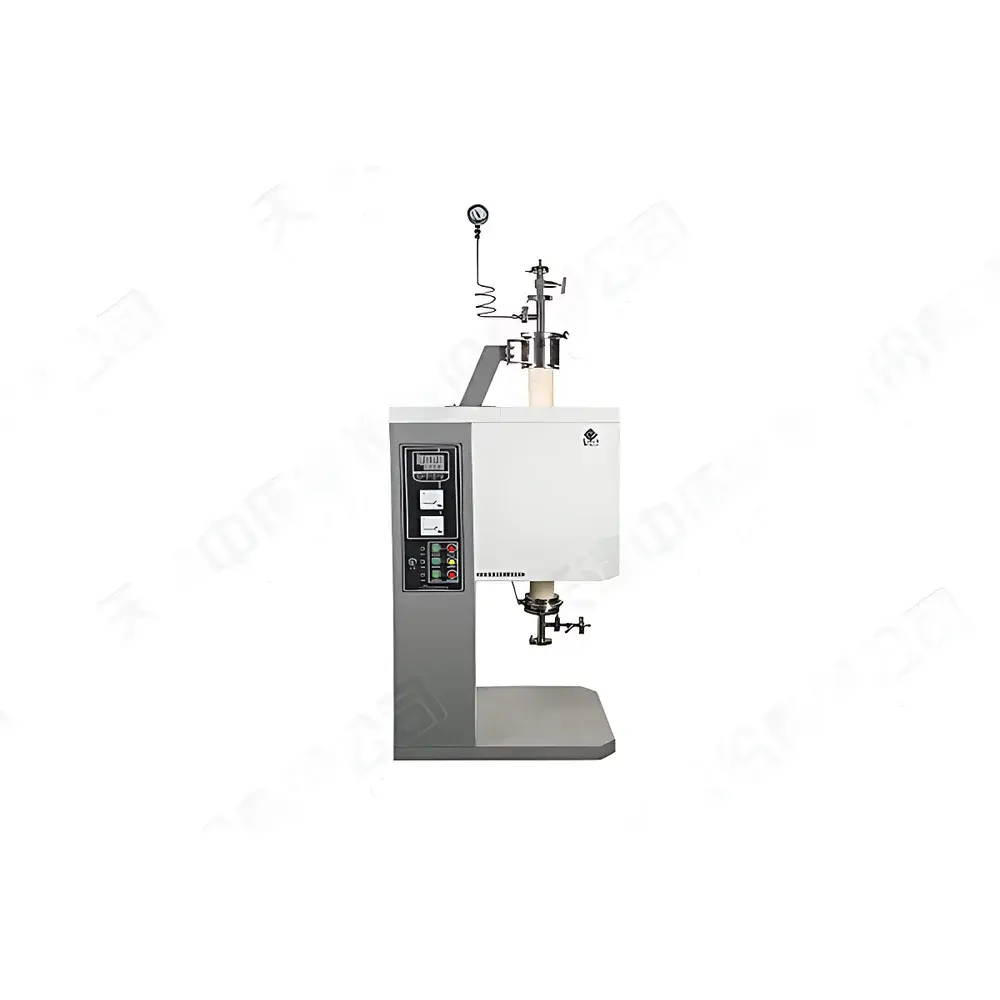
ZHONGHUAN FURNACE VT-1600V Vertical Single-Zone Tube Furnace
| Brand | ZHONGHUAN FURNACE |
|---|---|
| Origin | Tianjin, China |
| Model | VT-1600V |
| Max Temperature | 1600 °C |
| Temperature Control Accuracy | ±1 °C |
| Max Power | 7 kW |
| Heating Rate | ≤5 °C/min (≤500 °C), ≤10 °C/min (500–800 °C), ≤5 °C/min (800–1000 °C), ≤2 °C/min (1000–1400 °C), ≤2 °C/min (1400–1600 °C) |
| Heating Element | Silicon Molybdenum (MoSi₂) Rods |
| Chamber Dimensions (L×W×H) | 600 × 660 × 1260 mm |
| Configuration | Vertical Single-Zone Tube Furnace |
Overview
The ZHONGHUAN FURNACE VT-1600V is a vertically oriented, single-zone tube furnace engineered for high-temperature thermal processing under controlled atmosphere or vacuum conditions. It operates on the principle of resistive heating via high-purity silicon molybdenum (MoSi₂) rods, capable of sustained operation up to 1600 °C in oxidizing or inert environments. Its vertical configuration optimizes space utilization and facilitates gravity-assisted sample loading/unloading—particularly advantageous for long cylindrical substrates, fiber precursors, or powder-packed quartz tubes. Designed for laboratory-scale materials synthesis, annealing, sintering, and heat treatment, the VT-1600V delivers stable thermal profiles with minimal axial and radial temperature gradients, enabled by multi-crystalline mullite fiber insulation and precision-engineered thermal shielding.
Key Features
- Vertical single-zone architecture with 600 mm effective tube length and 1260 mm total chamber height—optimized for uniform heat distribution and simplified sample handling.
- High-efficiency multi-crystalline mullite fiber furnace lining, offering >50% energy savings versus traditional refractory brick designs and superior thermal retention.
- Dual-ring sealing flange system ensures leak-tight integrity at both ends of the quartz or alumina tube; compatible with standard O-ring seals and vacuum-rated gasket materials.
- Intelligent air-cooling interlock: integrated surface temperature sensor triggers automatic exhaust fan activation when external casing exceeds 50 °C, maintaining operator safety and structural longevity.
- Comprehensive safety suite including independent over-temperature cutoff (hardware-based thermocouple monitoring), earth-leakage circuit interruption (ELCI), and real-time fault diagnostics.
- Modular gas manifold interface with micro-adjustable inlet/outlet valves—enabling precise control of purge, reactive, or protective atmospheres (e.g., Ar, N₂, H₂, forming gas).
Sample Compatibility & Compliance
The VT-1600V accommodates standard OD 60–100 mm quartz, alumina, or silicon carbide tubes (custom lengths up to 1200 mm). Its internal dimensions (600 × 660 × 1260 mm) support upright positioning of rod-shaped catalysts, carbon fiber spools, semiconductor wafers on carriers, or stacked ceramic green bodies. The furnace meets fundamental electrical safety requirements per IEC 61010-1 and complies with CE marking directives for laboratory equipment. While not certified to UL/CSA standards out-of-box, its control architecture supports integration into GLP/GMP workflows through optional audit-trail-enabled software packages compliant with FDA 21 CFR Part 11 data integrity guidelines.
Software & Data Management
Equipped with RS-485 serial interface (standard), the VT-1600V enables bidirectional communication with host PCs running Windows/Linux-based furnace management software. The built-in PID controller supports auto-tuning, fuzzy logic compensation, and programmable ramp-soak cycles—up to 50 segments with user-defined rate limits, dwell times, and event-triggered outputs (e.g., gas valve actuation, vacuum pump start). Remote monitoring of up to 200 units is achievable via TCP/IP gateway modules. All temperature logs, alarm histories, and program executions are timestamped and exportable as CSV or PDF reports—facilitating traceability in R&D documentation and ISO 9001-compliant quality records.
Applications
- Thermal synthesis of advanced ceramics (e.g., SiC, AlN, BaTiO₃) under nitrogen or argon flow.
- Graphitization and oxidation resistance testing of carbon nanotubes and graphene oxide precursors.
- Controlled-atmosphere annealing of thin-film photovoltaic absorbers (CIGS, CZTS) and perovskite layers.
- Pre-sintering and debinding of metal injection molded (MIM) components in low-oxygen environments.
- High-temperature calibration of thermocouples and reference materials per ASTM E230/E1137 protocols.
- Research-grade pyrolysis and catalytic cracking studies requiring precise thermal history control.
FAQ
What tube materials are compatible with the VT-1600V at maximum temperature?
Quartz tubes are rated up to 1100 °C in air; for full 1600 °C operation, high-purity alumina (99.8% Al₂O₃) or silicon carbide (SiC) tubes must be used.
Can the furnace be operated under high vacuum (<10⁻³ mbar)?
Yes—when paired with a diffusion pump or turbomolecular pumping station and vacuum-rated flanges, the dual-ring seal design maintains integrity down to 10⁻⁴ mbar.
Is third-party calibration documentation available?
Factory-calibrated Type S thermocouples are supplied; NIST-traceable calibration certificates can be ordered separately for ISO/IEC 17025 compliance.
Does the controller support hold-and-soak profiles with dynamic gas flow modulation?
Yes—the programmable controller outputs TTL signals synchronized with soak periods to trigger external mass flow controllers (MFCs) or solenoid valves.
What maintenance intervals are recommended for MoSi₂ heating elements?
Under continuous use at ≤1500 °C in clean air, service life exceeds 2,000 hours; periodic visual inspection for sagging or surface oxidation is advised every 500 operating hours.



