
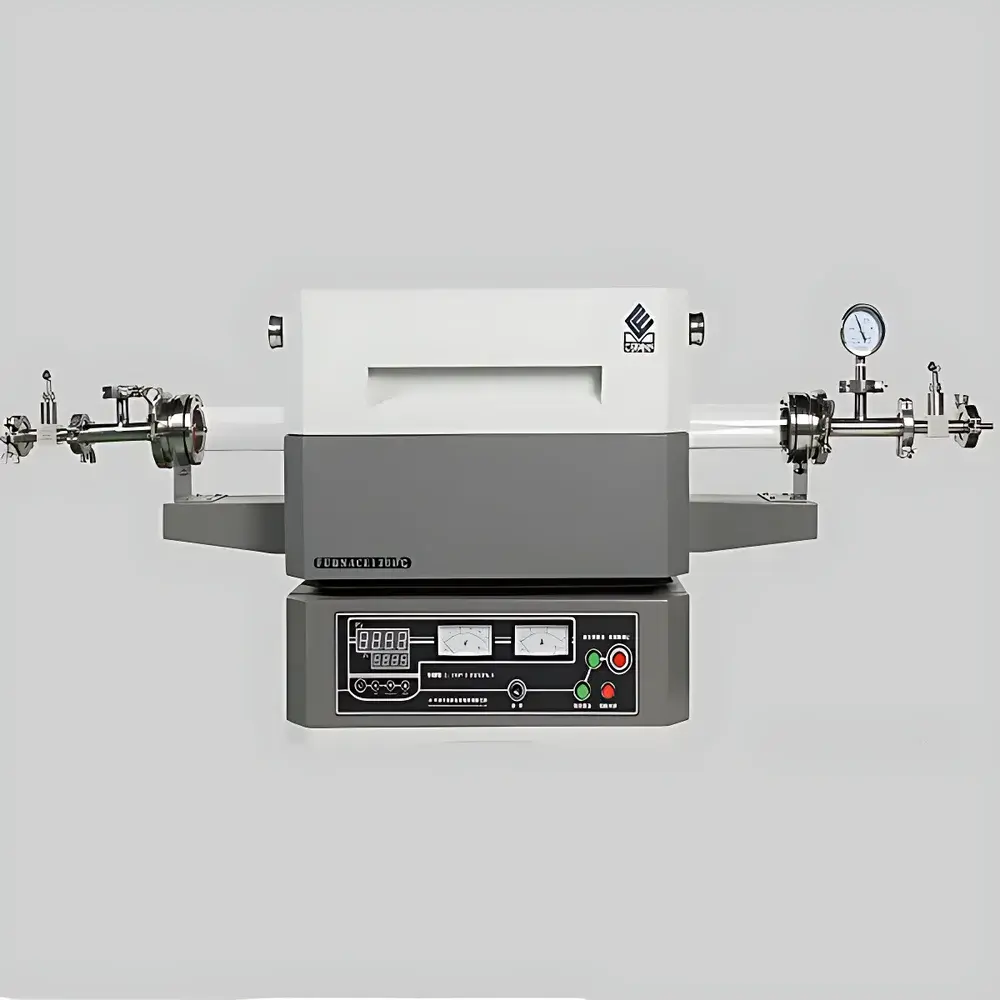
ZHONGHUAN FURNACE 1200℃ Multi-Zone Vacuum & Atmosphere Tube Furnace
| Brand | ZHONGHUAN FURNACE |
|---|---|
| Origin | Tianjin, China |
| Model | 1200℃ Multi-Zone Vacuum & Atmosphere Tube Furnace |
| Max Temperature | 1200℃ |
| Temperature Control Accuracy | ±1℃ |
| Max Power | 6 kW |
| Heating Rate | ≤5℃/min (≤500℃), ≤10℃/min (500–800℃), ≤5℃/min (800–1000℃), ≤2℃/min (1000–1200℃) |
| Heating Element | OCr27Al7Mo2 High-Resistance Alloy Wire |
| Internal Chamber Dimensions | 360 × 1035 × 555 mm |
| Heating Zone Configuration | Dual-zone (top/bottom split design with 110° rearward tilt) |
Overview
The ZHONGHUAN FURNACE 1200℃ Multi-Zone Vacuum & Atmosphere Tube Furnace is an engineered thermal processing system designed for controlled high-temperature synthesis, annealing, sintering, and heat treatment under precisely regulated vacuum or reactive/inert atmospheres. It operates on resistive heating principles using OCr27Al7Mo2 alloy wire elements embedded in a dual-zone, vertically split furnace chamber—enabling independent thermal profiling across axial segments and facilitating rapid sample access without compromising thermal stability. The furnace integrates vacuum compatibility (down to 10⁻³ Pa with optional pumping systems) and programmable gas atmosphere control (N₂, Ar, H₂, forming gas, or custom mixtures), making it suitable for materials research, ceramic processing, catalyst development, and thin-film precursor decomposition where thermal homogeneity, process repeatability, and environmental fidelity are critical.
Key Features
- Dual-zone modular furnace structure: Upper chamber tilts 110° rearward for unobstructed sample loading/unloading and real-time visual monitoring—eliminating the need for full disassembly and minimizing mechanical stress on quartz or alumina tubes.
- High-efficiency insulation: Vacuum-formed polycrystalline mullite fiber lining reduces thermal mass by >40% versus traditional refractory brick, achieving 50% energy savings while maintaining radial temperature uniformity of ±3℃ across the hot zone at 1200℃.
- Robust sealing architecture: Twin-ring flange sealing system ensures leak rates <5×10⁻⁵ mbar·L/s under vacuum and maintains pressure integrity up to 0.2 MPa gauge in pressurized inert gas environments.
- Intelligent safety interlock suite: Automatic power cutoff upon chamber opening, dual-stage overtemperature protection (hardware limit + software alarm), and grounded leakage current detection compliant with IEC 61000-6-3 EMC standards.
- Active surface cooling: Integrated thermal-sensing fan activation triggers when external casing temperature exceeds 50℃—preventing operator contact burns and extending front-panel electronics service life.
- Modular gas/vacuum integration: Standard 1/4″ VCR-compatible ports support direct coupling to mass flow controllers (MFCs), digital vacuum gauges, and turbomolecular pumps via ISO-KF or CF flanges.
Sample Compatibility & Compliance
The furnace accommodates cylindrical samples up to Ø80 mm × 1000 mm within its 1035 mm long heated zone. Compatible tube materials include fused quartz (up to 1100℃), high-purity alumina (up to 1600℃), and silicon carbide (for specialized high-conductivity applications). All electrical components meet CE marking requirements for low-voltage directive (2014/35/EU) and electromagnetic compatibility (2014/30/EU). Optional configurations support GLP-compliant operation: audit-trail-enabled temperature logging (via RS485 + optional software), 21 CFR Part 11–ready electronic signatures, and traceable calibration certificates aligned with ISO/IEC 17025-accredited reference standards.
Software & Data Management
Standard RS485 interface enables bidirectional communication with PC-based control platforms. The optional ZH-FurnaceControl Suite (Windows/Linux compatible) supports simultaneous monitoring and scripting for up to 200 furnaces—providing real-time PID parameter visualization, multi-curve overlay, automated report generation (PDF/CSV), and event-triggered data capture (e.g., ramp completion, alarm activation). Firmware supports 50-segment programmable profiles with dwell time, rate, and soak logic; optional imported controller modules offer enhanced noise immunity and sub-second loop update intervals. All data logs include timestamp, setpoint, actual PV, and status flags—exportable for LIMS integration or regulatory submission.
Applications
- Controlled-atmosphere sintering of oxide ceramics (e.g., BaTiO₃, YSZ) and metal-organic frameworks (MOFs).
- Vacuum annealing of semiconductor wafers and graphene precursors to minimize oxygen contamination.
- Thermal decomposition studies of battery cathode materials (LiCoO₂, NMC) under argon/helium purge.
- Catalyst reduction/activation protocols requiring precise H₂/N₂ ratio control and ramped temperature profiles.
- Preparation of phosphor powders via solid-state reaction under nitrogen with graded heating to suppress volatilization.
- Calibration and validation of thermocouples (Type S, R, B) and infrared pyrometers across extended temperature ranges.
FAQ
What vacuum level can this furnace achieve with standard configuration?
The base system includes a mechanical pump interface and achieves ≤10⁻² Pa. With optional turbomolecular pump integration and all-metal seals, ultimate vacuum reaches 10⁻⁴–10⁻⁵ Pa.
Is the furnace compatible with hydrogen atmospheres?
Yes—when equipped with H₂-rated MFCs, explosion-proof wiring, and leak-tested stainless-steel gas lines, it supports up to 100% H₂ at pressures up to 0.1 MPa (gauge), compliant with EN 15634-1 for hydrogen handling safety.
Can I upgrade from the standard controller to the imported 40-segment unit after purchase?
Yes—the RS485 protocol is hardware-agnostic; controller replacement requires only firmware reconfiguration and calibration verification.
Does the tilt mechanism affect temperature uniformity during operation?
No—the upper chamber locking system ensures mechanical rigidity and thermal continuity; temperature mapping per ASTM E220 confirms uniformity remains within specification during both static and tilted (maintenance) states.
What maintenance intervals are recommended for the heating elements and insulation?
OCr27Al7Mo2 elements require no scheduled replacement below 1100℃ continuous operation; annual visual inspection of fiber integrity and recalibration of thermocouple offsets are advised per ISO/IEC 17025 quality protocols.



