
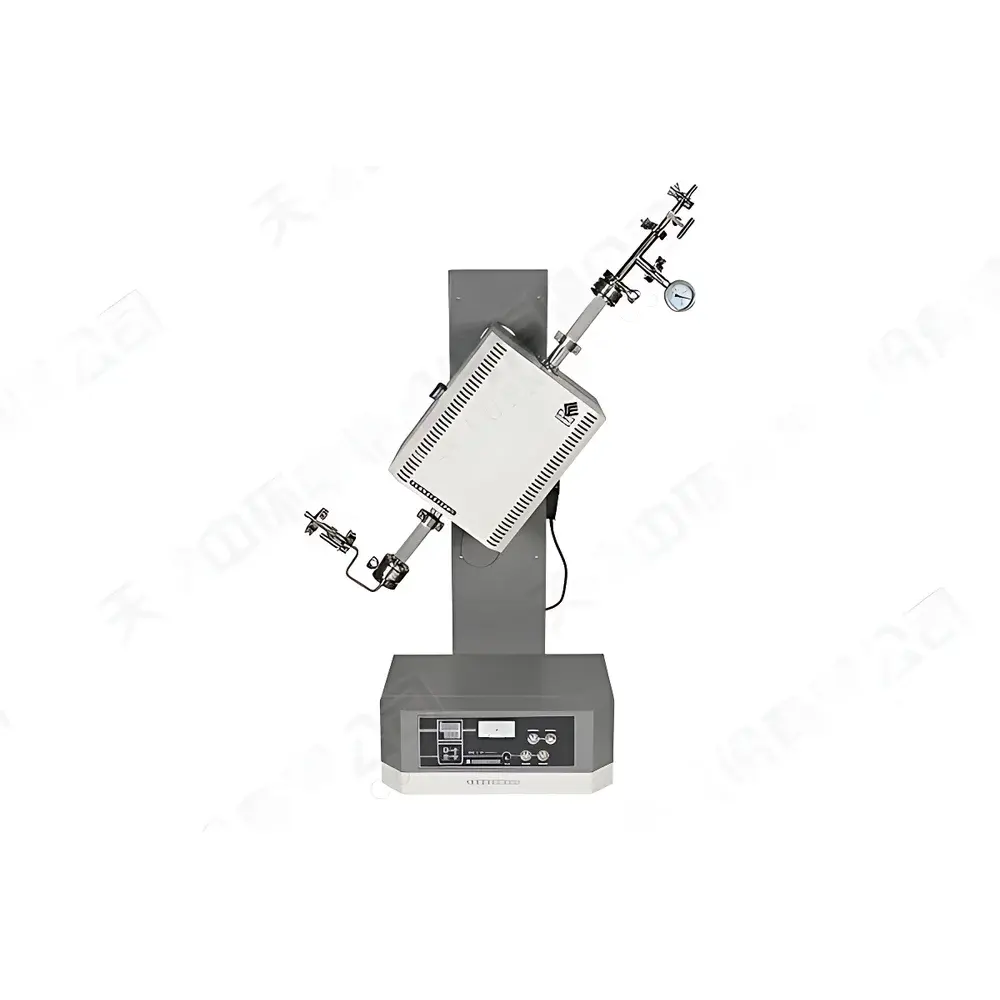
ZHONGHUAN FURNACE SK-G03123K-D / SK-G04123K-D Multi-Position Vacuum & Atmosphere-Controlled Tube Furnace
| Brand | ZHONGHUAN FURNACE |
|---|---|
| Origin | Tianjin, China |
| Model | SK-G03123K-D / SK-G04123K-D |
| Max Temperature | 1200 °C |
| Control Accuracy | ±1 °C |
| Max Power | 1.2 kW |
| Heating Rate | ≤5 °C/min (≤500 °C), ≤10 °C/min (500–800 °C), ≤5 °C/min (800–1000 °C), ≤2 °C/min (1000–1200 °C) |
| Heating Element | OCr27Al7Mo2 High-Resistance Alloy Wire |
| Chamber Dimensions | 310 × 310 × 310 mm (L×W×H) |
| Tube Options | Φ30/24×700 mm or Φ40/34×700 mm Quartz |
| Vacuum Compatibility | Low-to-Medium Vacuum (via optional vacuum system) |
| Atmosphere Control | Dual-gas inlet with micro-adjustable mass flow capability |
| Weight | 75 kg |
| Voltage | 220 V AC |
Overview
The ZHONGHUAN FURNACE SK-G03123K-D and SK-G04123K-D are precision-engineered multi-position vacuum and atmosphere-controlled tube furnaces designed for reproducible high-temperature thermal processing in research laboratories and materials development facilities. Operating up to 1200 °C, these furnaces integrate a horizontal tube configuration with configurable angular positioning (0°, 45°, or 90°), enabling flexible sample loading and experimental alignment—particularly valuable for directional annealing, crystal growth, thin-film deposition, and gas-phase reaction studies. The furnace employs resistive heating via OCr27Al7Mo2 alloy wire wound on a high-purity multi-crystalline mullite fiber insulation matrix, ensuring uniform radial and axial temperature distribution across the 100 mm effective isothermal zone. A dual-ring sealing flange system maintains leak-tight integrity under vacuum or controlled gas environments (e.g., N₂, Ar, H₂, forming gas), while integrated thermal safety logic—including automatic power cutoff upon door opening, independent overtemperature protection, and earth-leakage detection—ensures compliance with IEC 61000-6-2 and UL 61010-1 requirements for laboratory equipment.
Key Features
- Multi-angle positioning capability: Horizontal, 45° tilt, or vertical orientation supported via motor-assisted linear translation (290 mm travel range), facilitating ergonomic sample handling and process optimization.
- Quick-connect vacuum/gas flange interface: Single-knurled clamp design eliminates traditional bolted法兰 assembly, reducing installation time by >70% and minimizing mechanical stress on quartz tubes (Φ30/24×700 mm or Φ40/34×700 mm standard).
- Modular furnace chamber: Upper and lower insulation segments allow full rearward tilting (110°) of the top section for unobstructed access and real-time visual monitoring of samples during operation.
- Intelligent thermal management: Surface temperature sensing triggers an auto-start cooling fan when external casing exceeds 50 °C, maintaining safe operator interaction and extending component service life.
- Detachable PID controller: Front-panel controller can be removed to increase vertical clearance—critical for long substrates or custom fixtures requiring axial extension beyond standard tube length.
- Dual-programmable temperature control: Standard Chinese-made controller supports 50-segment ramp-hold profiles; optional imported controller offers 40-segment capability with enhanced noise immunity and RS-485 communication protocol.
Sample Compatibility & Compliance
These furnaces accommodate standard quartz glass tubes rated for continuous use up to 1150 °C, with short-term excursions to 1200 °C permitted under inert or reducing atmospheres. The 310 × 310 × 310 mm internal cavity accommodates multi-sample trays, crucibles (Al₂O₃, SiC, graphite), or custom jigs for parallel processing. Vacuum compatibility extends from rough vacuum (10⁻¹ mbar) to medium vacuum (10⁻³ mbar) when paired with optional two-stage rotary vane pumps and digital vacuum gauges. For atmosphere-controlled applications, dual independent gas inlets support simultaneous introduction of reactive and purge gases—with optional integration of calibrated mass flow controllers (MFCs) meeting ISO 6326-1 traceability standards. All electrical and thermal subsystems conform to GLP-relevant documentation practices, including audit-ready calibration logs and firmware version traceability.
Software & Data Management
Equipped with RS-485 serial interface as standard, the furnace integrates seamlessly into centralized lab infrastructure via Modbus RTU protocol. Optional PC software enables remote supervision of up to 200 units simultaneously, providing synchronized data logging at user-defined intervals (1–60 s resolution), real-time temperature curve overlay, historical trend comparison, and automated report generation (CSV/PDF). Data integrity is maintained through timestamped records with embedded checksums, satisfying FDA 21 CFR Part 11 requirements for electronic records when deployed with validated user authentication and audit trail modules. Software-generated reports include thermal profile deviation analysis, hold-time accuracy verification, and alarm event chronology—supporting ISO/IEC 17025 method validation workflows.
Applications
- Thermal annealing of semiconductor wafers and 2D materials (graphene, TMDs) under controlled N₂/H₂ mixtures.
- Sintering and densification of ceramic powders (BaTiO₃, YSZ) with precise dwell-time control at peak temperature.
- Carbonization and graphitization of polymer-derived ceramics under argon sweep.
- In-situ reduction of metal oxide precursors (e.g., NiO → Ni, Co₃O₄ → Co) for catalyst synthesis.
- Thermogravimetric pre-treatment prior to XRD or SEM analysis—enabling direct transfer without ambient exposure.
- Calibration of thermocouples (Type S, R, B) and reference materials per ASTM E220 and ISO 17025 guidelines.
FAQ
What vacuum level can this furnace achieve?
With an optional two-stage rotary vane pump and cold trap, the system achieves stable base pressures of 1×10⁻³ mbar. For high-vacuum applications (<10⁻⁵ mbar), a turbomolecular pump upgrade is required.
Can I use stainless steel or alumina tubes instead of quartz?
Yes—custom tube adapters are available for OD-compatible alumina or Inconel 600 tubes; however, maximum operating temperature must be derated per material specifications (e.g., 1600 °C for alumina, but limited by furnace rating and seal compatibility).
Is the temperature uniformity verified and documented?
Each unit undergoes factory mapping using 9-point thermocouple array validation across the 100 mm hot zone, with uniformity certified to ±2 °C at 1200 °C—report included with shipment.
Does the system support automated gas switching during a temperature program?
Yes—when equipped with optional solenoid valve manifold and MFCs, gas composition can be scheduled synchronously with temperature ramps via the PC software interface.
What maintenance is required for long-term reliability?
Annual inspection of heating element continuity, flange gasket integrity, and vacuum seal lubrication is recommended. Multi-crystalline fiber insulation requires no routine replacement under normal cycling conditions (≤500 cycles/year).
Related Products



