
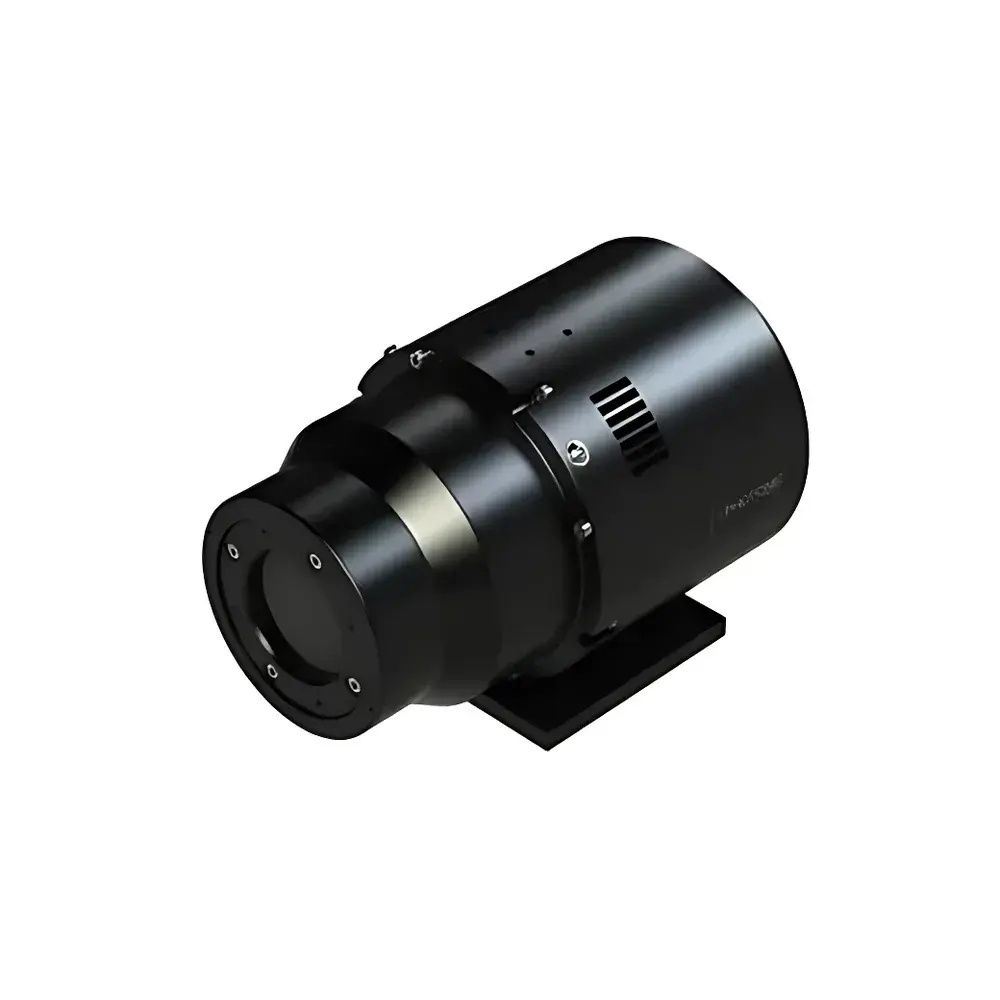
FDS Series Ultra-High-Resolution X-ray CCD Camera
| Origin | United Kingdom |
|---|---|
| Distribution Model | Authorized Distributor |
| Import Status | Imported |
| Model | FDS Series |
| Effective Pixel Count | Up to 24 MP (multi-module configuration) |
| Pixel Size | 4.54–22.57 µm |
| Active Area | 8.7 mm × 6.7 mm to 100 mm × 80 mm (multi-module) |
| X-ray Energy Range | 1–300 keV (Gd₂O₂S:Tb for 1–55 keV |
| CsI | Tl for 20–300 keV) |
| Readout Noise | 3–7 e⁻ (with noise reduction mode) |
| Full Well Capacity | 22,000–352,000 e⁻ |
| Dynamic Range | 14-bit standard / 18-bit extended |
| Frame Rate | >10 fps (region-of-interest or line-scan mode) |
| Exposure Time | 5 µs to 35 min |
| Operating Sensor Temperature | –20 °C |
| Quantum Efficiency Peak | 62–77% |
| Shutter Type | Integrated mechanical shutter + shutterless acquisition capability |
Overview
The FDS Series Ultra-High-Resolution X-ray CCD Camera is a scientific-grade imaging detector engineered for demanding synchrotron, laboratory X-ray diffraction (XRD), X-ray fluorescence (XRF), computed tomography (CT), and radiographic applications. Based on front-illuminated, deep-depletion CCD architecture with thermoelectric cooling to –20 °C, the system delivers high quantum efficiency across a broad X-ray energy spectrum—from soft X-rays (1 keV) to hard X-rays (300 keV)—via interchangeable scintillator options (Gd₂O₂S:Tb for low-to-medium energy; CsI:Tl for medium-to-high energy). Its modular design supports scalable active areas—from single-chip configurations (e.g., 8.77 mm × 6.71 mm) up to large-area tiled arrays (up to 200 mm × 40 mm or 100 mm × 80 mm), enabling flexible integration into custom beamline endstations or industrial inspection systems. The camera operates with true 100% duty-cycle acquisition, eliminating dead time between frames—a critical requirement for time-resolved studies and pump-probe experiments.
Key Features
- Modular architecture supporting single- and multi-chip configurations, with total resolution up to 24 megapixels via precise optical and electronic tiling.
- Two native ADC modes: 14-bit standard readout for high-speed acquisition and 18-bit extended dynamic range mode for quantitative intensity linearity over >4 orders of magnitude.
- Integrated mechanical shutter ensuring zero light leakage during exposure; also supports shutterless acquisition with microsecond-level timing precision (down to 5 µs).
- Region-of-interest (ROI) and line-scan readout modes enabling sustained frame rates exceeding 10 fps—ideal for real-time process monitoring or dynamic structural analysis.
- Low-noise electronics with selectable noise-reduction algorithms: typical readout noise of 3–4 e⁻ (in optimized mode), dark current as low as 0.0018 e⁻/pixel/s at –20 °C.
- Full software-controllable servo interface compatible with common lab automation frameworks (e.g., EPICS, LabVIEW, Python-based control stacks) for remote data acquisition and synchronization.
Sample Compatibility & Compliance
The FDS Series is designed for non-destructive, high-fidelity X-ray imaging of diverse samples—including polycrystalline metals, biological tissues, composite materials, and geological specimens—without requiring vacuum compatibility (standard operation in air or He purge environments). Scintillator selection is application-driven: Gd₂O₂S:Tb provides optimal contrast for low-energy X-ray imaging (e.g., mammography, soft-material tomography), while CsI:Tl ensures efficient conversion of high-energy photons (e.g., industrial NDT, synchrotron white-beam imaging). All models comply with CE marking requirements and meet electromagnetic compatibility (EMC) standards per EN 61326-1. Firmware and driver stacks support audit-ready metadata logging—including exposure time, temperature, gain settings, and timestamped trigger events—facilitating GLP/GMP-aligned workflows and FDA 21 CFR Part 11–compliant data integrity where integrated with validated acquisition software.
Software & Data Management
The FDS Series ships with a cross-platform SDK (C/C++, Python, MATLAB bindings) and a native GUI application supporting live preview, histogram-based exposure optimization, flat-field correction, and real-time binning. Raw image data is output in standard TIFF or HDF5 format with embedded EXIF-like metadata (including sensor temperature, ADC mode, scintillator ID, and synchronization pulse status). For high-throughput environments, the camera supports GenICam-compliant streaming and can be integrated into distributed acquisition pipelines using ZeroMQ or MQTT protocols. Optional OEM firmware variants include deterministic latency control, hardware-triggered ROI readout, and on-board FPGA-based preprocessing (e.g., background subtraction, centroid calculation) to reduce host CPU load.
Applications
- Synchrotron beamline imaging: time-resolved powder diffraction, micro-tomography, coherent diffraction imaging (CDI).
- Industrial CT and NDT: high-resolution defect detection in aerospace components, additive manufacturing parts, and battery electrode structures.
- Materials science: in situ strain mapping, phase transformation kinetics, grain boundary analysis via XRD imaging.
- Life sciences: small-animal radiography, soft-tissue contrast enhancement, and correlative X-ray/optical microscopy.
- Security and cargo scanning: dual-energy material discrimination using sequential low-/high-kV exposures.
FAQ
What scintillator options are available, and how do I select the appropriate one?
Gd₂O₂S:Tb is recommended for energies below 55 keV (e.g., Cu-Kα, Mo-Kα sources); CsI:Tl is preferred for 20–300 keV applications (e.g., industrial linacs, synchrotron bending magnet beams). Selection depends on absorption efficiency and spatial resolution trade-offs.
Can the FDS Series be synchronized with external equipment such as lasers or choppers?
Yes—the camera supports TTL-compatible hardware triggering with sub-microsecond jitter and configurable delay/width parameters. It also accepts encoder inputs for motion-coupled acquisition (e.g., rotary stage CT).
Is OEM integration supported, including custom form factors or firmware features?
Yes—custom mechanical housings, thermal management solutions, and application-specific firmware extensions (e.g., real-time FFT, ring-detection logic) are available under NDA for qualified OEM partners.
What is the calibration procedure for quantitative intensity measurements?
Each unit includes factory-measured gain, offset, and pixel-response non-uniformity (PRNU) maps. Users may perform additional flat-field and dark-current calibration using standard X-ray sources and controlled exposure sequences.
Does the system support long-term unattended operation?
With stable thermal regulation (–20 °C ± 0.1 °C) and robust power management, the FDS Series is rated for continuous operation over 72-hour cycles under monitored environmental conditions (20–25 °C ambient, <60% RH).






