
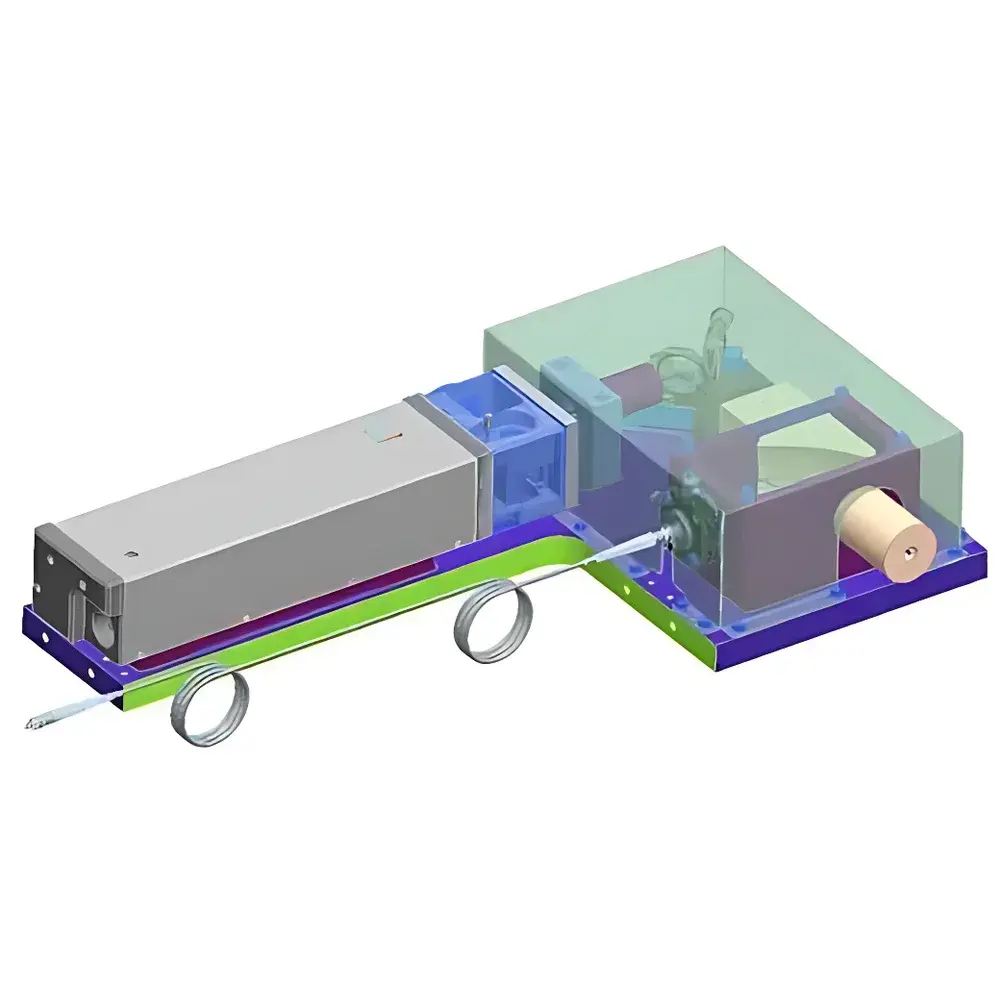
Spectral Industries SPECTRAL LIBS Time-Gated Laser-Induced Breakdown Spectroscopy System
| Brand | Spectral Industries |
|---|---|
| Origin | Netherlands |
| Model | SPECTRAL LIBS |
| Type | Online, Integrated |
| Spectrometer | IRIS Echelle (UV/Deep-UV & NIR) |
| Laser | Actively Q-Switched Nanosecond Pulsed |
| Spectral Range | 180–800 nm & 880–1100 nm (N₂-purged option for DUV) |
| Resolution | 0.1–0.45 nm (@ 180–800 nm, 25 µm slit) |
| F/# | f/2 |
| Delay Jitter | <10 ns |
| Working Distance | 50–500 mm (customizable) |
| Spot Size | ≤100 µm |
| Detector | Deep-UV-enhanced CMOS, Integration Time: 28 µs – 30 s |
| Stage | Motorized 3-Axis Translation (50 × 50 mm travel) |
| Software | Full Hardware Control + MATLAB-Based Data Processing & Visualization |
Overview
The Spectral Industries SPECTRAL LIBS Time-Gated Laser-Induced Breakdown Spectroscopy System is an engineered solution for rapid, calibration-free elemental analysis across solid, liquid, and powdered samples. Based on the fundamental principle of laser-induced plasma generation—where a focused nanosecond laser pulse ablates a micro-volume of material to form a transient, high-temperature plasma—the system captures time-resolved optical emission spectra emitted during plasma decay. Elemental identification and semi-quantitative concentration estimation are achieved by correlating characteristic atomic and ionic emission lines (e.g., Fe I at 371.99 nm, Ca II at 393.37 nm, Al I at 396.15 nm) with NIST Atomic Spectra Database references. Unlike conventional techniques such as XRF or ICP-OES, LIBS requires no sample digestion, vacuum environment, or conductive coating, enabling direct analysis of insulating materials, layered structures, and in-situ industrial surfaces. The SPECTRAL LIBS system integrates time-gated detection to suppress early-stage continuum radiation (bremsstrahlung), significantly improving signal-to-noise ratio and spectral fidelity—critical for trace element detection and matrix-effect mitigation.
Key Features
- Time-gated acquisition with <10 ns electronic jitter and 100 ns step resolution, enabling precise temporal separation of plasma continuum and atomic line emission.
- IRIS echelle spectrometer with f/2 optical throughput, delivering high light collection efficiency and superior SNR compared to conventional Czerny-Turner systems.
- Dual spectral coverage: 180–800 nm (deep-UV capable with N₂ purge) and extended NIR range 880–1100 nm—supporting comprehensive elemental coverage including H, Li, Be, B, C, N, O, F, and heavy metals.
- High spectral resolution (0.1–0.45 nm at 25 µm slit width), enabling resolution of closely spaced lines (e.g., Mn II 257.610 nm / Fe II 257.630 nm) without peak overlap.
- Motorized 3-axis translation stage (50 × 50 mm travel, ±1 µm repeatability) for automated spatial mapping and depth profiling—fully synchronized with laser firing and spectrometer triggering.
- Modular optical path with adjustable working distance (50–500 mm) and ≤100 µm laser spot size, supporting both macro-scale bulk analysis and micro-domain characterization.
- Robust mechanical design (3 kg total spectrometer mass, thermal drift <5 pm/K), qualified for operation in non-climate-controlled industrial environments and multi-orientation mounting.
Sample Compatibility & Compliance
The SPECTRAL LIBS system accommodates diverse sample forms—including geological cores, metallic alloys, polymer composites, pharmaceutical tablets, soil pellets, and semiconductor wafers—without preprocessing. Its non-contact, minimal-ablation nature (<1 ng per shot) preserves sample integrity for sequential analysis or archival purposes. For regulated environments, the system supports audit-ready data workflows: all instrument parameters (laser energy, delay time, integration gate, stage coordinates) are timestamped and logged in machine-readable format. While LIBS itself is not inherently compliant with pharmacopeial monographs, the platform’s architecture aligns with GLP/GMP principles through deterministic hardware control, full parameter traceability, and MATLAB-based scriptable processing—facilitating validation under ISO/IEC 17025 or FDA 21 CFR Part 11 when integrated into validated laboratory information management systems (LIMS).
Software & Data Management
The native control suite provides real-time hardware orchestration: synchronized laser pulsing, gated detector exposure, stage positioning, and spectral acquisition—all programmable via intuitive GUI or command-line interface. Raw spectra are stored in HDF5 format with embedded metadata (wavelength calibration, slit width, ambient temperature, laser fluence). Post-acquisition, MATLAB-based analysis modules enable background subtraction, peak fitting (Voigt profiles), multivariate regression (PLS, PCA), and 2D/3D elemental mapping visualization. Export options include CSV, ASCII, and industry-standard JCAMP-DX for interoperability with third-party chemometric tools. No cloud dependency or vendor-locked licensing: all source scripts are accessible for method customization and internal validation.
Applications
- Geoscience & Mining: Rapid lithological classification of drill core segments; quantitative Li, Na, K, Mg mapping in spodumene-rich pegmatites; real-time grade control during ore sorting.
- Metallurgy & Manufacturing: Coating thickness verification (Zn, Al on steel); inclusion analysis in aluminum alloys; weld seam composition homogeneity assessment.
- Environmental Monitoring: Heavy metal screening (Pb, Cd, As) in soil and sediment slurries; fly ash composition tracking in coal-fired power plants.
- Forensics & Cultural Heritage: Non-destructive pigment identification in historical paintings; gunshot residue (Ba, Sb, Pb) pattern analysis on fabric substrates.
- Pharmaceutical QA: Excipient uniformity testing in tablet cross-sections; elemental impurity screening per ICH Q3D guidelines (e.g., Ni, V, Co).
- Space & Extreme Environments: IRIS spectrometer variant qualified for planetary rovers (radiation-hardened housing, passive thermal stabilization); demonstrated operation under simulated Mars atmospheric pressure (7–10 mbar CO₂).
FAQ
Is the SPECTRAL LIBS system suitable for quantitative analysis?
Yes—when coupled with matrix-matched reference standards and multivariate calibration models (e.g., PLS regression), detection limits for major elements range from 10–100 ppm; minor/trace elements (e.g., Cr, Ni, Cu) achieve 50–500 ppm depending on plasma stability and line intensity.
Can it analyze liquids or gases directly?
Liquids require surface stabilization (e.g., static droplet or thin film on substrate) to minimize splashing; gases necessitate high-pressure confinement cells (>1 bar) to sustain detectable plasma—both configurations are supported via optional accessories.
What maintenance does the IRIS spectrometer require?
No routine optical alignment or lamp replacement. The deep-UV-enhanced CMOS detector and sealed echelle grating assembly are designed for >10⁷ laser shots without performance degradation. N₂ purge lines require annual filter replacement.
How is calibration performed?
Wavelength calibration uses internal Hg/Ar hollow-cathode lamp or external laser frequency comb (optional). Intensity calibration employs NIST-traceable neutral density filters. Plasma temperature and electron density are derived from Boltzmann plot and Stark-broadened line ratios for plasma diagnostics.
Is OEM integration supported?
Yes—the system provides TTL-triggered I/O ports, Ethernet-based SCPI command set, and SDK for C/C++/Python integration. Mechanical footprint (220 × 195 × 80 mm for IRIS) and modular cabling simplify embedding into production lines or mobile platforms.




