
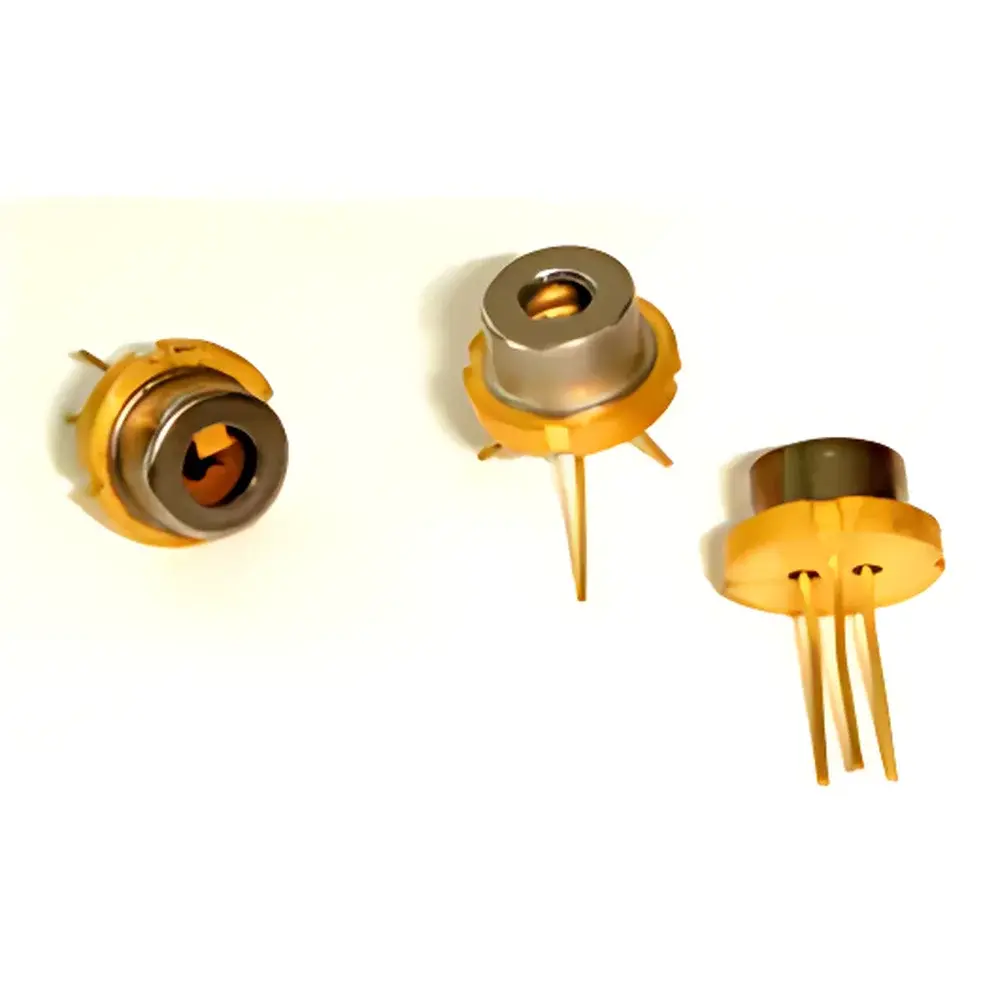
Laser Diode – FLC Model 1
| Brand | FLC |
|---|---|
| Origin | USA |
| Manufacturer Type | Authorized Distributor |
| Import Status | Imported |
| Model | 1 |
| Core Construction | Solid-State Laser Device |
| Wavelength Range | 375–3100 nm |
| Output Power | 1–500 mW |
| Packaging Options | TO-can, Butterfly, C-mount, Coaxial, Fiber-Pigtailed |
| Optional Integrations | Thermoelectric (TE) Coolers, Monitor Photodiodes, FC/PC or SMA Fiber Coupling Interfaces |
Overview
The FLC Model 1 Laser Diode is a high-reliability, solid-state semiconductor light source engineered for precision optical instrumentation and industrial integration. Based on edge-emitting diode laser architecture, it operates across an exceptionally broad spectral range—from ultraviolet (375 nm) through visible (405–690 nm), near-infrared (780–1550 nm), and into the short-wave infrared (up to 3100 nm)—enabling deployment in diverse photonic systems where wavelength specificity and stable continuous-wave (CW) output are critical. Unlike pulsed or Q-switched lasers, this device delivers inherently low-noise, diffraction-limited beam characteristics suitable for interferometric alignment, spectroscopic excitation, and calibrated illumination tasks. Its monolithic chip design ensures long-term power stability (<±2% over 8 hours at constant current and temperature), making it compatible with applications requiring traceable radiometric performance under GLP-compliant laboratory conditions.
Key Features
- Wide spectral coverage: 375 nm to 3100 nm—spanning UV-VIS-NIR-SWIR bands with discrete wavelength options aligned to ISO 11146 and IEC 60825-1 safety classifications.
- Output power scalability: Standard CW output from 1 mW to 500 mW, with factory-calibrated power monitoring via integrated back-facet photodiode (±3% uncertainty, NIST-traceable calibration available).
- Thermal management ready: Designed for direct mounting onto TE coolers (e.g., 1-stage or 2-stage Peltier modules) with thermal resistance < 0.8 K/W, enabling active wavelength stabilization within ±0.05 nm/°C.
- Modular packaging: Available in industry-standard configurations including TO-56/TO-9, 14-pin butterfly, C-mount, coaxial, and fiber-pigtailed variants (SMF-28, HI1060, or PM980 fiber options).
- Compliance-ready interfaces: Integrated monitor photodiode output (analog voltage proportional to optical power), TTL-compatible modulation input (up to 250 MHz small-signal bandwidth), and RS-232 or USB-C digital control option (via external driver module).
Sample Compatibility & Compliance
The FLC Model 1 is compatible with standard optical breadboards, kinematic mounts (e.g., Thorlabs KM100 series), and OEM laser engine assemblies. It meets IEC 60825-1:2014 Class 3R or Class 3B requirements depending on configured output power and collimation optics. For regulated environments—including medical device manufacturing (FDA 21 CFR Part 820), pharmaceutical analytical labs (USP ), and aerospace-grade test setups—the diode supports full audit trail documentation of batch-specific L-I-V (light-current-voltage) curves, spectral emission profiles, and aging data (MTTF > 25,000 hours at rated operating point). All units ship with CE marking, RoHS 2011/65/EU compliance certification, and optional ISO 17025-accredited calibration reports.
Software & Data Management
While the laser diode itself is analog-hardware-based, FLC provides reference firmware and SDKs for integration with third-party control platforms (LabVIEW, MATLAB, Python via PyVISA). Driver modules support SCPI command sets compliant with IEEE 488.2, enabling automated power ramping, temperature setpoint synchronization, and real-time power logging. Data export formats include CSV and HDF5, supporting traceability in FDA 21 CFR Part 11–compliant workflows when used with validated electronic lab notebooks (ELNs) such as LabArchives or IDBS E-WorkBook. Firmware updates are delivered via signed binary packages with SHA-256 verification.
Applications
- Visible-band systems: Barcode scanning engines (ANSI X9.37), laser line projectors for machine vision (ISO 10110-3 surface metrology), CD/DVD/Blu-ray optical pickup units, laser printing subsystems, and photoelectric sensor triggers.
- Infrared sensing: Tunable diode laser absorption spectroscopy (TDLAS) for CH₄, CO₂, H₂O, and NH₃ detection; free-space optical communications (FSO) up to 10 Gbps using OOK modulation; IR scene projection for thermal camera calibration.
- Biomedical instrumentation: Low-level laser therapy (LLLT) devices per IEC 60601-2-57; flow cytometry excitation sources; fluorescence lifetime imaging (FLIM) pump lasers; and optical coherence tomography (OCT) swept-source seed lasers.
- Industrial metrology: Interferometric displacement sensors (e.g., heterodyne Michelson configurations), confocal microscope illumination, and laser triangulation profilers compliant with VDI/VDE 2634 Part 2.
FAQ
What is the typical spectral linewidth of the FLC Model 1 laser diode?
Spectral linewidth ranges from 1 MHz (for DFB-stabilized variants) to 2–5 nm (for FP cavity types), depending on selected wavelength and package configuration. Linewidth specifications are provided per batch in the Certificate of Conformance.
Can the laser diode be operated in pulsed mode?
Yes—when driven by external current pulsers with rise/fall times < 10 ns, the device supports quasi-CW and gated operation up to 100 kHz repetition rate. Pulse width stability is maintained within ±1.5% at 10%–90% duty cycle.
Is fiber coupling included as standard?
Fiber coupling is optional. SMF-28 pigtailing (FC/PC connector) is available with coupling efficiency ≥65% (typical); polarization-maintaining (PM) fiber variants require custom quoting.
Does FLC provide drive electronics?
FLC offers complementary laser diode drivers (e.g., LD-1000 series) with current stability ≤0.01% RMS, low-noise analog modulation inputs, and interlock-safe shutdown circuits meeting EN 61511 SIL-2 requirements.
How is wavelength accuracy verified prior to shipment?
Each unit undergoes spectral characterization using a calibrated Ocean Insight QE Pro spectrometer (NIST-traceable grating calibration), with results documented in the individual test report accompanying the shipment.




