
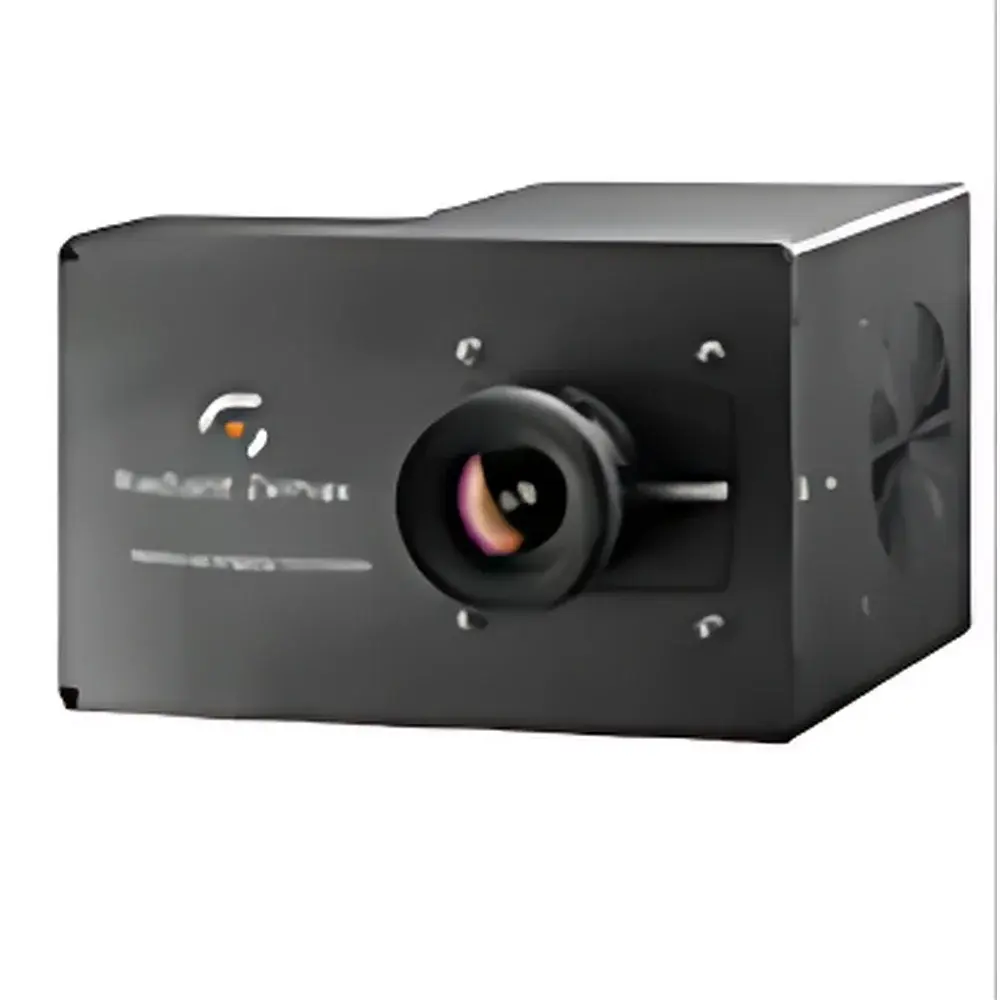
Radiant Zemax PM-1400F Series CCD-Based Imaging Photometer and Colorimeter
| Brand | Radiant Zemax |
|---|---|
| Origin | USA |
| Model | PM-1400F Series |
| Sensor Resolution | 768×512 / 1536×1024 / 3072×2048 pixels |
| ADC Dynamic Range | 14 bits (16,384 gray levels) |
| Luminance Range | 0.001 to 10¹⁰ nit (with ND filters) |
| Photometric Accuracy | Illuminance ±3%, Luminance (Y) ±3%, Chromaticity (x,y) ±0.003 |
| Short-Term Repeatability | Illuminance <±0.5%, Luminance <±0.5%, Chromaticity ±0.0006 |
| FOV Options | 1°–26° / 3°–50° / 5°–87° |
| Measurement Time (at 100 cd/m²) | 1.8–25 s depending on resolution |
| Interface | USB 2.0 |
| Dimensions | 154 × 242 × 200 mm |
| Weight | 4.8 kg |
| Operating Temperature | 0–30 °C |
| Operating Humidity | 20–70% RH (non-condensing) |
| Photometric Units | cd/m², cd/cm², fL, nit, mnit, W/sr/m², lux, fc, W/m², cd/sr, CIE (x,y), (u′,v′), CCT (K) |
Overview
The Radiant Zemax PM-1400F Series is a high-precision, cooled CCD-based imaging photometer and colorimeter engineered for quantitative spatial measurement of luminance, chromaticity, and uniformity across emissive and reflective surfaces. Operating on the principle of calibrated digital imaging photometry, it captures full-field radiometric and photometric data in a single exposure—enabling pixel-level analysis of display performance, LED array consistency, lighting distribution, and optical defect detection. Unlike scanning photometers or spot meters, the PM-1400F provides simultaneous acquisition of spatially resolved photometric values across its entire field of view (FOV), eliminating mechanical interpolation errors and ensuring traceable, repeatable measurements aligned with CIE 1931 and CIE 1976 (u′,v′) colorimetric standards. Its thermoelectrically cooled sensor minimizes dark current noise, supporting low-light measurement integrity down to 0.001 nit—a critical capability for OLED, microLED, and automotive HUD characterization.
Key Features
- Cooled 14-bit scientific-grade CCD sensor with selectable resolutions: 768×512, 1536×1024, or 3072×2048 pixels—optimized for speed, resolution, or dynamic range trade-offs
- Optical path incorporating CIE-matched photopic (V(λ)) and color-matching filters, plus precision neutral density (ND) attenuation stages for extended luminance range (up to 10¹⁰ nit)
- Integrated mechanical shutter enabling precise exposure control and dark-frame subtraction for enhanced photometric stability
- Modular lens system supporting FOV flexibility—from narrow-angle macro inspection (1°) to wide-field wall or luminaire coverage (87°)
- ProMetric® software suite providing real-time image acquisition, ISO/IEC 17025-aligned calibration management, automated Mura and defect detection algorithms, and statistical uniformity reporting (e.g., min/max deviation, Δu′v′ maps)
- USB 2.0 interface compliant with Windows-based host systems; supports integration into automated test stations via SDK and LabVIEW drivers
Sample Compatibility & Compliance
The PM-1400F is validated for use across flat-panel displays (LCD, OLED, QD-LCD), microLED arrays, automotive instrument clusters, signage, architectural lighting, and general illumination products. It meets essential requirements for conformance testing per IEC 62341-6-2 (OLED displays), VESA DisplayHDR™ certification workflows, and TM-30-15 (IES) spectral fidelity evaluation when paired with optional spectroradiometric validation. All factory calibrations are traceable to NIST standards, and system-level accuracy complies with CIE Publication 127:2007 recommendations for LED measurement geometry. The instrument supports GLP/GMP-compliant operation through ProMetric’s audit-trail-enabled calibration logging, user-access controls, and electronic signature functionality per FDA 21 CFR Part 11.
Software & Data Management
ProMetric software delivers comprehensive measurement automation, including programmable multi-point uniformity grids, pass/fail threshold mapping, and export of calibrated TIFF, CSV, and XML datasets compatible with MATLAB, Python (NumPy/Pandas), and industry-standard QA databases. Spatial metrics—such as luminance uniformity (LU), chromaticity shift (Δu′v′), and Mura severity index—are computed per ISO 9241-307 and ASTM E308-22. Raw image metadata includes EXIF-tagged calibration coefficients, exposure parameters, and environmental conditions (temperature/humidity logs). Data security is enforced via role-based access, encrypted project files, and version-controlled calibration certificate archives.
Applications
- Pixel-level luminance and chromaticity mapping for AMOLED and microLED display manufacturing
- Mura, line defect, and dead-pixel detection in TFT-LCD and Mini-LED backlit panels
- Full-wall brightness and color uniformity verification for video walls and control room displays
- Photometric characterization of streetlights, architectural fixtures, and automotive headlamps per ECE R112 and SAE J1383
- Calibration and verification of display manufacturing test equipment (e.g., pattern generators, ATE systems)
- Research-grade spatial color science studies requiring sub-0.001 Δu′v′ repeatability under controlled thermal conditions
FAQ
What standards does the PM-1400F support for display uniformity testing?
It implements calculation methods defined in ISO 9241-307 (visual display ergonomics) and VESA DisplayHDR™ Test Specification v1.2, including peak luminance, black level, and local dimming uniformity metrics.
Can the system perform automated Mura detection without manual thresholding?
Yes—ProMetric’s Mura Analysis module applies adaptive spatial filtering and contrast-normalized segmentation to classify Mura types (cloud, streak, halo) per JEITA CP-1201 guidelines, with configurable sensitivity and area thresholds.
Is the instrument suitable for measuring ultra-low-brightness automotive displays at night-mode settings?
Absolutely—the cooled CCD and 14-bit dynamic range enable stable measurement down to 0.001 nit, with short-term chromaticity repeatability of ±0.0006 (u′,v′), meeting OEM requirements for Class IV night-driving display validation.
How is calibration traceability maintained over time?
Each unit ships with a NIST-traceable calibration certificate. ProMetric supports periodic recalibration via Radiant’s ISO/IEC 17025-accredited service lab, with automatic import of new coefficients and revision-controlled calibration history.
Does the PM-1400F require external temperature stabilization during operation?
No—its integrated thermoelectric cooler maintains sensor temperature within ±0.1°C of setpoint across the 0–30°C ambient operating range, eliminating need for external chillers or climate chambers.




