
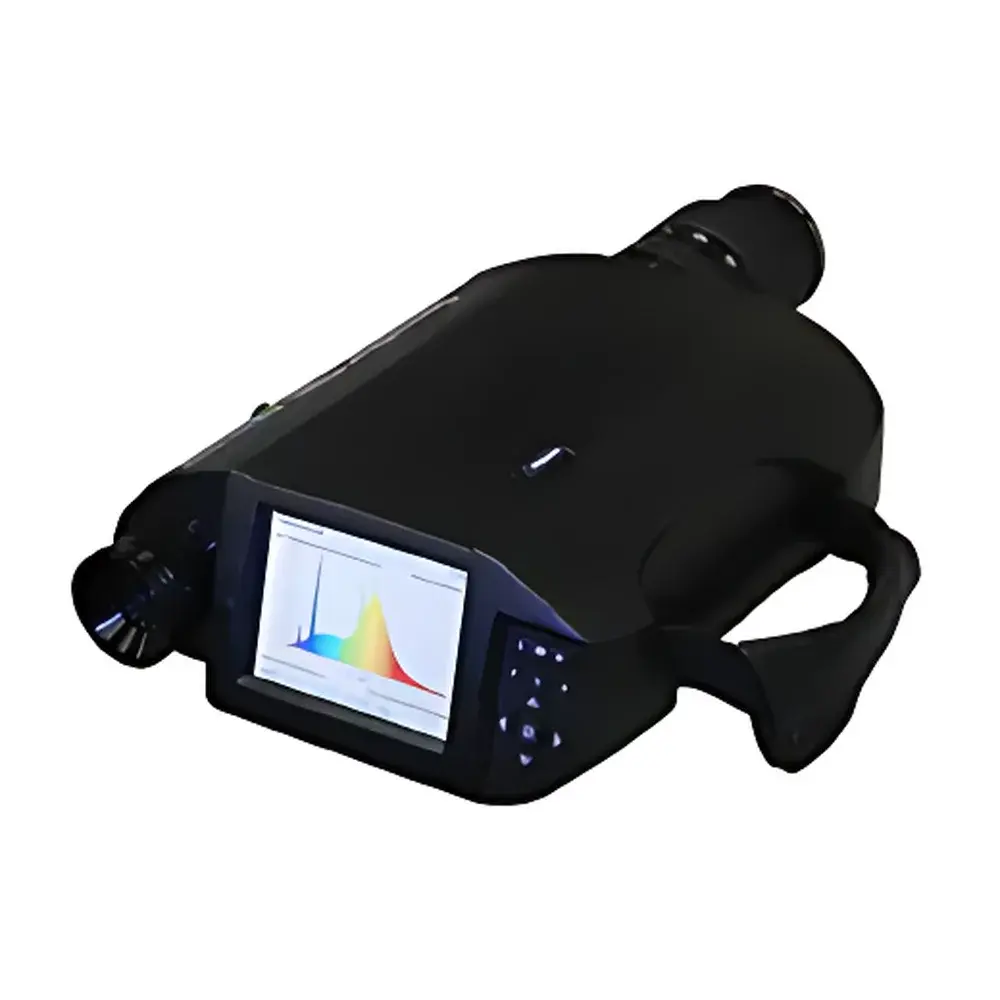
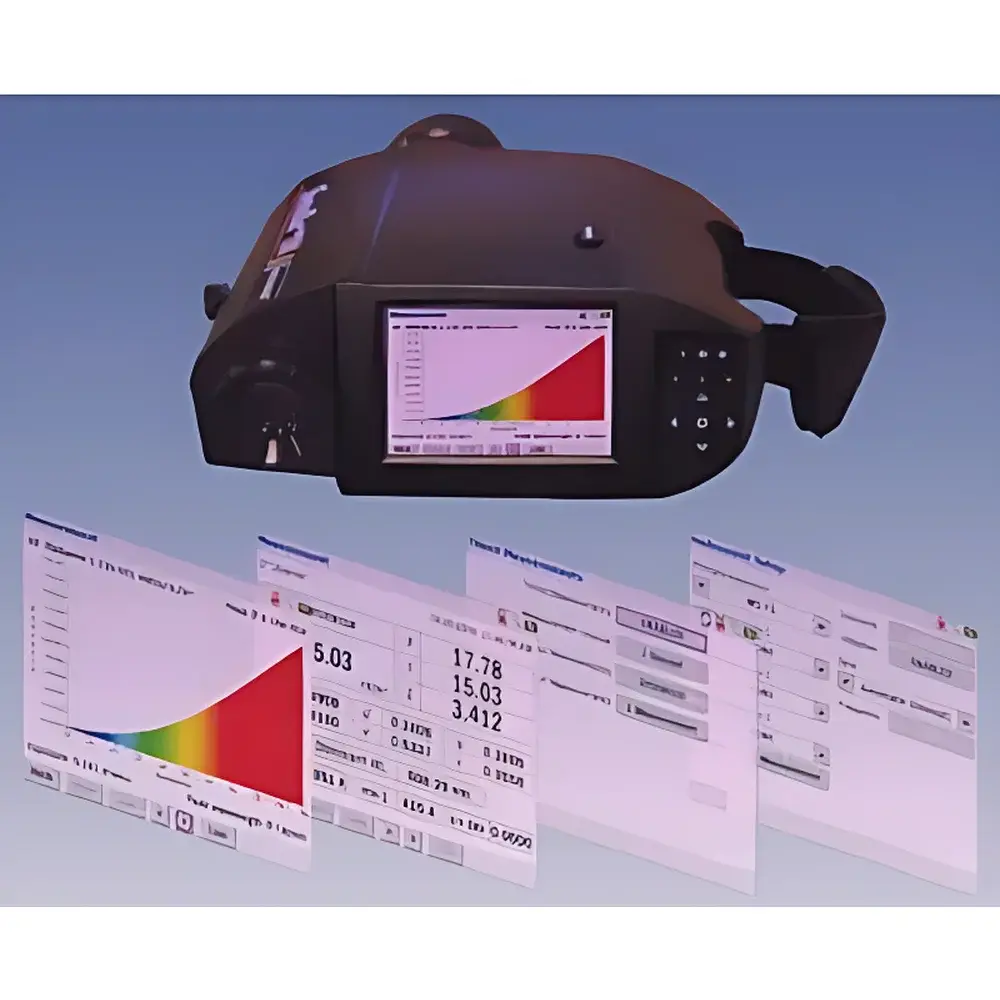
Photo Research PR655 Portable Spectroradiometer
| Brand | Photo Research |
|---|---|
| Origin | USA |
| Model | PR655 |
| Spectral Resolution | 3.12 nm/pixel |
| Detector Array | 128-element linear CCD |
| Standard Field of View | 1° (0.5° optional) |
| Measurement Modes | Luminance, Radiance, Illuminance, Irradiance, Chromaticity, CCT, CRI (optional), Dominant Wavelength, Spectral Power Distribution |
| Interface | USB, Bluetooth (optional), RS-232 emulation (driver provided), External Trigger Input |
| Display | 2.25" × 3" full-color touchscreen |
| Battery Life | Up to 12 hours (rechargeable Li-ion) |
| Data Storage | SD card (thousands of spectra) |
| Compliance | NIST-traceable calibration, CIE 127-compliant with LR-127 accessory, ISO/CIE standard-conformant photometric and radiometric measurement architecture |
Overview
The Photo Research PR655 Portable Spectroradiometer is a high-precision, field-deployable instrument engineered for absolute spectral radiance, luminance, and chromaticity measurements across visible and near-visible wavelengths (380–780 nm). Based on the proven Czerny-Turner optical design and utilizing a 128-element linear CCD detector array, the PR655 captures full spectral data in a single scan with 3.12 nm spectral resolution per pixel—enabling rigorous compliance with CIE S 026/E:2015, ISO/CIE 11664, and IEC 62471 photobiological safety frameworks. Unlike filter-based photometers, the PR655 delivers spectrally resolved data essential for characterizing non-standard light sources (e.g., narrowband LEDs, micro-LEDs, OLEDs, and laser-based displays), where metamerism and spectral mismatch errors render traditional tristimulus instruments inadequate. Its NIST-traceable calibration—maintained through Photo Research’s thirteen accredited optical calibration laboratories—ensures metrological continuity from factory to end-user, supporting GLP/GMP traceability requirements in regulated environments including medical device validation and display quality assurance.
Key Features
- Integrated 128-channel CCD spectrometer with fixed 3.12 nm/pixel resolution and <1.5 nm FWHM optical bandwidth
- Auto-synchronizing acquisition (AutoSync) locks measurement timing to AC-powered source flicker frequencies (50/60 Hz and harmonics), eliminating aliasing in pulsed or PWM-driven lighting
- Dual-field-of-view optics: standard 1° aperture; optional 0.5° telephoto lens for high-spatial-resolution measurements of small-emitting areas
- Full-color 2.25″ × 3″ resistive touchscreen with intuitive menu navigation—enabling fully autonomous operation without external computing
- Onboard SD card storage supporting >10,000 full-spectrum records with embedded metadata (timestamp, integration time, FOV, calibration ID)
- Rechargeable lithium-ion battery rated for ≥12 hours continuous operation under typical measurement duty cycles
- External trigger input for synchronization with test fixtures, automated stages, or external signal generators in ATE environments
Sample Compatibility & Compliance
The PR655 supports diverse optical geometries via interchangeable accessories compliant with international standards. The LR-127 LED measurement module implements CIE 127:2007 angular averaging for total flux and spatial uniformity assessment. A cosine-corrected irradiance head enables ISO/CIE 19476-compliant illuminance and irradiance measurements. Fiber-optic probes permit remote access to confined or thermally sensitive targets (e.g., inside display enclosures or dental curing lights), while microscope objectives support sub-millimeter spot measurements down to 0.1 mm diameter. All accessories retain NIST-traceable responsivity calibration. The system meets ASTM E308-22 for color computation, USP analytical instrument qualification guidelines, and supports FDA 21 CFR Part 11 audit trails when used with SpectraWin software in validated configurations.
Software & Data Management
Standalone operation is fully functional via the onboard UI; however, SpectraWin v6.x (Windows-based) unlocks advanced capabilities including batch spectral analysis, CRI/Rf/Rg calculation per TM-30-20, spectral comparison overlays, and export to CSV, XML, or CIE 15:2018-compliant .cie files. Remote control is supported via ASCII command protocol over USB or Bluetooth (optional module), enabling integration into LabVIEW, Python (PySerial), or MATLAB automation frameworks. An RS-232 emulation driver allows legacy ATE systems to interface without hardware modification. All calibrations are digitally signed and stored with cryptographic checksums; firmware updates preserve calibration lineage per ISO/IEC 17025 clause 6.6.
Applications
- Display characterization: luminance uniformity, chromaticity shift vs. viewing angle, temporal flicker analysis (IEEE 1789-2015), HDR tone mapping verification
- LED and solid-state lighting R&D: spectral power distribution modeling, binning consistency, phosphor degradation monitoring
- Medical device validation: dental curing light irradiance profiling, surgical display color fidelity (DICOM GSDF compliance), ophthalmic photostimulation dosimetry
- Print and packaging QC: spectral reflectance of inks/pigments, metamerism index quantification, substrate fluorescence correction
- Human factors research: mesopic photometry, scotopic/photopic ratio mapping, circadian stimulus (CS) calculation per UL 24480
- Automotive lighting: adaptive driving beam (ADB) pattern validation, glare assessment per UNECE Regulation 149
FAQ
Is the PR655 suitable for measuring pulsed or modulated light sources?
Yes—the AutoSync function dynamically adjusts integration timing to match source modulation frequency up to 10 kHz, ensuring phase-locked spectral capture without temporal aliasing.
Can the PR655 perform CRI and TM-30 calculations out of the box?
CRI (Ra) is computed onboard; TM-30-20 metrics (Rf, Rg, color vector graphics) require SpectraWin software and optional license.
What is the calibration validity period and how is traceability maintained?
Photo Research recommends annual recalibration; each unit ships with a NIST-traceable certificate listing uncertainty budgets per CIE 127 Annex B, with full calibration history preserved in firmware.
Does the PR655 support irradiance measurements?
Yes—when fitted with the optional cosine-corrected irradiance diffuser (PR-1000 series), it complies with ISO/CIE 19476 for spectral irradiance and illuminance.
Is Bluetooth connectivity included or optional?
Bluetooth 4.2 BLE module is optional and requires separate ordering (part # BT-PR655); USB remains standard for direct PC communication and firmware updates.
Related Products




