
PbSe Photoconductive Detector
| Origin | Beijing |
|---|---|
| Manufacturer Type | Distributor |
| Origin Category | Domestic (China) |
| Model | PbSe |
| Pricing | Upon Request |
Overview
The PbSe photoconductive detector is a mid-infrared (MIR) optoelectronic sensor engineered for high-sensitivity detection in the 1–3.5 µm and 2–6 µm spectral ranges. Operating on the principle of photoconductivity, it leverages the intrinsic bandgap properties of lead selenide (PbSe) thin-film semiconductors to generate measurable changes in electrical resistance upon photon absorption. Unlike photovoltaic detectors, photoconductive devices require bias voltage and exhibit gain—making them particularly suitable for low-light, continuous-wave (CW) spectroscopic applications where signal-to-noise ratio (SNR) and dynamic response are critical. Designed for integration into Fourier-transform infrared (FTIR) spectrometers, gas analyzers, flame photometers, and non-contact optical pyrometry systems, this detector delivers stable responsivity across its operational bandwidth without requiring cryogenic cooling—though thermoelectric stabilization is available for enhanced performance.
Key Features
- Two standard spectral response bands: 1.0–3.5 µm and 2.0–6.0 µm—optimized for CO, CO₂, CH₄, NOₓ, SO₂, and hydrocarbon gas absorption lines
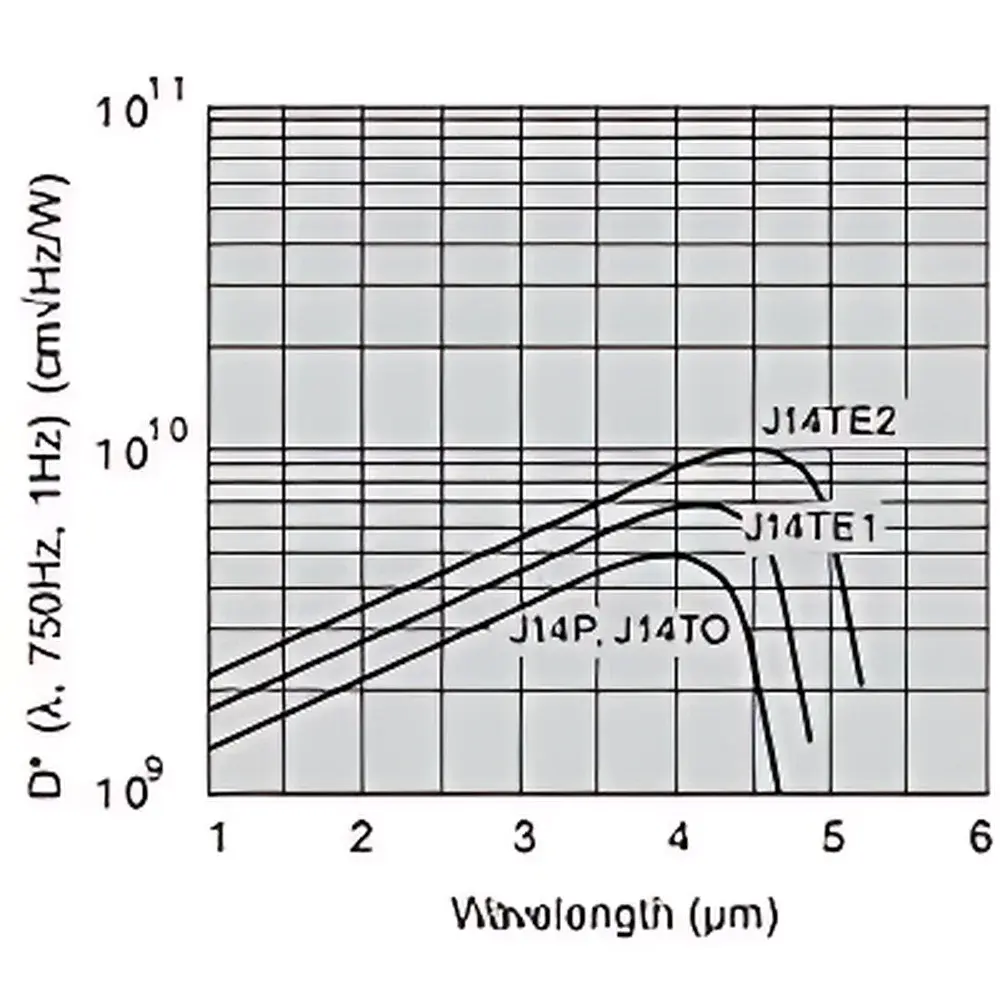
- Photoconductive architecture enabling internal gain (typically 10²–10³), improving detectivity (D*) at room temperature
- Thermoelectrically cooled variants available with multi-stage Peltier modules (−10 °C to +25 °C setpoint range), reducing dark current and improving long-term baseline stability
- Hermetically sealed TO-8 or TO-5 metal package with AR-coated ZnS or Ge window for optimal transmission in MIR
- Low 1/f noise characteristics and fast thermal time constant (<10 ms), supporting real-time monitoring in process control environments
- Compatible with standard 5 V DC bias and transimpedance amplifier interfaces; output impedance matched for OEM integration
Sample Compatibility & Compliance
The PbSe detector is intended for use with gaseous, vapor-phase, and broadband thermal emission samples in controlled laboratory and industrial settings. It supports quantitative analysis in compliance with ASTM E1421 (Standard Practice for Describing and Measuring Performance of FTIR Spectrometers) and ISO 12099 (Animal feeding stuffs — Guidance on the application of near-infrared spectroscopy). While not intrinsically rated for hazardous locations, it may be integrated into ATEX- or IECEx-certified analyzer housings when paired with appropriate explosion-proof enclosures and purge systems. All units undergo burn-in testing and spectral responsivity calibration traceable to NIM (National Institute of Metrology, China) standards. Device packaging meets IPC-J-STD-020 moisture sensitivity level (MSL) 3 requirements for surface-mount assembly.
Software & Data Management
As a hardware-level sensing component, the PbSe detector does not include embedded firmware or standalone software. However, it is fully interoperable with industry-standard data acquisition platforms—including National Instruments DAQmx, Keysight IO Libraries Suite, and MATLAB Instrument Control Toolbox—enabling synchronized spectral acquisition, baseline correction, and peak integration workflows. When deployed in regulated environments (e.g., pharmaceutical QC labs), system integrators may configure audit trails, electronic signatures, and 21 CFR Part 11-compliant data logging via host PC-based analytical software (e.g., Thermo OMNIC, Bruker OPUS, or custom LabVIEW applications). Raw detector output (voltage or current) is analog and requires external digitization; recommended sampling rates range from 10 Hz to 1 kHz depending on modulation frequency and signal averaging requirements.
Applications
- Industrial stack gas monitoring for environmental compliance (EPA Method 320, ISO 14956)
- In-line humidity sensing in semiconductor cleanroom dry air systems via H₂O absorption at 2.7 µm
- Medical respiratory gas analysis (e.g., end-tidal CO₂, anesthetic agent concentration) per ISO 80601-2-55
- Non-contact temperature measurement of molten metals, glass, and ceramics (optical pyrometry in 2–5 µm band)
- Flame detection and combustion diagnostics using OH*, CH*, and CO emission bands
- OEM integration into portable FTIR and dispersive NIR-MIR hybrid spectrometers
FAQ
What is the typical detectivity (D*) value for this PbSe detector at 3.4 µm and 25 °C?
D* is highly dependent on active area, bias voltage, and modulation frequency. Typical values range from 1×10⁹ to 5×10⁹ cm·Hz½/W under 1 kHz square-wave modulation at 5 V bias.
Can the detector operate uncooled in ambient conditions?
Yes—stable operation is achievable at 20–30 °C ambient, though D* degrades by ~30% and dark current increases exponentially above 35 °C.
Is spectral calibration data provided with each unit?
Yes—each detector ships with a normalized relative spectral response curve (RSR) measured against a NIST-traceable blackbody source.
What is the maximum permissible bias voltage?
Absolute maximum is 10 V DC; recommended operating range is 3–7 V to balance responsivity and thermal drift.
Are custom window materials or spectral filters available?
Yes—ZnS, Ge, KRS-5, and interference bandpass filters (FWHM = 50–200 nm) can be integrated upon request.




