
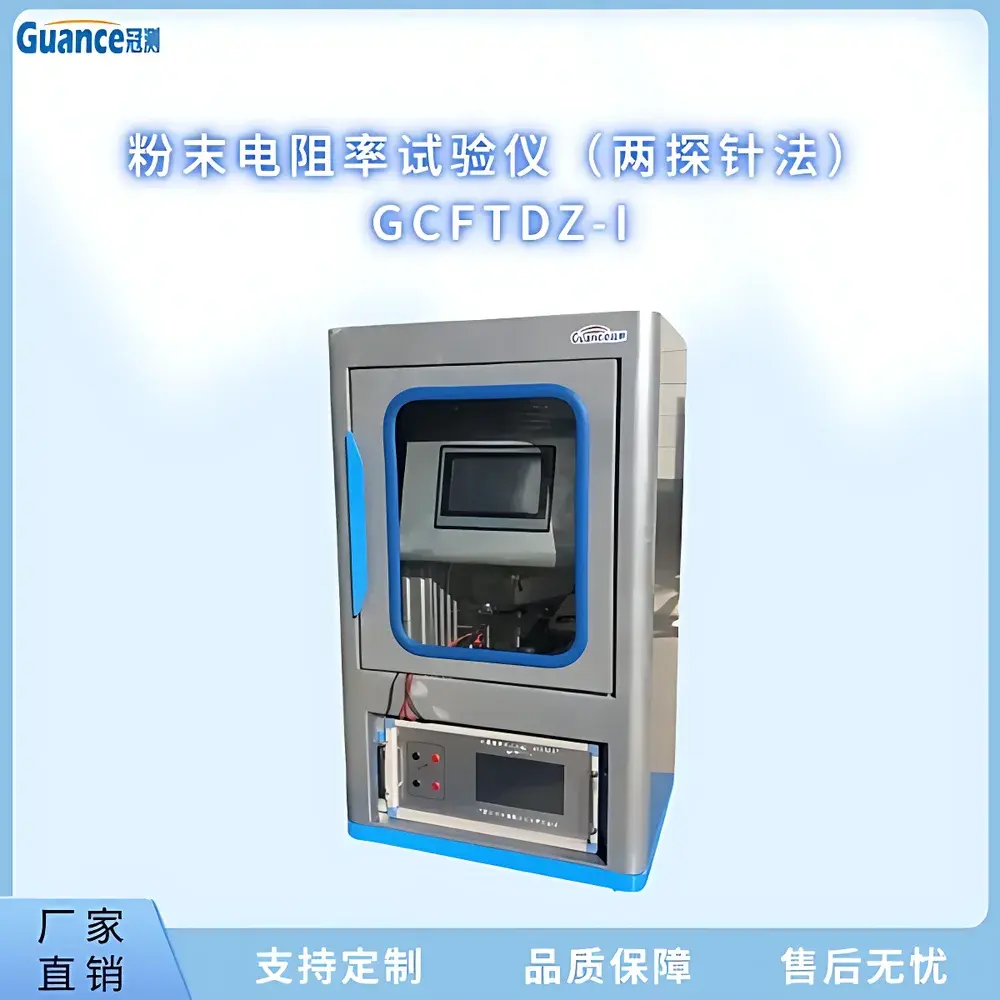
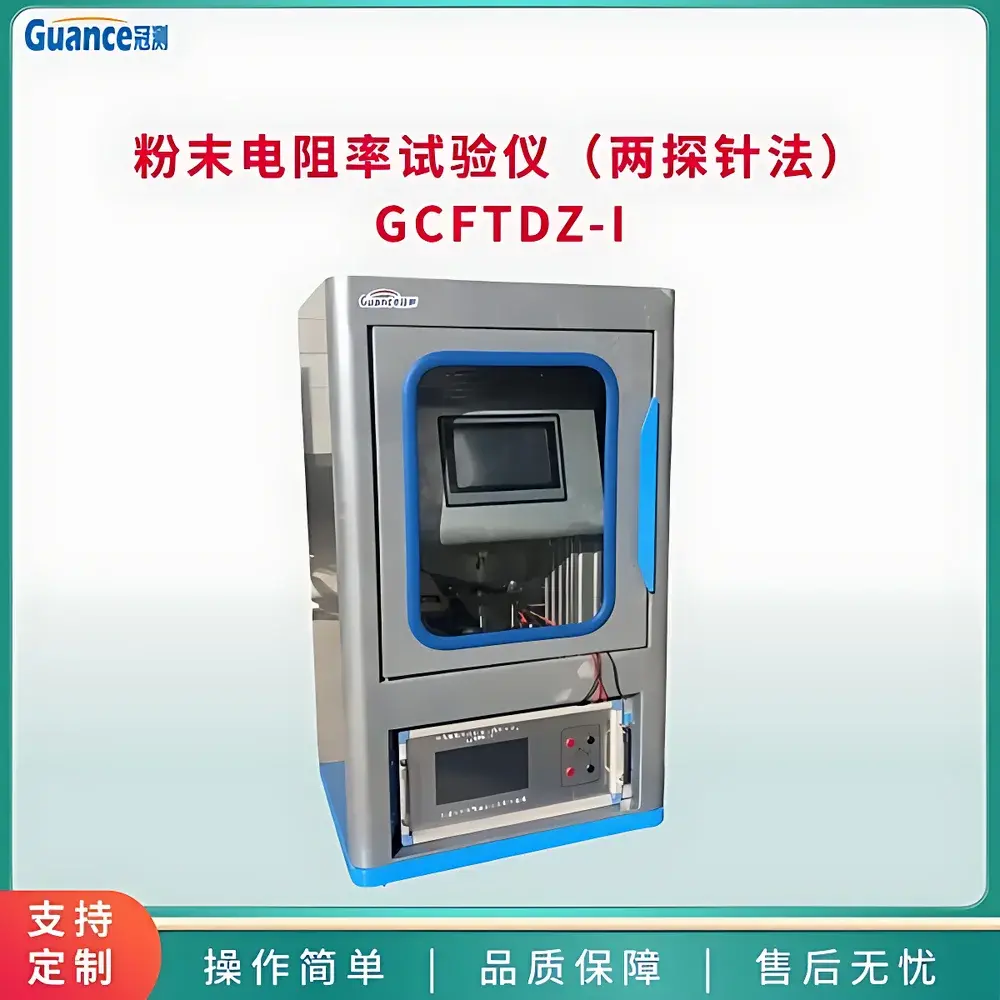
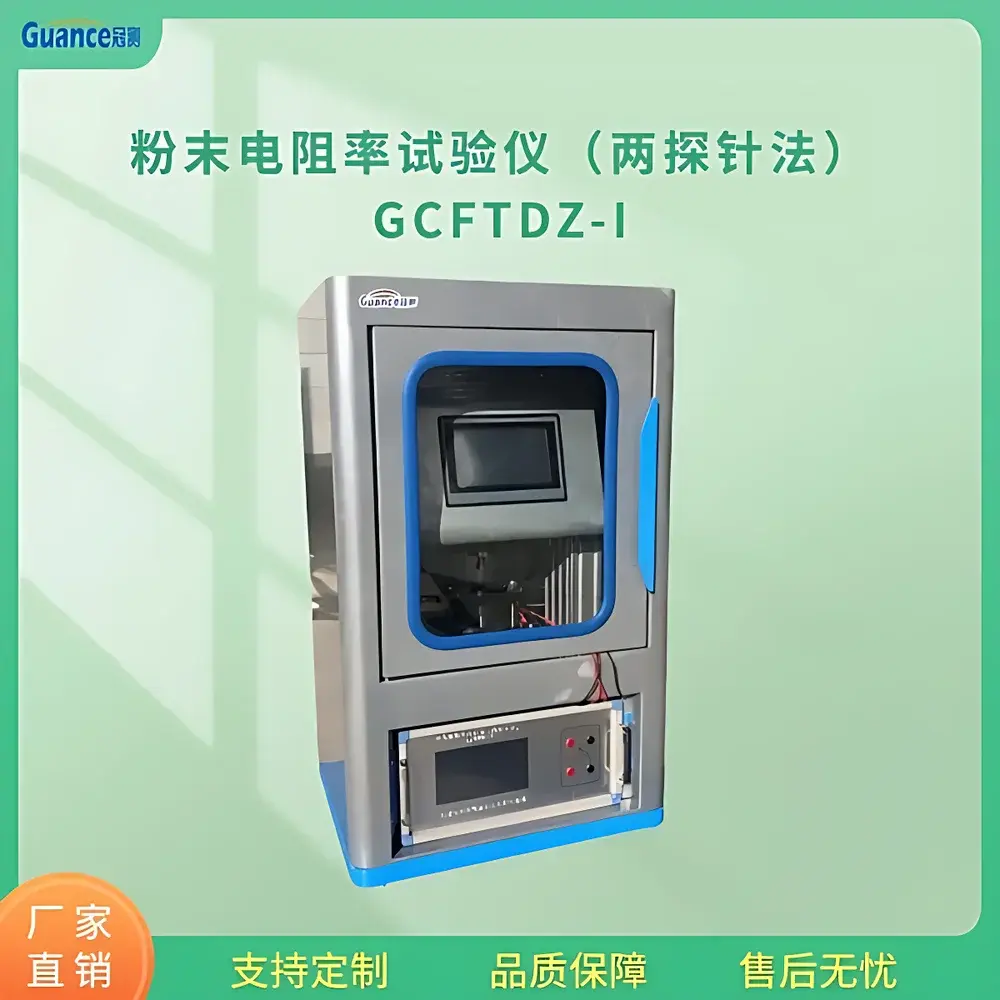
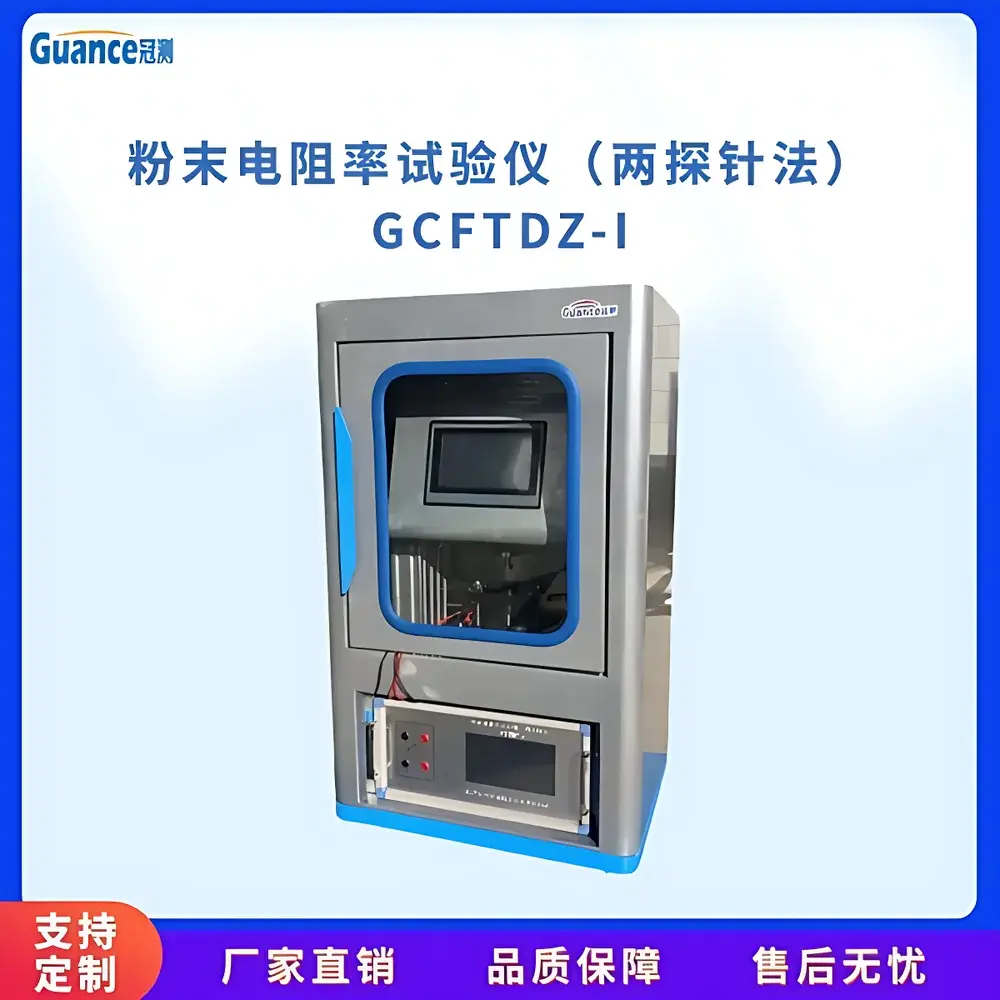
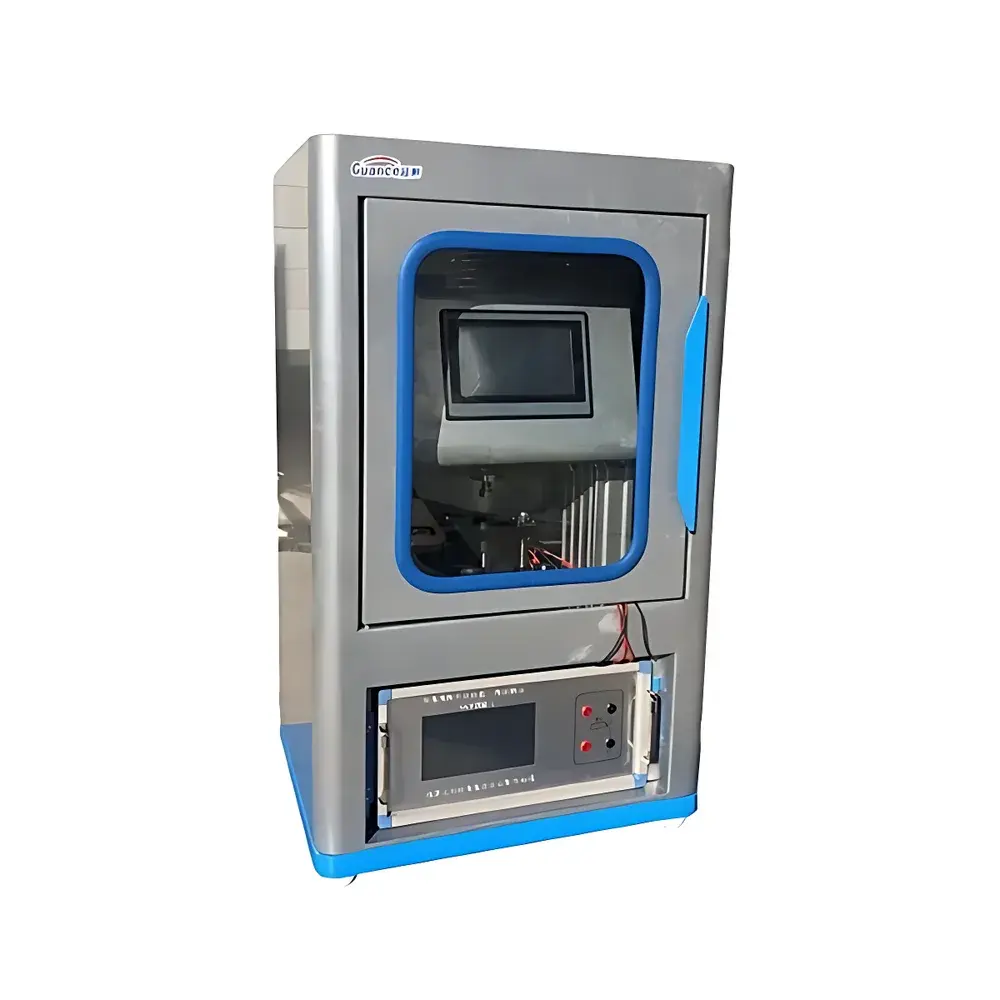
GuanCe GCFTDZ-I Graphite Powder Resistivity Tester (Two-Point Probe Method)
| Brand | GuanCe Instruments |
|---|---|
| Origin | Beijing, China |
| Manufacturer Type | Authorized Distributor |
| Country of Origin | China |
| Model | GCFTDZ-I |
| Price | USD 2,100 (FOB) |
| Force Range | 0–5 kN (up to 3.9 MPa) |
| Force Accuracy | ±0.5% FS |
| Electrode Diameters | φ16.0 mm & φ30.0 mm |
| Resistivity Measurement Range | 10⁻⁶ – 10⁵ Ω·m |
| Resistance Resolution | 10⁻⁸ Ω |
| Current Sources | 10 μA – 10 A (8 ranges) |
| Voltage Range | 2 mV – 2 V |
| Voltage Accuracy | ±0.1% |
| Thickness Resolution | ±1 μm |
| Power Supply | 220 V / 50 Hz |
| Power Consumption | 1 kW |
| Dimensions (L×W×H) | 550 × 450 × 960 mm |
| Weight | ~75 kg |
Overview
The GuanCe GCFTDZ-I Graphite Powder Resistivity Tester is an automated, PLC-controlled instrument engineered for precise and repeatable measurement of electrical resistivity in carbonaceous powders—including calcined anthracite, graphite, carbon black, baked coke fragments, calcined petroleum coke, graphitized coke, and needle coke—according to GB/T 24521–2018, the Chinese national standard for resistivity determination of carbon raw materials and coke. The system operates on the two-point probe (collinear electrode) principle, applying controlled uniaxial compression to a conditioned powder sample within a precision die cavity, followed by simultaneous application of a calibrated direct current and measurement of voltage drop across the compressed bed. Resistivity (ρ) is calculated using the geometric correction factor derived from measured sample height, cross-sectional area, and applied current: ρ = R × A / L, where R is resistance, A is electrode area, and L is compressed thickness. This method eliminates contact resistance artifacts common in four-probe configurations when used with low-conductivity or heterogeneous powders, while maintaining traceability to standardized test protocols required in industrial QC laboratories.
Key Features
- Integrated Siemens S7-1200 PLC control architecture with real-time closed-loop force regulation via servo motor actuation, enabling stable pressure maintenance at ±0.5% FS accuracy
- 10-inch industrial-grade capacitive touchscreen HMI with intuitive, icon-driven workflow navigation—no specialized operator training required
- Dual interchangeable electrode sets: φ16.0 mm (optimized for particle size 0.315–0.5 mm) and φ30.0 mm (for 0.5–1.0 mm), both compliant with GB/T 24521–2018 dimensional specifications
- Seven programmable test modes: constant-force, constant-pressure, stepped-force, stepped-pressure, compression-ratio (displacement-based), time-scheduled, and multi-point gradient profiling
- Real-time synchronized display of 12 physical parameters: applied force (kN), pressure (MPa), compacted thickness (mm), bulk density (g/cm³), voltage (mV/V), current (A), resistance (Ω), resistivity (Ω·m or Ω·cm), conductivity (S/m or % IACS), compression rate (mm/min), dwell time (s), and relative density (%)
- Onboard thermal-printer for immediate hardcopy output of single-test reports; USB export of CSV-formatted datasets with full metadata (timestamp, operator ID, sample ID, calibration log)
- Automated zero-point compensation, post-test mechanical reset to home position, and manual jog mode with adjustable speed for safe electrode alignment and sample loading
Sample Compatibility & Compliance
The GCFTDZ-I is validated for use with dry, free-flowing carbon and graphite powders conforming to GB/T 24521–2018 particle size grading requirements. Sample preparation follows strict conditioning protocols: drying at 105 °C ± 2 °C for 2 h, cooling in a desiccator, and sieving prior to loading into the cylindrical die. The instrument’s force range (0–5 kN) supports compaction pressures up to 3.9 MPa—matching the upper limit specified in the standard for high-density graphite testing. All electrical measurements adhere to IEC 60404-16 (Magnetic materials — Part 16: Methods of measurement of resistivity of magnetic sheet and strip) for low-resistance DC metrology, and comply with GLP documentation requirements including audit-trail-enabled parameter logging, user-access levels, and timestamped data integrity. While not FDA 21 CFR Part 11 certified out-of-the-box, the system supports integration with external LIMS via Modbus TCP for electronic record retention in regulated environments.
Software & Data Management
The embedded HMI firmware provides full local data governance without dependency on external PCs. Each test generates a structured dataset containing raw sensor readings, derived values, environmental metadata (ambient temperature/humidity if externally logged), and operator-defined annotations. Data export includes header rows with unit definitions and ISO 8601 timestamps. Calibration records—force transducer, voltage channel, and current source—are stored with expiration dates and verification history. Firmware updates are delivered via secure HTTPS OTA (Over-The-Air) protocol, requiring digital signature validation before installation. No cloud storage or telemetry is enabled by default; all processing and archiving occur locally on the device’s industrial-grade eMMC module.
Applications
This tester serves as a primary QC tool in carbon material manufacturing facilities, electrode production lines, and battery anode R&D labs. Typical use cases include batch acceptance testing of synthetic graphite feedstock for lithium-ion battery anodes; evaluation of green coke densification behavior during prebake process development; comparative analysis of graphitization efficiency across heat-treatment schedules; and quality monitoring of carbon black dispersion consistency in conductive polymer composites. Its gradient-mode capability enables construction of pressure-resistivity curves critical for modeling electron transport mechanisms in compressed powder electrodes—a key input for electrochemical cell design simulation.
FAQ
What standards does the GCFTDZ-I comply with?
It is fully aligned with GB/T 24521–2018 and technically compatible with ASTM D3764 (Standard Test Method for Bulk Density of Carbon and Graphite Powders) for sample conditioning and dimensional metrology.
Can the instrument measure anisotropic resistivity?
No—it performs isotropic (bulk) resistivity measurement only. Anisotropy assessment requires directional four-probe or van der Pauw configurations, which are outside this model’s scope.
Is external calibration required?
Yes. Annual recalibration of the load cell and electrical measurement subsystems is recommended per ISO/IEC 17025 guidelines; NIST-traceable calibration kits are available through GuanCe’s service network.
Does it support ASTM D4292 or ISO 11713?
While not explicitly certified for those standards, its core methodology satisfies the fundamental physical principles (controlled compaction + two-terminal DC measurement) referenced in both documents for carbon resistivity screening.
How is sample height measured?
Via a high-resolution linear encoder (±1 µm repeatability) integrated into the upper platen assembly, continuously tracking displacement during compression and relaxation cycles.



