
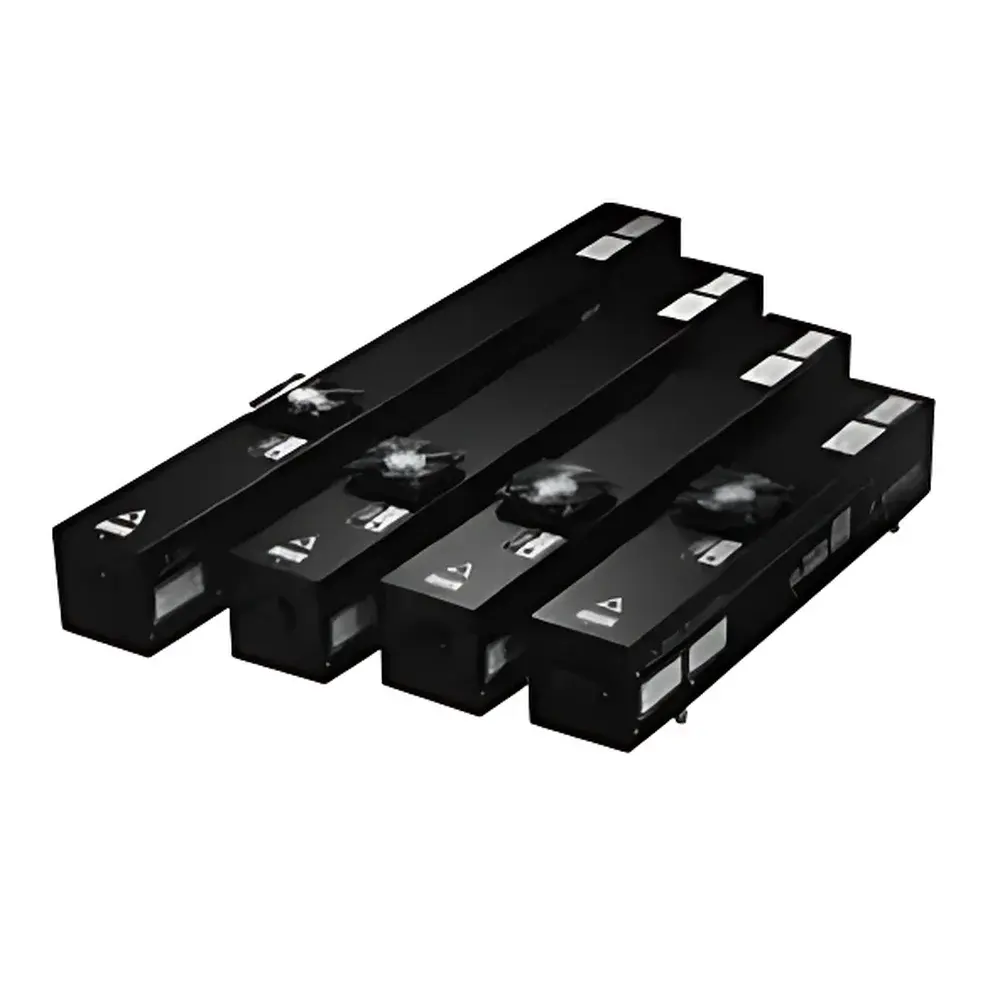
Kimmon IK3023R-BR Helium-Cadmium (HeCd) Laser System
| Brand | Kimmon |
|---|---|
| Origin | Japan |
| Model | IK3023R-BR |
| Wavelength | 325 nm |
| Output Power | 2 mW |
| Beam Mode | TEM₀₀ |
| Beam Diameter | 0.9 mm |
| Beam Divergence | 0.6 mrad |
| Coherence Length | 10 cm |
| Laser Type | Gas Laser (HeCd) |
| Cooling | Air-cooled |
| Polarization | Linear, >100:1 |
| Warm-up Time | <15 min |
| Lifetime | ≥10,000 hours |
| Compliance | CE, RoHS, IEC 60825-1 Class 3B Laser Product |
Overview
The Kimmon IK3023R-BR is a continuous-wave (CW), air-cooled helium-cadmium (HeCd) gas laser engineered for high-stability ultraviolet (UV) emission at 325 nm. Operating on the Cd+ ion transition within a sealed plasma discharge tube containing helium and cadmium vapor, this laser delivers narrow-linewidth, spatially coherent radiation with TEM₀₀ transverse mode quality. Its intrinsic wavelength stability (±0.005 nm over 8 hours), low amplitude noise (<1% RMS, 10 Hz–10 MHz), and long-term power repeatability make it suitable for precision optical metrology, spectroscopic excitation, and photolithographic alignment where UV coherence and beam uniformity are critical. Unlike solid-state or diode-pumped UV sources, HeCd lasers provide inherent spectral purity without external frequency doubling, eliminating nonlinear crystal alignment sensitivity and thermal drift concerns.
Key Features
- Stable 325 nm UV output with 2 mW nominal power and TEM₀₀ spatial profile for diffraction-limited focusing
- Beam diameter of 0.9 mm (1/e²) and divergence of 0.6 mrad — optimized for fiber coupling and interferometric setups
- Coherence length ≥10 cm, enabling applications in holography, speckle metrology, and multi-pass absorption cells
- Integrated thermal management and regulated discharge current ensure <±0.5% power stability over 4-hour operation
- Linear polarization ratio >100:1, supporting polarimetric measurements and photoelastic stress analysis
- Compliant with IEC 60825-1:2014 Class 3B laser safety requirements; includes interlock-ready connector and key-switch enable
- Designed for 24/7 laboratory operation with mean time between failures (MTBF) exceeding 10,000 hours
Sample Compatibility & Compliance
The IK3023R-BR is routinely deployed in environments requiring traceable UV irradiance and spectral fidelity. It meets optical alignment specifications outlined in ISO 10110-7 (laser beam parameters) and supports calibration traceability to NIST SRM 2034 (UV radiometric standards). The system complies with EU Directive 2014/30/EU (EMC) and 2011/65/EU (RoHS), and its mechanical housing conforms to IP20 environmental protection rating. For regulated laboratories, the laser’s stable output enables adherence to ASTM E275 (UV-Vis spectrophotometer qualification) and USP (photometric accuracy verification). No special gas handling or vacuum infrastructure is required — operation relies solely on standard 100–240 VAC, 50/60 Hz input.
Software & Data Management
While the IK3023R-BR operates as a standalone analog laser source, it integrates seamlessly into automated platforms via TTL-compatible modulation input (0–5 V, rise time <1 µs) and analog power monitor output (0–5 V = 0–2.5 mW). When paired with third-party DAQ systems (e.g., National Instruments PXI or Thorlabs Kinesis), users can log power drift, trigger acquisition synchronously with detector gates, and implement closed-loop intensity stabilization using external photodiodes. Audit trails for operational logs (on/off cycles, temperature readings, error flags) may be maintained through host PC software compliant with FDA 21 CFR Part 11 when deployed in GLP/GMP environments — though the laser itself does not embed firmware-based electronic records.
Applications
- Photoluminescence (PL) Excitation: Selective bandgap probing of wide-bandgap semiconductors (ZnO, GaN, SiC) and 2D materials (MoS₂, WS₂)
- Raman Spectroscopy: Resonant enhancement of Raman cross-sections in carbon nanotubes and graphene derivatives
- Defect Inspection: UV fluorescence mapping of microcracks and dopant segregation in silicon wafers and compound semiconductor substrates
- Metrology & Interferometry: Calibration of UV-sensitive position-sensitive detectors (PSDs) and alignment of lithographic steppers
- Biophotonics: DNA crosslinking studies, UV-induced protein conformational analysis, and fluorescence lifetime imaging (FLIM) reference source
- Microfabrication: Maskless direct-write lithography for SU-8 and AZ-series photoresists with sub-micron resolution
FAQ
What is the typical warm-up time before achieving full power stability?
The IK3023R-BR reaches thermal equilibrium and specified output power stability within 12–15 minutes after cold start.
Is external water cooling required?
No — the unit is fully air-cooled and designed for benchtop use in ambient laboratory conditions (15–30 °C, non-condensing humidity).
Can the laser be modulated externally?
Yes — it accepts TTL-level digital modulation (0–5 V) with bandwidth up to 10 kHz and analog intensity control via 0–5 V input.
What safety certifications does this model carry?
It is certified to IEC 60825-1:2014 Class 3B, CE (EMC & LVD), and RoHS 2011/65/EU. A safety interlock port (2.5 mm jack) is provided for integration into interlocked enclosures.
How is beam pointing stability characterized?
Beam pointing drift is ≤5 µrad over 8 hours at constant ambient temperature (±0.5 °C), measured per ISO 11554 Annex B.





