
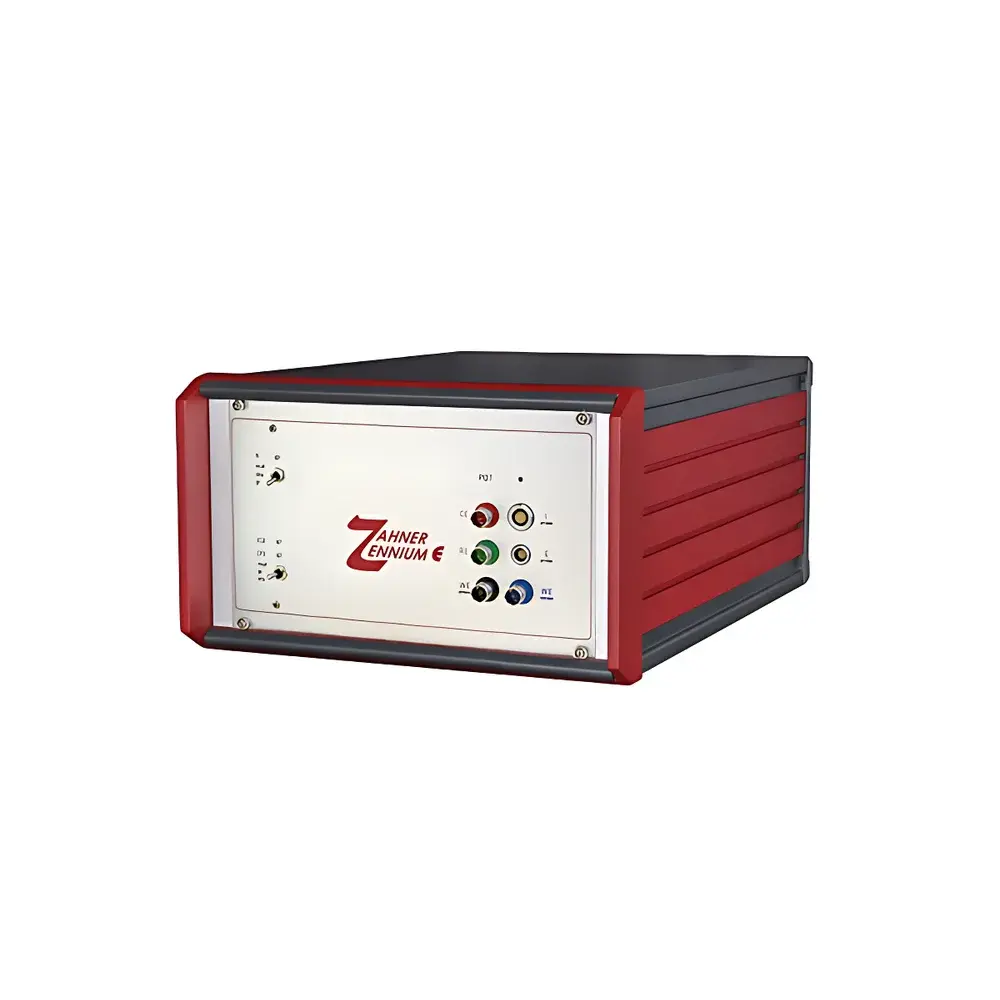
Zahner Zennium E4 Electrochemical Workstation
| Origin | Beijing |
|---|---|
| Manufacturer Type | Authorized Distributor |
| Origin Category | China-sourced (German-engineered) |
| Model | Zahner Zennium E4 |
| Pricing | Available Upon Request |
| Potentiostat Bandwidth | 5 MHz |
| EIS Frequency Range | 10 µHz – 4 MHz |
| Frequency Accuracy | ±0.0025% |
| Frequency Resolution | 0.0025%, 10,000 steps/decade |
| EIS Accuracy | ±0.2% @ 100 mΩ – 10 MΩ |
| Max Current Output | ±2 A |
| Applied Potential Range | ±12 V |
| Cell Voltage Compliance | ±14 V |
| Operating Modes | POT, GAL, OC, ZRA, FRA |
| Grounding Options | Switchable Grounded / Floating Configuration |
| IR Compensation | Real-time Automatic iR Compensation |
| ADC Resolution | Triple 18-bit Synchronized Analog-to-Digital Converters |
| Signal Processor | 410 MIPS ColdFire® v2 Core |
| Common-Mode Rejection Ratio (CMRR) | High-Precision U/I Amplifier Architecture |
| Noise Floor | Ultra-Low-Noise Potentiostat Design |
Overview
The Zahner Zennium E4 Electrochemical Workstation is a modular, high-fidelity electrochemical measurement system engineered in Germany and distributed globally with localized technical support infrastructure. Designed for demanding research and industrial R&D environments, the Zennium E4 integrates potentiostatic, galvanostatic, zero-resistance amperometry (ZRA), open-circuit potential (OCV), and frequency response analysis (FRA) capabilities into a single synchronized platform. Its core architecture employs a 5 MHz analog bandwidth potentiostat coupled with a dedicated 4 MHz frequency response analyzer — enabling high-resolution electrochemical impedance spectroscopy (EIS) from ultra-low frequencies (10 µHz) up to the megahertz regime. This wide dynamic range supports rigorous characterization of fast interfacial kinetics, double-layer charging, bulk diffusion, and distributed capacitance effects across diverse electrochemical systems. The instrument’s floating-ground capability — switchable via hardware configuration — permits safe, artifact-free measurements in electrically isolated or grounded-cell configurations, including buried pipeline corrosion studies, high-pressure autoclave electrochemistry, and grounded battery module testing.
Key Features
- Triple 18-bit synchronized analog-to-digital converters for simultaneous high-fidelity voltage, current, and auxiliary signal acquisition
- 410 MIPS ColdFire® v2 microprocessor enabling real-time data streaming, on-the-fly FFT processing, and deterministic timing control
- Ultra-low-noise potentiostat design optimized for sub-picoampere current resolution and stable low-current EIS measurements
- High CMRR U/I amplifier architecture minimizing common-mode interference in noisy laboratory or industrial settings
- Real-time automatic iR compensation with adaptive step adjustment during EIS or transient experiments
- Switchable grounding topology: configurable between earth-referenced and fully floating operation without external adapters or grounding kits
- Modular firmware architecture supporting user-defined experiment sequences, script-based automation (via ZPlot/ZView-compatible protocols), and hardware expansion
Sample Compatibility & Compliance
The Zennium E4 is compatible with standard three-electrode cells, rotating disk electrodes (RDE), microelectrodes, gas diffusion electrodes (GDE), and custom-built electrochemical reactors — including high-pressure, elevated-temperature, and corrosive-environment cells when paired with appropriate accessories. It meets essential electromagnetic compatibility (EMC) requirements per IEC 61326-1 and safety standards aligned with IEC 61010-1. While not certified as a medical device, its hardware design and firmware traceability support GLP-compliant workflows. Data integrity features include timestamped raw binary logging, checksum-verified file export, and optional audit trail modules compliant with FDA 21 CFR Part 11 when integrated with validated LIMS environments.
Software & Data Management
Zennium E4 operates natively with Thales XT — Zahner’s proprietary, Windows-based electrochemical software suite. Thales XT provides intuitive experiment setup wizards, real-time visualization of time-domain and frequency-domain responses, advanced equivalent circuit modeling (including distributed element models), and batch-processing tools for multi-sample EIS datasets. All raw data are stored in open-format .z files containing metadata (instrument ID, calibration timestamps, environmental conditions), enabling long-term reproducibility tracking. Export options include ASCII, CSV, and IMP format for interoperability with MATLAB®, Python (via PyZahner libraries), and commercial fitting packages such as EC-Lab® or Equivalent Circuit Analyzer (ECA). Firmware updates and calibration validation logs are digitally signed and version-controlled.
Applications
- Physical electrochemistry: charge transfer kinetics, diffusion-controlled processes, and Butler–Volmer parameter extraction
- Fuel cell R&D: membrane electrode assembly (MEA) impedance mapping, catalyst layer degradation monitoring, and humidity-dependent proton conductivity profiling
- Lithium-ion and solid-state battery development: SEI formation analysis, interfacial resistance evolution, and full-cell impedance deconvolution
- Photovoltaic and photoelectrochemical systems: electron lifetime estimation in dye-sensitized solar cells (DSSCs) and perovskite interfaces
- Corrosion science: electrochemical noise analysis (ENA), localized corrosion detection, and cathodic protection system evaluation in simulated soil or seawater electrolytes
- Electrochemical sensor development: sensitivity calibration, drift assessment, and selectivity validation under controlled interferent exposure
- Coating and inhibitor performance: pore resistance quantification, delamination onset detection, and long-term barrier property tracking
FAQ
Does the Zennium E4 support true floating-ground operation for underground pipeline corrosion monitoring?
Yes — the instrument features hardware-switchable grounding topology, allowing direct connection to grounded structures without ground loops or measurement artifacts.
Can the Zennium E4 perform simultaneous multi-channel EIS on two independent electrochemical cells?
No — it is a single-channel workstation. Multi-cell parallel testing requires external multiplexing hardware or sequential automated measurement routines.
Is the 4 MHz EIS capability usable down to 10 µHz without sacrificing accuracy?
Yes — the frequency sweep engine maintains ±0.0025% accuracy across the full 10 µHz–4 MHz range, with 10,000 logarithmic steps per decade ensuring high-resolution dispersion analysis.
What level of iR compensation does the Zennium E4 provide during potentiodynamic scans?
It offers real-time automatic iR compensation using current-interrupt or current-step methods, adjustable per segment within a scan protocol.
Are calibration certificates and traceable standards included with shipment?
Factory calibration is performed prior to dispatch; NIST-traceable calibration reports are available upon request and may be required for ISO/IEC 17025-accredited labs.



