
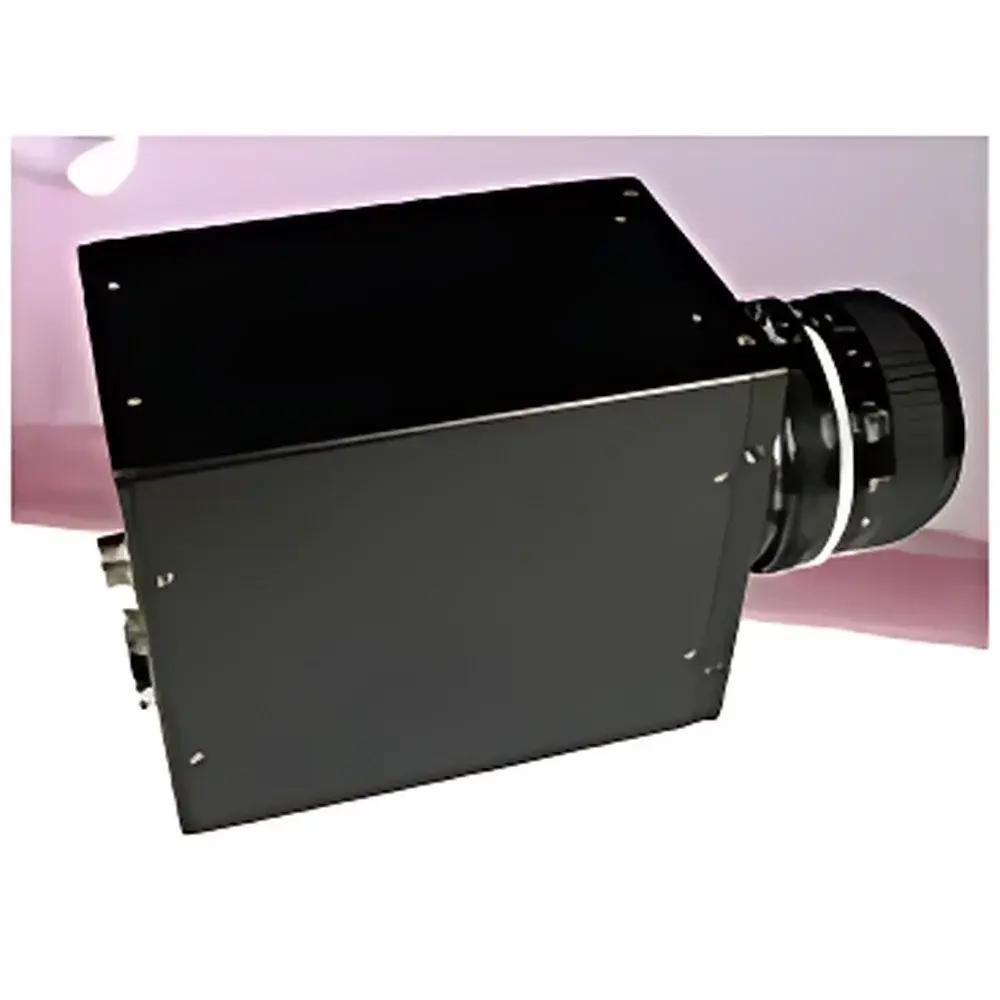
Quest-Innovations Condor3-CIE-618 Trichromatic CIE-Compliant Multispectral Camera
| Brand | Quest-Innovations |
|---|---|
| Origin | Netherlands |
| Manufacturer Type | Authorized Distributor |
| Origin Category | Imported |
| Model | Condor3-CIE-618 |
| Pricing | Upon Request |
| Sensor | ICX618 (640 × 494 pixels) |
| Optical Architecture | Prism-based trichroic beam splitting with CIE 1931 x̄(λ), ȳ(λ), z̄(λ) spectral filters |
| Frame Rate | Up to 120 fps |
| Bit Depth | 8-bit or 12-bit per channel |
| Triggering | Independent asynchronous triggering per channel |
| Gain & Exposure Control | Per-channel programmable gain and integration time |
| ROI Mode | Region-of-interest acquisition supported |
| Dynamic Range | >56 dB |
| Spectral Output Channels | CIE-X, CIE-Y, CIE-Z (tristimulus) |
Overview
The Quest-Innovations Condor3-CIE-618 is a trichromatic multispectral imaging system engineered for photometric and colorimetric fidelity in scientific and industrial applications requiring human vision–correlated spectral response. Unlike conventional RGB or monochrome CCD cameras, the Condor3-CIE-618 implements the CIE 1931 standard observer color matching functions (x̄(λ), ȳ(λ), z̄(λ)) directly at the optical level—using precision dielectric-coated prism beam splitters and spectrally matched interference filters. This architecture eliminates mechanical filter wheels and associated motion artifacts, enabling true simultaneous acquisition of all three tristimulus signals. The camera employs three identical Sony ICX618 progressive-scan CCD sensors (640 × 494 active pixels), each dedicated to one CIE channel, ensuring temporal registration at sub-millisecond resolution. Its design conforms to foundational principles of color science and supports traceable radiometric calibration protocols aligned with CIE Technical Reports (e.g., CIE TR 157:2004) and ISO/CIE 11664 series standards.
Key Features
- True simultaneous tristimulus capture via prism-based optical path separation—no temporal misalignment between CIE-X, CIE-Y, and CIE-Z channels
- Per-channel independent control of analog gain, integration time, and asynchronous external triggering—enabling high-dynamic-range (HDR) acquisition and stroboscopic synchronization
- Programmable region-of-interest (ROI) readout for reduced data volume and increased frame rate in targeted analysis zones
- Configurable output depth: 8-bit for real-time processing or 12-bit for quantitative photometric analysis requiring extended grayscale resolution
- Robust mechanical housing rated for integration into UAV gimbals, laboratory optical benches, and industrial inspection enclosures
- Low-noise analog signal chain and correlated double sampling (CDS) architecture supporting >56 dB dynamic range under controlled illumination conditions
Sample Compatibility & Compliance
The Condor3-CIE-618 is compatible with standard C-mount lenses and supports both collimated and focused illumination geometries typical in reflectance, transmittance, and emission measurement setups. It meets CE marking requirements for electromagnetic compatibility (EMC Directive 2014/30/EU) and low-voltage safety (LVD Directive 2014/35/EU). While not certified as medical device hardware per FDA 21 CFR Part 820, its output data format (raw 12-bit TIFF or packed binary) is suitable for integration into GLP-compliant workflows when paired with validated calibration procedures and NIST-traceable reference standards (e.g., calibrated diffusers, spectral lamps, and ceramic tiles per ISO 13655:2017). The camera’s fixed spectral response enables repeatable inter-instrument comparisons across distributed testing sites—a key requirement in multi-laboratory quality assurance programs governed by ISO/IEC 17025.
Software & Data Management
The camera operates with Quest-Innovations’ SDK (Windows/Linux, C/C++, Python bindings) and integrates natively with common machine vision frameworks including HALCON, OpenCV, and MATLAB Image Processing Toolbox. Acquired tristimulus data can be converted to CIE XYZ, xyY, or sRGB using standardized chromatic adaptation transforms (e.g., Bradford or CAT02) and stored in vendor-neutral formats compliant with TIFF/EP (ISO 12234-2) and HDF5. Audit trails—including exposure parameters, gain settings, timestamp metadata, and firmware revision—are embedded in image headers to support regulatory documentation needs. Optional add-ons include automated calibration routines referencing NIST SRM 2021a or equivalent daylight simulators, and batch-processing modules for spectral index computation (e.g., NDVI analogs adapted for CIE space).
Applications
- Remote Sensing & UAV Payloads: Real-time CIE-based vegetation health assessment, soil moisture mapping, and oil spill boundary detection via spectral contrast in tristimulus ratios
- Food Quality Inspection: Objective color consistency evaluation across production lines—detecting bruising, ripeness, or contamination without subjective observer bias
- Medical Imaging Research: Non-invasive tissue oxygenation monitoring and lesion characterization where melanin/hemoglobin spectral overlap necessitates CIE-aligned band separation
- Industrial Coating & Printing: In-line verification of spectral metamerism compliance against brand-specific color targets under multiple illuminants (D50, D65, A)
- Material Science: Quantitative analysis of thin-film interference, pigment dispersion homogeneity, and aging-induced spectral drift in polymer composites
FAQ
Is the Condor3-CIE-618 suitable for absolute radiometric measurements?
Yes—when used with factory-calibrated responsivity curves and NIST-traceable irradiance standards, it supports quantitative radiance and luminance calculations per CIE S 026/E:2015.
Can the camera operate under pulsed illumination sources?
Yes—its per-channel asynchronous trigger capability allows precise synchronization with laser pulses, flash lamps, or LED strobes down to microsecond-level jitter.
Does the SDK support real-time CIE xy chromaticity coordinate calculation?
Yes—the included software library provides optimized CPU/GPU-accelerated conversion pipelines from raw CIE-X/Y/Z counts to CIE 1931 chromaticity coordinates and correlated color temperature (CCT).
What is the maximum sustained frame rate at full resolution and 12-bit depth?
120 fps is achievable at full 640 × 494 resolution in 8-bit mode; at 12-bit, sustained throughput is 60 fps over Camera Link Base configuration or 40 fps over GigE Vision with packet reserving enabled.
Are calibration certificates provided with each unit?
Each Condor3-CIE-618 ships with a factory spectral responsivity report referenced to CIE 1931 CMFs and includes a certificate of conformance to optical alignment tolerances specified in Quest-Innovations QI-SPC-004 Rev. B.




