
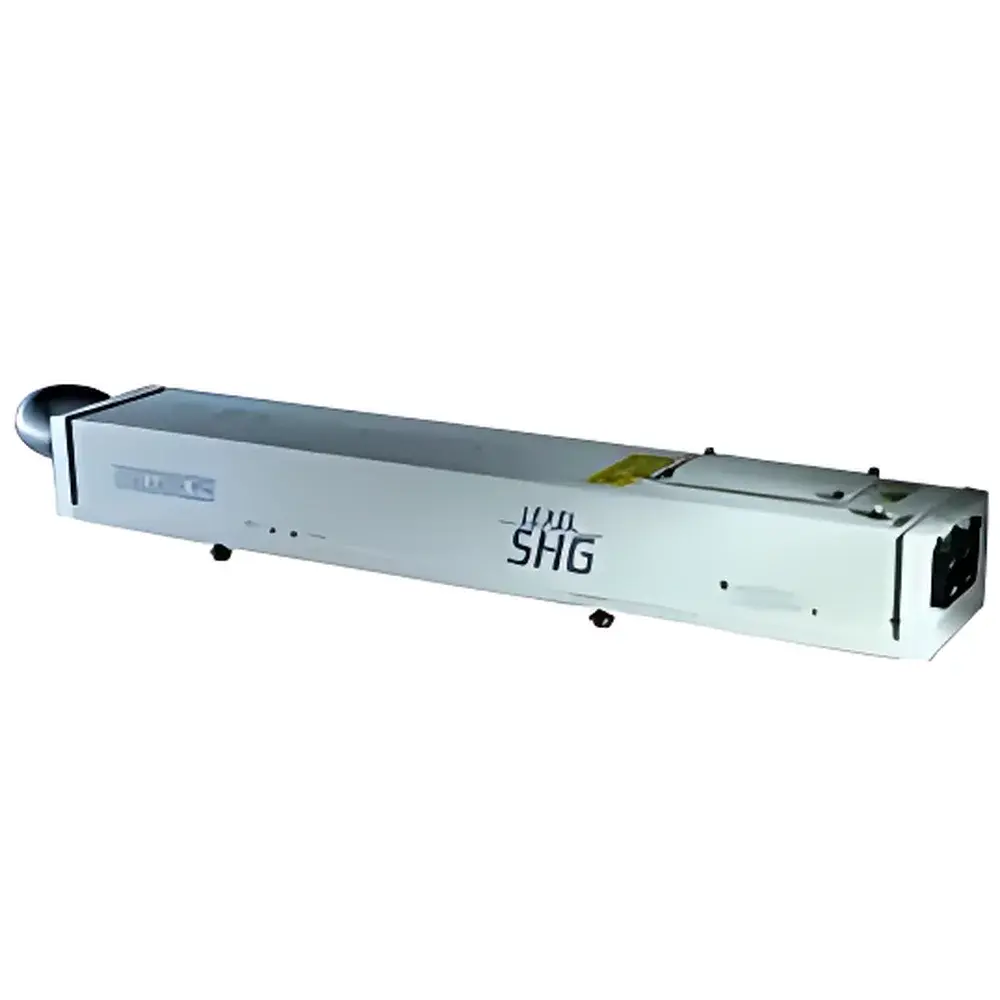
Lexel 85-SHG / 95-SHG Water-Cooled Fundamental-Frequency Argon Ion Laser
| Origin | USA |
|---|---|
| Manufacturer Type | Authorized Distributor |
| Origin Category | Imported |
| Model | 85-SHG / 95-SHG |
| Core Technology | Gas Laser System (Argon Ion) |
Overview
The Lexel 85-SHG and 95-SHG water-cooled fundamental-frequency argon ion lasers are precision-engineered continuous-wave (CW) gas lasers designed for high-stability, long-lifetime operation in demanding scientific and industrial environments. Based on the well-established plasma discharge principle within a sealed argon-filled quartz bore, these lasers generate coherent radiation across multiple discrete spectral lines in the visible and near-UV spectrum — including prominent lines at 457.9 nm, 476.5 nm, 488.0 nm, 496.5 nm, 501.7 nm, 514.5 nm, 528.7 nm, and 568.2 nm. Unlike frequency-doubled (SHG) variants, the fundamental-frequency configuration delivers maximum output power directly from the ionized argon plasma without nonlinear crystal conversion, ensuring superior power stability, reduced thermal drift, and higher optical efficiency for primary-line applications. Engineered for laboratory-grade reproducibility and OEM integration, these systems feature active water cooling with closed-loop temperature regulation, rigid mechanical architecture, and optimized magnetic confinement to sustain TEM00 spatial mode quality over extended operational periods.
Key Features
- Stable CW output across 8–10 discrete argon ion emission lines in the 457–568 nm range
- TEM00 beam profile with M² < 1.1, divergence ≤ 1.2 mrad, and pointing stability < ±5 µrad/hour
- Water-cooled plasma tube with integrated thermoelectric monitoring and flow-safety interlock
- Dual-model architecture: 85-SHG (medium-power platform, up to 2.4 W @ 514.5 nm) and 95-SHG (high-power platform, up to 24 W @ 514.5 nm)
- Modular power supply with soft-start sequencing, arc-current regulation, and real-time discharge voltage feedback
- Compliance with IEC 60825-1:2014 Class IV laser safety requirements; includes key-switched emission control and interlocked shutter interface
Sample Compatibility & Compliance
These lasers are compatible with standard optical tables, kinematic mounts, and beam delivery systems utilizing UV-grade fused silica or CaF₂ optics. The fundamental-frequency output eliminates concerns associated with SHG crystal degradation, photorefractive damage, or phase-matching drift — making them particularly suitable for long-duration experiments requiring unattended operation. All units conform to FDA 21 CFR Part 1040.10/1040.11 (U.S. laser product performance standard), CE marking per Directive 2014/35/EU (Low Voltage Directive) and 2014/30/EU (EMC Directive), and meet ISO 11146-1:2019 beam characterization requirements. Full documentation supports GLP/GMP audit readiness, including factory calibration reports traceable to NIST standards and comprehensive maintenance logs.
Software & Data Management
While inherently analog-controlled for maximum stability, optional digital interfaces (RS-232 and analog 0–10 V input/output) enable integration into automated test benches and process control environments. Compatible with LabVIEW™ drivers and Python-based control libraries (PyVISA), the system supports remote power modulation, interlock status polling, and runtime diagnostics. All firmware updates and configuration files are delivered via secure encrypted package; no cloud connectivity is embedded, preserving data sovereignty in regulated laboratories. Audit trails for operational parameters (discharge current, coolant temperature, runtime hours) are stored locally in non-volatile memory and exportable as CSV for QA review — satisfying FDA 21 CFR Part 11 electronic record requirements when deployed with validated timestamping infrastructure.
Applications
- Laser holography requiring high coherence length (>10 m) and low phase noise
- UV-Raman spectroscopy excitation at 244 nm, 248 nm, and 257 nm (via external harmonic generation)
- Semiconductor wafer inspection and defect mapping using 488 nm and 514.5 nm illumination
- Photolithography alignment and mask inspection in microfabrication cleanrooms
- Flow cytometry light source replacement for multi-line excitation schemes
- Fundamental research in atomic physics, including Doppler-free saturation spectroscopy and laser cooling precursor setups
FAQ
What distinguishes the fundamental-frequency argon ion laser from its SHG counterpart?
The fundamental-frequency version emits directly from the argon plasma at native visible wavelengths, offering higher wall-plug efficiency, improved long-term power stability, and elimination of nonlinear crystal aging effects inherent in second-harmonic generation systems.
Is water cooling mandatory, and what are the recommended chiller specifications?
Yes — active water cooling is required for thermal management of the plasma tube. A recirculating chiller with ±0.1 °C temperature stability, flow rate ≥ 3.5 L/min, and corrosion-resistant stainless-steel circuitry is recommended.
Can the laser be operated in single-line mode, and how is line selection achieved?
Yes — discrete line selection is accomplished via intracavity prism or birefringent filter tuning; all models support manual or motorized wavelength selection with < ±0.05 nm repeatability.
What is the typical lifetime of the plasma tube under rated operating conditions?
Rated tube lifetime exceeds 20,000 hours at nominal current; accelerated life testing shows >95% output retention after 15,000 hours under continuous operation at 80% of max current.
Are service contracts and spare parts available internationally?
Yes — global technical support, certified field service engineers, and genuine OEM replacement tubes and power supplies are available through authorized distribution partners in EMEA, APAC, and the Americas.




