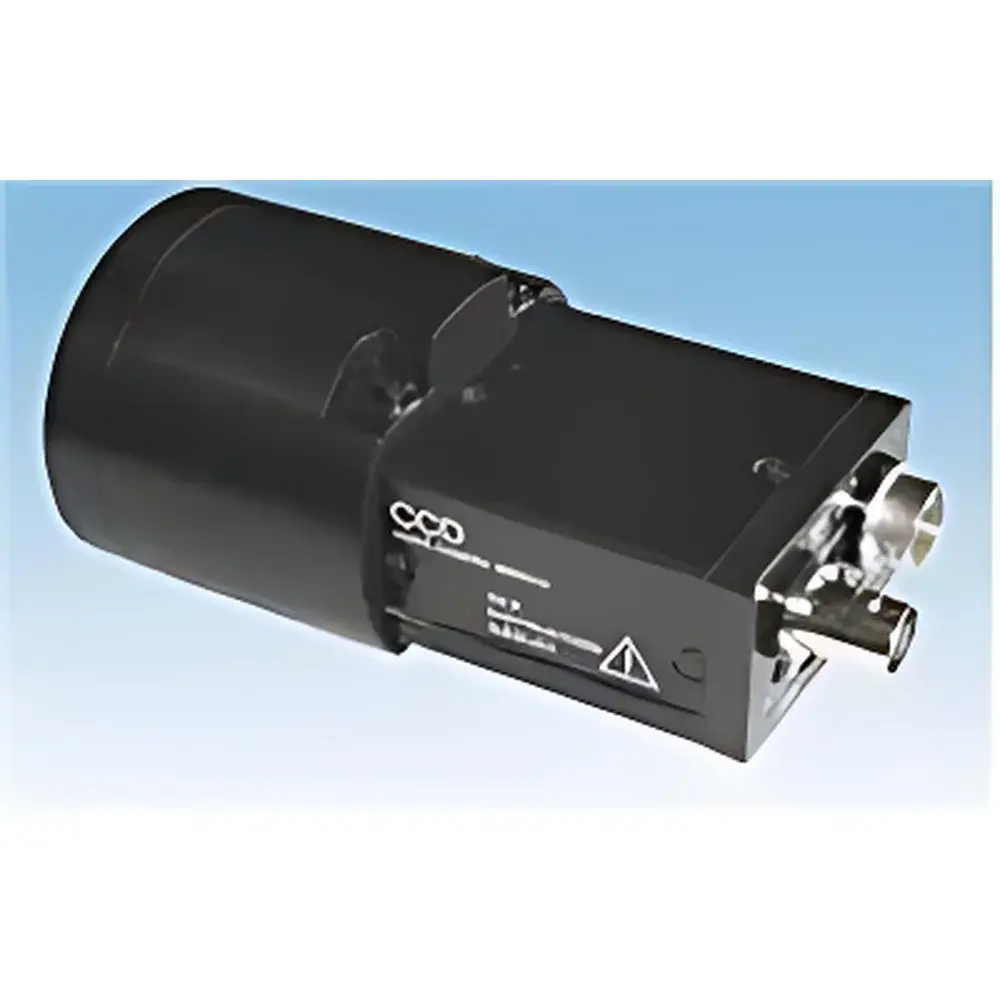
Proxivision HR-25-X-Ray Fiber-Optic Coupled X-ray Detector
| Brand | Proxivision |
|---|---|
| Origin | Canada |
| Model | HR-25-X-Ray |
| Coupling | 1:1 Fiber-Optic Taper |
| Coupling Efficiency | up to 70% |
| Sensor Format | 2/3″ CCD, 752 × 582 pixels |
| Pixel Size | 11.6 µm × 11.2 µm |
| Output | CCIR analog or 8/12-bit digital |
| Frame Rate | 17–30 fps |
| Field of View | 20 mm × 15 mm (configurable) |
| Scintillator | P43 phosphor (25 mg/cm², 55 µm thick) |
| X-ray Energy Range | 20–100 keV |
| Input Window | 0.5 mm Al foil (customizable) |
| Spatial Resolution | ≤50 µm / 10 lp/mm |
| Dimensions | Ø55 mm × 68 mm |
| Compliance | RoHS, CE-marked for industrial & NDT use |
Overview
The Proxivision HR-25-X-Ray is a high-performance, fiber-optic coupled X-ray detector engineered for precision radiographic imaging in demanding industrial and scientific applications. Unlike conventional lens-coupled or direct-detection architectures, this detector employs a monolithic 1:1 fiber-optic taper to interface the scintillation screen directly with the CCD sensor. This optical coupling method preserves spatial fidelity across the entire field of view—eliminating geometric distortion, eliminating the need for real-time image correction algorithms, and significantly reducing software complexity in integrated inspection systems. The design achieves up to 70% photon transmission efficiency from X-ray–induced visible light generated in the P43 phosphor layer, substantially improving detective quantum efficiency (DQE) at diagnostic and industrial X-ray energies (20–100 keV). Its compact cylindrical form factor (Ø55 mm × 68 mm) enables seamless integration into constrained spaces such as inline CT gantries, microfocus X-ray inspection stations, and portable NDT platforms.
Key Features
- Fiber-optic taper coupling ensures zero geometric distortion and native 1:1 pixel mapping—no software-based flat-field or pincushion correction required.
- High DQE optimized via P43 scintillator (25 mg/cm², 55 µm thickness), delivering superior contrast sensitivity for low-dose imaging scenarios.
- Robust mechanical architecture with removable, customizable input window (standard 0.5 mm Al; optional ITO-coated or vacuum-compatible variants available).
- Flexible output options: CCIR-compliant analog video signal or 8/12-bit digital output via programmable timing registers.
- Thermally stable housing designed for continuous operation under ambient temperature fluctuations typical in factory-floor environments.
- RoHS-compliant construction and CE marking for deployment in regulated industrial settings compliant with ISO 9001 and EN 61326-1 standards.
Sample Compatibility & Compliance
The HR-25-X-Ray is compatible with sealed-tube, microfocus, and open-tube X-ray sources operating within the 20–100 keV range. Its aluminum entrance window provides inherent beam filtration while maintaining adequate transmission for medium-energy applications including PCB solder-joint inspection, BGA void analysis, semiconductor wire-bond evaluation, and cast-metal porosity assessment. When deployed in GMP-aligned manufacturing lines—such as those governed by ISO 13485 or IATF 16949—the detector supports audit-ready documentation packages, including calibration traceability to NIST-traceable X-ray reference sources and full MTF characterization reports. Optional vacuum flange integration allows compatibility with high-vacuum X-ray diffraction or electron-beam-excited luminescence setups.
Software & Data Management
The detector operates without proprietary drivers; analog output integrates natively with standard frame grabbers supporting CCIR/RS-170 protocols, while digital variants support IEEE 1394a (FireWire) or GigE Vision-compliant acquisition stacks. All firmware and register-level control are accessible via ASCII command protocol over RS-232 or Ethernet, enabling deterministic synchronization with external triggers (TTL or LVDS) and precise exposure timing down to 10 µs resolution. Raw image data retains full bit-depth integrity—critical for post-processing workflows involving histogram equalization, edge-enhanced segmentation, or AI-assisted defect classification pipelines trained on uncorrected radiographs. Audit trail functionality—including timestamped gain/offset logs and sensor temperature telemetry—is supported when interfaced with GLP/GMP-compliant data acquisition suites.
Applications
- Industrial non-destructive testing: weld integrity verification, casting porosity mapping, turbine blade inspection, and additive manufacturing part qualification.
- Electronics failure analysis: BGA interconnect void detection, IC package delamination assessment, bond wire break localization, and PCB trace continuity validation.
- Security & defense: cargo screening, explosive residue identification, and contraband detection using dual-energy subtraction techniques.
- Scientific instrumentation: synchrotron beamline end-stations, laboratory-scale X-ray tomography, and time-resolved radiography experiments requiring sub-50 µm spatial resolution.
- Custom OEM integration: embedded modules for dental panoramic imagers, veterinary DR panels, and real-time X-ray fluorescence (XRF) mapping systems.
FAQ
What scintillator materials can be substituted for the standard P43 layer?
Proxivision offers validated alternatives including Gd₂O₂S:Tb (P46), CsI:Tl, and custom-thickness ZnS:Ag screens—each characterized for MTF, afterglow, and DQE response across the 20–100 keV band.
Is the HR-25-X-Ray suitable for use in vacuum environments?
Yes—optional CF-35 or KF-25 vacuum feedthrough variants are available, with hermetically sealed electronics and outgassing-certified materials compliant with UHV (<1×10⁻⁷ mbar) specifications.
Can the detector be calibrated for absolute dose measurement?
While not a dosimeter per se, the detector’s linear response (R² > 0.999 over 4 orders of magnitude) and NIST-traceable gain calibration enable quantitative radiometric mapping when paired with an ionization chamber reference.
Does the system support synchronized multi-camera acquisition?
Yes—via hardware trigger input (TTL/LVDS) with jitter < 20 ns, enabling precise temporal alignment in laminography or stereo-radiography configurations.
What is the expected lifetime of the P43 scintillator under continuous 50 kVp irradiation?
Accelerated aging tests indicate >5 × 10⁹ integrated X-ray photons/cm² before measurable luminance degradation (10 years of typical industrial NDT usage.