
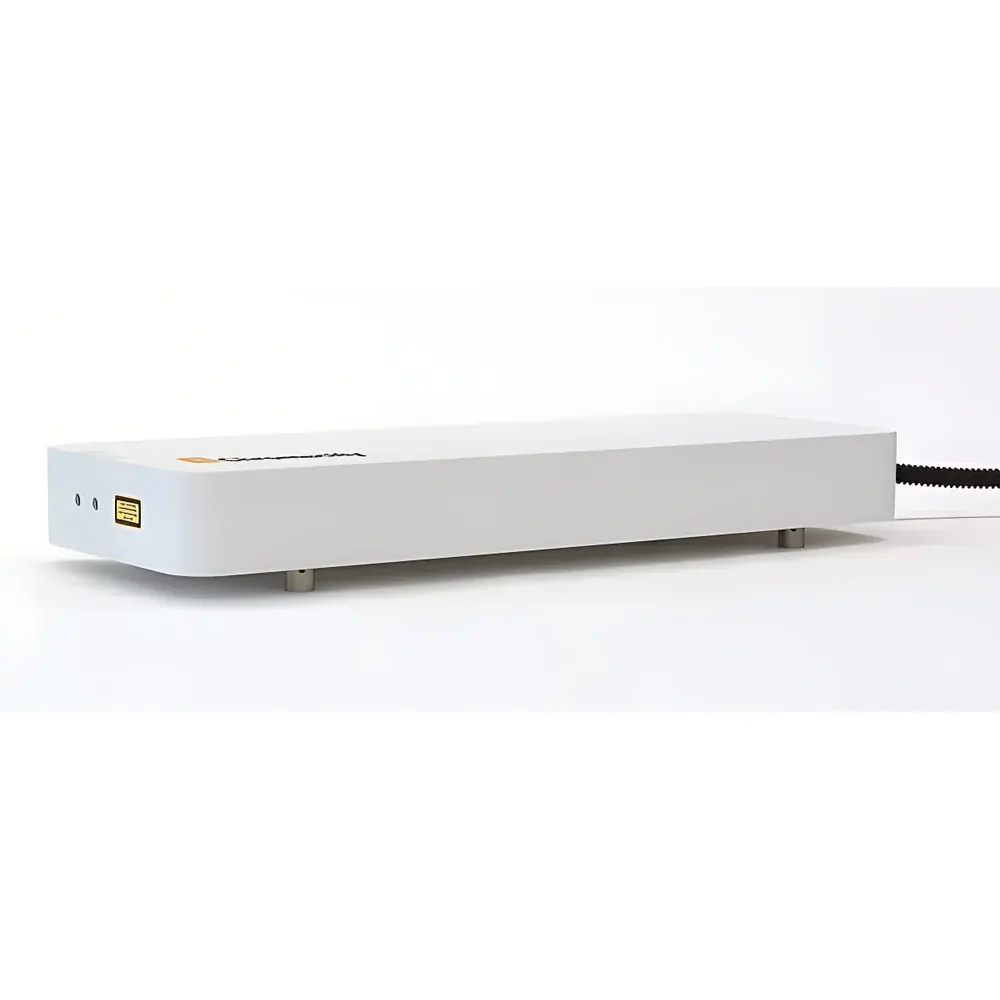
Chromacity Spark FIR Mid-Infrared Optical Parametric Oscillator
| Brand | Chromacity |
|---|---|
| Origin | United Kingdom |
| Model | Spark FIR |
| Wavelength Range | 5–12 µm |
| Output Power | 75 mW @ 5–7 µm, 10 mW @ 12 µm |
| Pump Source | Spark 1040 |
| Pump Wavelength | 1040 nm |
| Repetition Rate | 100 MHz |
| Cooling Method | Air-cooled |
| Laser Head Dimensions | 970 × 245 × 82 mm |
| Controller Dimensions | 483 × 285 × 86 mm |
| Laser Head Weight | 18 kg |
| Controller Weight | 2 kg |
| Power Supply | 110–240 V AC, 50–60 Hz |
| Interface | Ethernet |
| Compliance | CE, RoHS, IEC 61000-6-3/6-4 |
| Optional Output | Residual Pump Beam (1040 nm) |
Overview
The Chromacity Spark FIR is the world’s first commercially available broadband ultrafast optical parametric oscillator (OPO) engineered for continuous, high-repetition-rate operation across the critical 5–12 µm mid-infrared (MIR) spectral region. Leveraging quasi-phase-matched (QPM) orientation-patterned gallium arsenide (OP-GaAs) nonlinear crystals, the Spark FIR delivers coherent, tunable MIR pulses synchronized to a high-stability 100 MHz femtosecond pump laser at 1040 nm. This architecture enables access to the molecular “fingerprint region”, where fundamental vibrational transitions of organic and inorganic compounds exhibit strong, spectrally distinct absorption features. Unlike thermal or quantum cascade-based sources, the Spark FIR provides transform-limited pulse durations (sub-100 fs), narrow instantaneous linewidths (<5 cm⁻¹), and excellent amplitude and phase stability—attributes essential for time-resolved spectroscopy, dual-comb applications, and coherent control experiments.
Key Features
- Commercially deployed QPM-based OPO operating continuously from 5 to 12 µm—covering over 1000 cm⁻¹ of unbroken spectral bandwidth
- High average power output: up to 75 mW between 5–7 µm and 10 mW at 12 µm, enabling rapid signal averaging and high signal-to-noise ratio (SNR) measurements
- Integrated 100 MHz femtosecond Yb-fiber pump laser (Spark 1040) with industrial-grade thermal management and long-term pointing stability
- Air-cooled design eliminates need for chilled water or cryogenic infrastructure—reducing footprint, operational cost, and maintenance complexity
- Optional residual 1040 nm beam delivery via fiber-coupled port for pump-probe or dual-wavelength experiments
- Fully Ethernet-enabled control interface supporting remote configuration, real-time monitoring, and integration into automated lab environments
- Ruggedized mechanical architecture with precision kinematic mounts and vibration-damped optical baseplate for stable field deployment
Sample Compatibility & Compliance
The Spark FIR is compatible with standard FTIR accessories—including gas cells (path lengths 10 cm–10 m), liquid transmission cells, attenuated total reflection (ATR) modules, and reflective sampling stages for solids and thin films. Its high brightness and coherence support both transmission and photoacoustic detection modalities. The system complies with CE marking requirements under the EU Electromagnetic Compatibility Directive (2014/30/EU) and Low Voltage Directive (2014/35/EU). It meets IEC 61000-6-3 (emissions) and IEC 61000-6-4 (immunity) standards. All firmware and controller software are designed in accordance with ISO/IEC 17025:2017 guidelines for calibration laboratories, and data logging supports audit-trail functionality required for GLP and GMP-regulated environments.
Software & Data Management
Chromacity Control Suite—a cross-platform (Windows/macOS/Linux), Python- and MATLAB-compatible application—provides intuitive wavelength tuning, power stabilization feedback, and real-time spectral preview via integrated pyroelectric array detectors. The software exports fully annotated datasets in HDF5 and CSV formats, preserving metadata including timestamp, pump power, crystal temperature, and environmental sensor readings (ambient temperature/humidity). Remote API access allows integration with LabVIEW, EPICS, or custom acquisition pipelines. All configuration changes and measurement logs are stored with cryptographic timestamps, satisfying traceability requirements under FDA 21 CFR Part 11 for regulated analytical workflows.
Applications
- Molecular fingerprint spectroscopy: Identification and quantification of volatile organic compounds (VOCs), pharmaceutical polymorphs, and biomarkers in complex matrices
- Real-time breath analysis: Non-invasive detection of acetone (diabetes), ammonia (renal function), and NO (asthma inflammation) at sub-ppb levels
- Gas-phase reaction dynamics: Time-resolved monitoring of combustion intermediates (e.g., CO, CH₄, HCN) and atmospheric radical species (OH, HO₂)
- High-resolution hyperspectral imaging: Pixel-by-pixel chemical mapping of tissue sections, polymer blends, and battery electrode degradation
- Photoacoustic spectroscopy (PAS): Background-free detection in scattering media using resonant cell designs optimized for 5–12 µm excitation
- Materials characterization: Phonon mode analysis in 2D materials (e.g., MoS₂, h-BN), ferroelectrics, and topological insulators
FAQ
Is the Spark FIR compatible with existing FTIR spectrometers?
Yes—the output beam is collimated (1/e² diameter ~2 mm) and spatially mode-matched to standard FTIR input optics. Optional coupling optics kits enable direct integration with Bruker, Thermo Fisher, and PerkinElmer benchtop systems.
Can the output wavelength be tuned continuously across 5–12 µm?
Tuning is achieved by adjusting the OP-GaAs crystal temperature (±0.1 °C stability) and angular orientation; full coverage requires two interchangeable crystal sets—each optimized for 5–8 µm or 8–12 µm—to maintain >70% quantum conversion efficiency across the band.
What maintenance is required for long-term operation?
No consumables or periodic alignment are needed. Annual verification of pump laser mode quality and OPO cavity alignment is recommended; Chromacity offers certified on-site service and remote diagnostics support.
Does the system support synchronization with external equipment?
Yes—100 MHz TTL sync output and programmable delay generators (via Ethernet) enable precise timing with ultrafast detectors, choppers, or scanning stages for pump-probe or lock-in configurations.




