
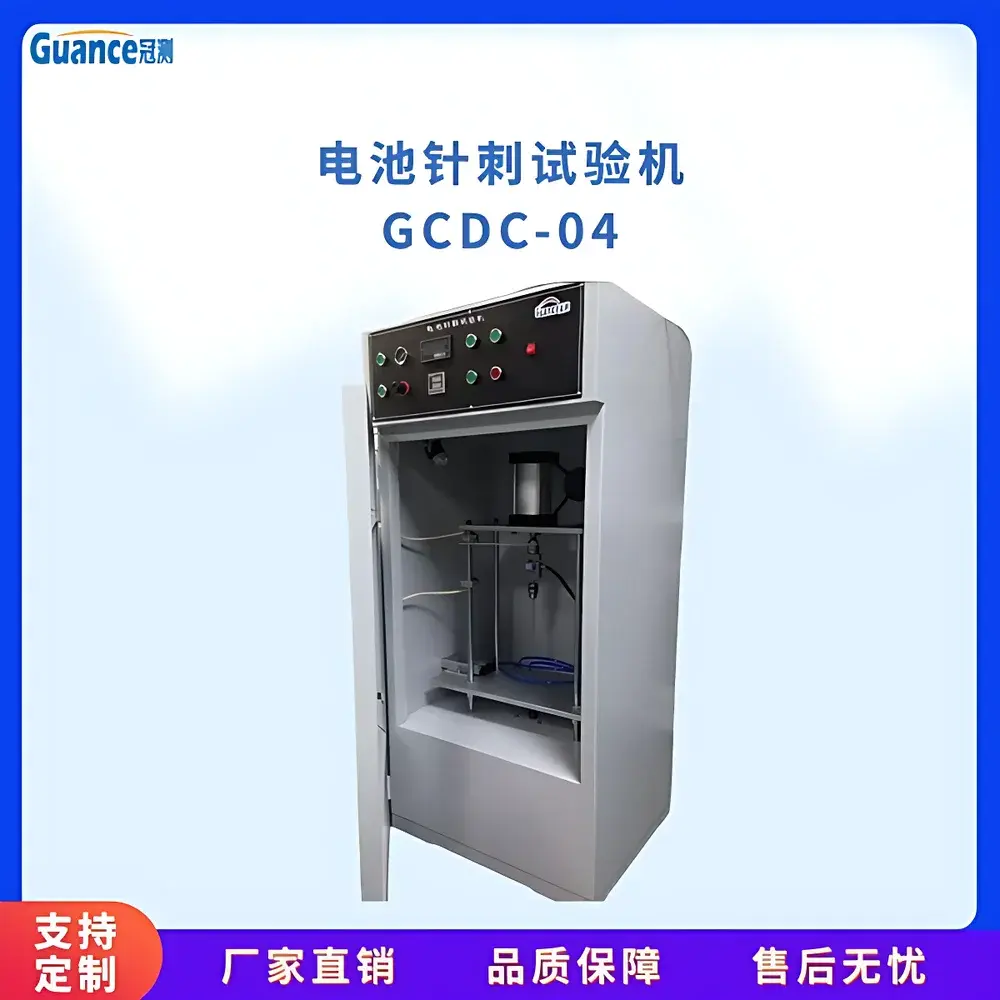
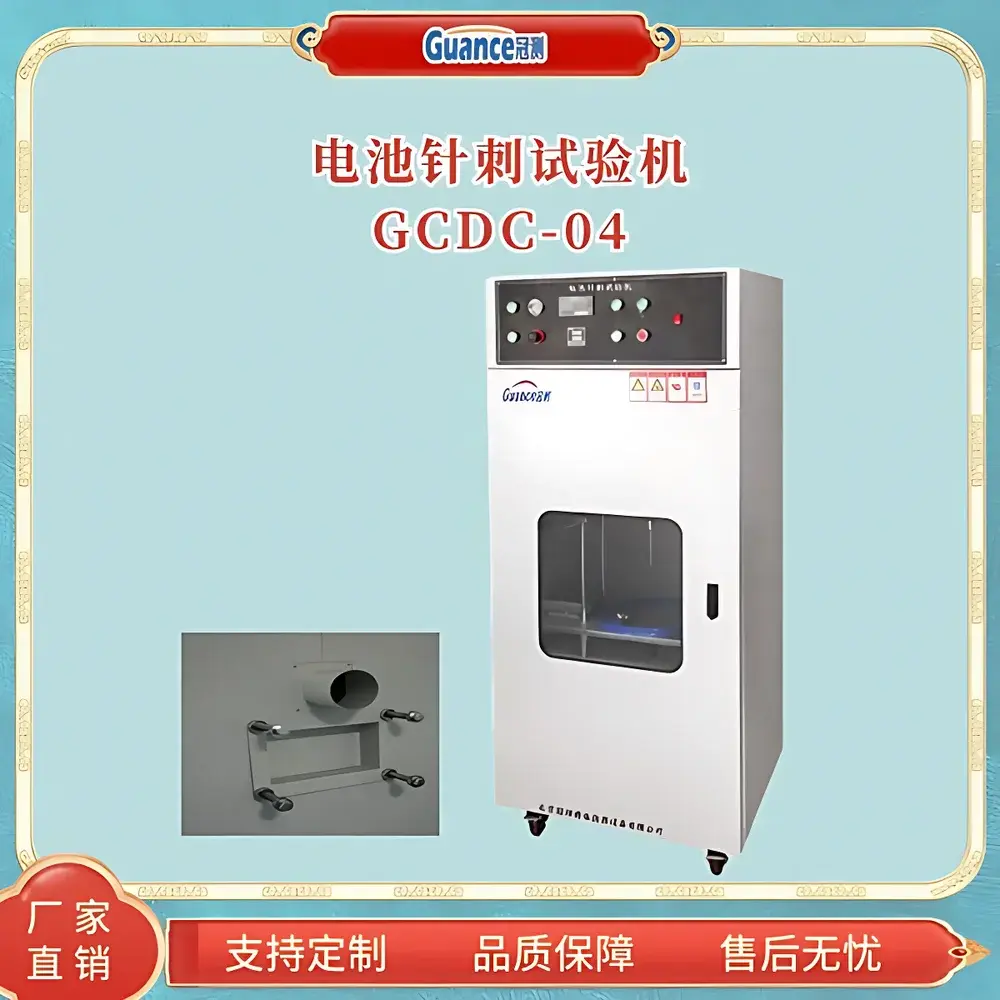

GuanCe Instruments GCDC-04.2 Battery Nail Penetration & Physical Safety Tester
| Brand | GuanCe Instruments |
|---|---|
| Origin | Beijing, China |
| Manufacturer Type | Authorized Distributor |
| Country of Origin | China |
| Model | GCDC-04.2 |
| Price | USD 2,580 (FOB Beijing) |
| Drive Mechanism | Pneumatic Cylinder |
| Maximum Penetration Force | 200 kgf (1.96 kN) |
| Force Resolution | 10 N |
| Sensor Resolution | 1/10,000 |
| Penetration Speed | 10–40 mm/s (adjustable, independently displayed) |
| Needle Diameter | Φ2–Φ8 mm stainless steel, L = 100 mm, heat-resistant, corrosion-resistant, 2 pcs per size |
| Penetration Direction | Perpendicular to electrode plate surface |
| Stroke | 100 mm |
| Test Chamber Dimensions | 300 × 200 × 300 mm (W×H×D) |
| Chamber Material | Inner – 1.5 mm SUS304 stainless steel lined with PTFE |
| Observation Window | 200 × 200 mm triple-layer vacuum tempered glass with explosion-proof mesh and LED lighting |
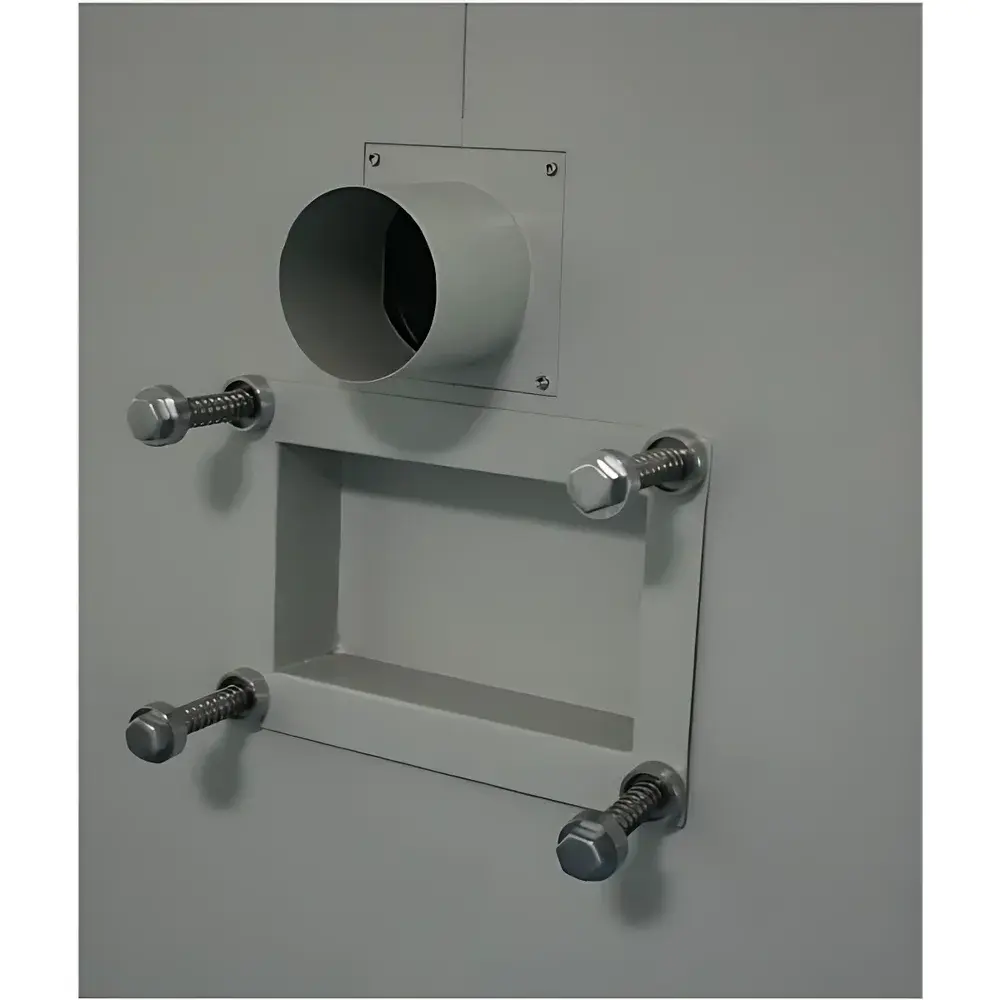
| Ventilation | Rear-mounted 120 mm exhaust fan + duct interface, auto-activated on power-up |
| Explosion Relief | Rear-mounted pressure-relief door |
| Safety Interlock | Door-mounted limit switch (power cut-off upon opening) |
| Data Acquisition | 80 Hz sampling rate for force, time, displacement, and optional thermocouple/voltage/current inputs |
| Delay Timer | 0–99 h/min/sec programmable |
| Power Supply | AC 220 V, 50–60 Hz, 5 A |
| Rated Power | 1100 W |
| Net Weight | ~120 kg |
| Footprint | 610 × 600 × 1200 mm (L×W×H) |
| Mobility | Four swivel casters with brakes |
Overview
The GuanCe Instruments GCDC-04.2 Battery Nail Penetration & Physical Safety Tester is a purpose-built, pneumatically actuated safety evaluation system engineered for standardized mechanical abuse testing of lithium-based electrochemical cells and battery packs. It implements the controlled, high-fidelity nail penetration protocol defined in major international safety standards—including GB 31241, IEC 62281, UL 1642, and UN 38.3—to assess thermal runaway initiation under worst-case internal short-circuit conditions. The device operates on the principle of dynamic mechanical intrusion: a calibrated, temperature-stable stainless-steel needle is driven at a precisely regulated velocity (10–40 mm/s) perpendicular to the largest planar surface of the cell—mimicking dendrite-induced or foreign-object-induced internal short circuits. Real-time force, displacement, and time data are acquired at 80 Hz, enabling quantitative analysis of penetration resistance, peak load, and mechanical failure thresholds. All tests occur inside a fully enclosed, PTFE-lined stainless-steel test chamber rated for Class 1 hazardous energy release, with integrated explosion relief, forced ventilation, and optical observation—ensuring operator safety and experimental reproducibility under ISO/IEC 17025-aligned laboratory conditions.
Key Features
- Pneumatic drive system delivering consistent, repeatable penetration force up to 200 kgf (1.96 kN), with force resolution of ±10 N and sensor linearity better than 0.1% FS.
- Modular needle set: Two each of Φ2 mm, Φ3 mm, Φ4 mm, Φ5 mm, Φ6 mm, Φ8 mm heat-treated stainless-steel needles (100 mm length), compliant with GB 31241 and UL 1642 dimensional requirements.
- Triple-layer vacuum-sealed observation window (200 × 200 mm) with embedded explosion-proof wire mesh and high-CRI LED illumination—enabling unobstructed visual monitoring without compromising containment integrity.
- Fail-safe interlocked design: Door-mounted limit switch cuts main power immediately upon opening; rear-mounted pressure-relief door activates automatically at ≥15 kPa overpressure.
- Integrated 120 mm exhaust system with automatic fan activation on power-up, plus dedicated 50 mm feedthrough port for thermocouple, voltage, and current signal routing—supporting simultaneous thermal-electrochemical profiling.
- Programmable delay timer (0–99 h/min/sec) and independent digital speed display ensure strict adherence to standard-specified dwell times and velocity tolerances.
Sample Compatibility & Compliance
The GCDC-04.2 accommodates prismatic, pouch, and cylindrical cells—as well as small-format modules—up to 350 × 350 × 60 mm. Its 300 × 200 × 300 mm test volume provides sufficient clearance for thermal expansion, gas venting, and flame propagation during failure events. The system is fully aligned with the mechanical abuse test clauses of GB 31241-2014, IEC 62281:2012, UL 1642:2012, UN Manual of Tests and Criteria Part III, Subsection 38.3, and YD/T 2344.1-2011. Chamber construction meets UL 508A enclosure requirements for industrial control equipment, while PTFE lining ensures chemical inertness against electrolyte decomposition byproducts (e.g., HF, PF₅). Optional thermocouple mounting fixtures support ASTM E595-compliant outgassing measurement protocols when used with external data loggers.
Software & Data Management
The GCDC-04.2 employs an embedded microcontroller-based force and motion control system with analog-to-digital conversion at 16-bit resolution. Raw test data—including force (N), displacement (mm), time (ms), and user-defined analog inputs—are timestamped and exported via USB to CSV format for post-processing in MATLAB, Python (Pandas), or industry-standard statistical analysis tools. While no proprietary GUI is included, the device supports GLP-compliant audit trails when integrated with validated third-party laboratory information management systems (LIMS) that enforce 21 CFR Part 11 electronic signature and change-control workflows. All calibration records, maintenance logs, and test reports may be archived with metadata (operator ID, ambient T/RH, sample ID, standard reference) to satisfy ISO/IEC 17025 clause 7.8 and IATF 16949 traceability requirements.
Applications
- Pre-certification safety validation of Li-ion, Li-polymer, and LiFePO₄ cells prior to UN 38.3, CE, CCC, or KC mark submission.
- R&D screening of separator mechanical strength, electrode stack compression tolerance, and jelly-roll structural integrity under localized stress.
- Quality assurance testing for battery manufacturers performing incoming inspection of cell lots from Tier-1 suppliers.
- Failure mode and effects analysis (FMEA) of thermal runaway propagation pathways in multi-cell modules.
- Supporting DOE-funded projects requiring NIST-traceable mechanical abuse datasets for AI-driven battery safety modeling.
FAQ
Does the GCDC-04.2 comply with UL 1642 Section 9 (Nail Penetration Test)?
Yes—the device satisfies all dimensional, velocity, needle material, and environmental control requirements specified in UL 1642:2012 Clause 9.2, including 20 ± 5 °C ambient operation and post-penetration observation for fire/explosion within 1 hour.
Can thermocouples be installed directly on the cell surface during testing?
Yes—the 50 mm right-side feedthrough port and internal chamber mounting points allow secure attachment of K-type or T-type thermocouples to the cell’s geometric center, with leads routed to external data loggers.
Is calibration certification provided with the instrument?
Each unit ships with a factory calibration report traceable to CNAS-accredited standards; annual recalibration using NIST-traceable deadweight testers is recommended per ISO/IEC 17025.
What maintenance is required for long-term pneumatic system reliability?
Monthly inspection of air filter regulator lubricator (FRL) units, quarterly replacement of cylinder seals, and biannual verification of pressure transducer linearity using certified load cells.
Can the GCDC-04.2 be integrated into an automated battery testing line?
Yes—digital I/O ports (opto-isolated) support TTL-level start/stop triggers and status feedback (test complete, overpressure, door open), enabling synchronization with robotic handlers and MES systems.



