
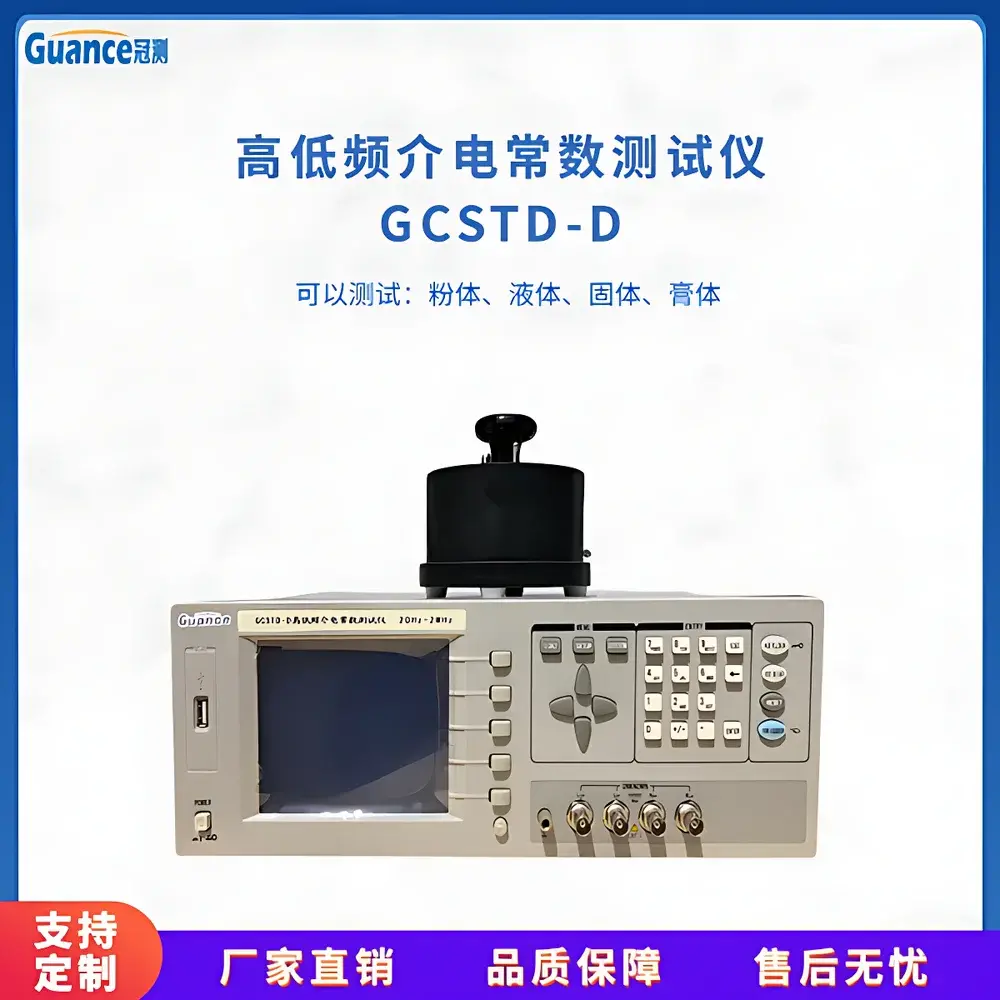
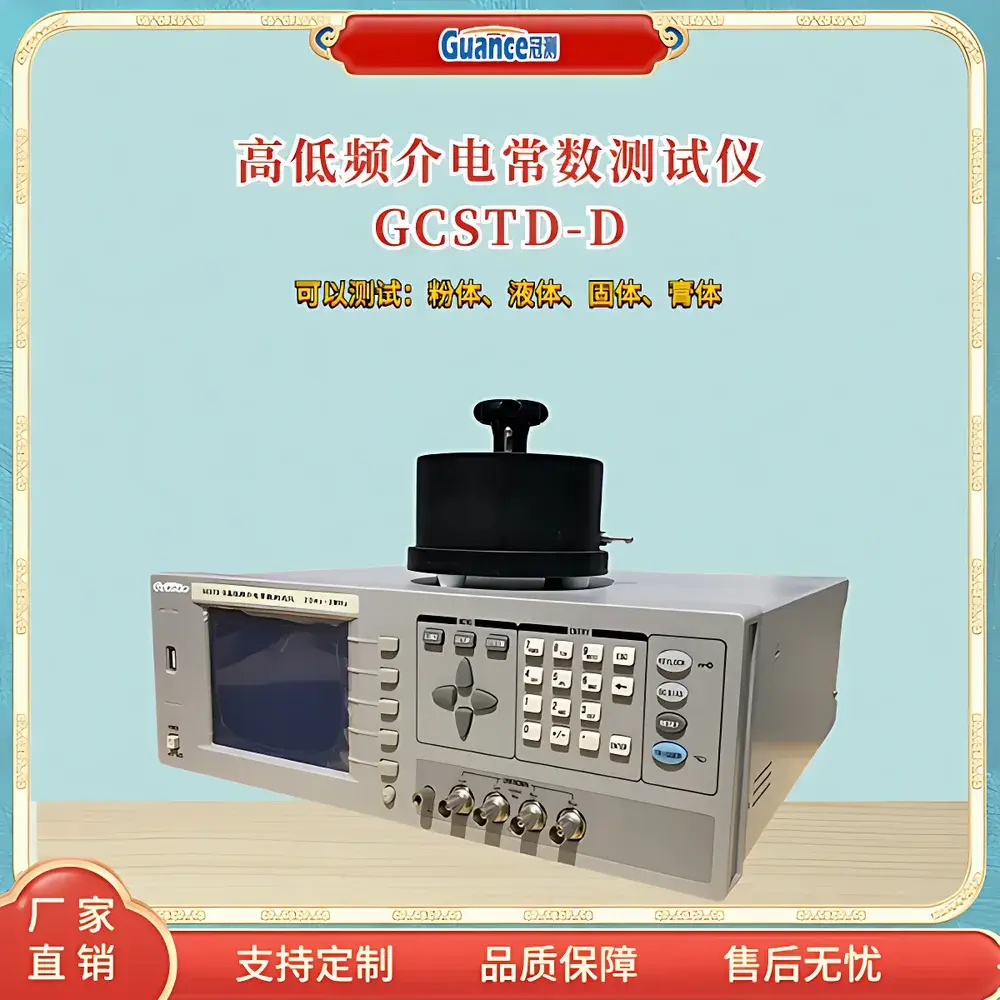
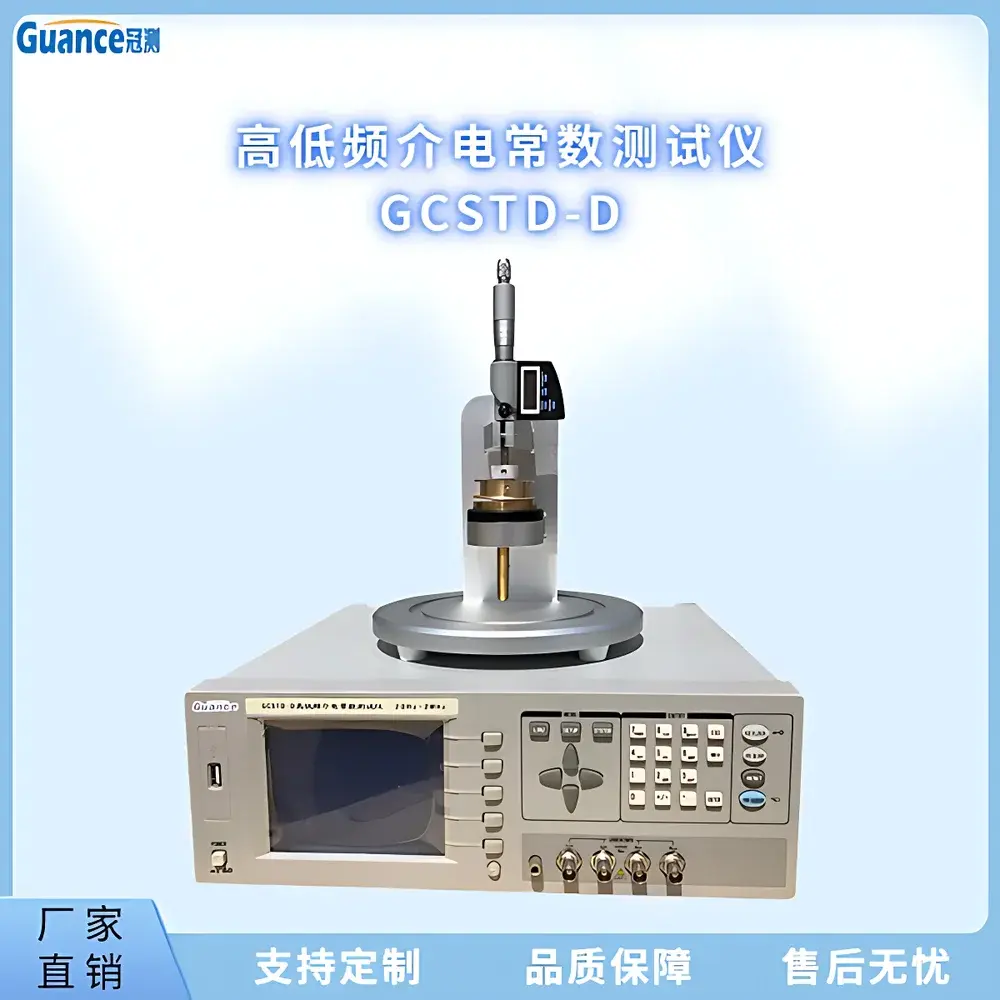
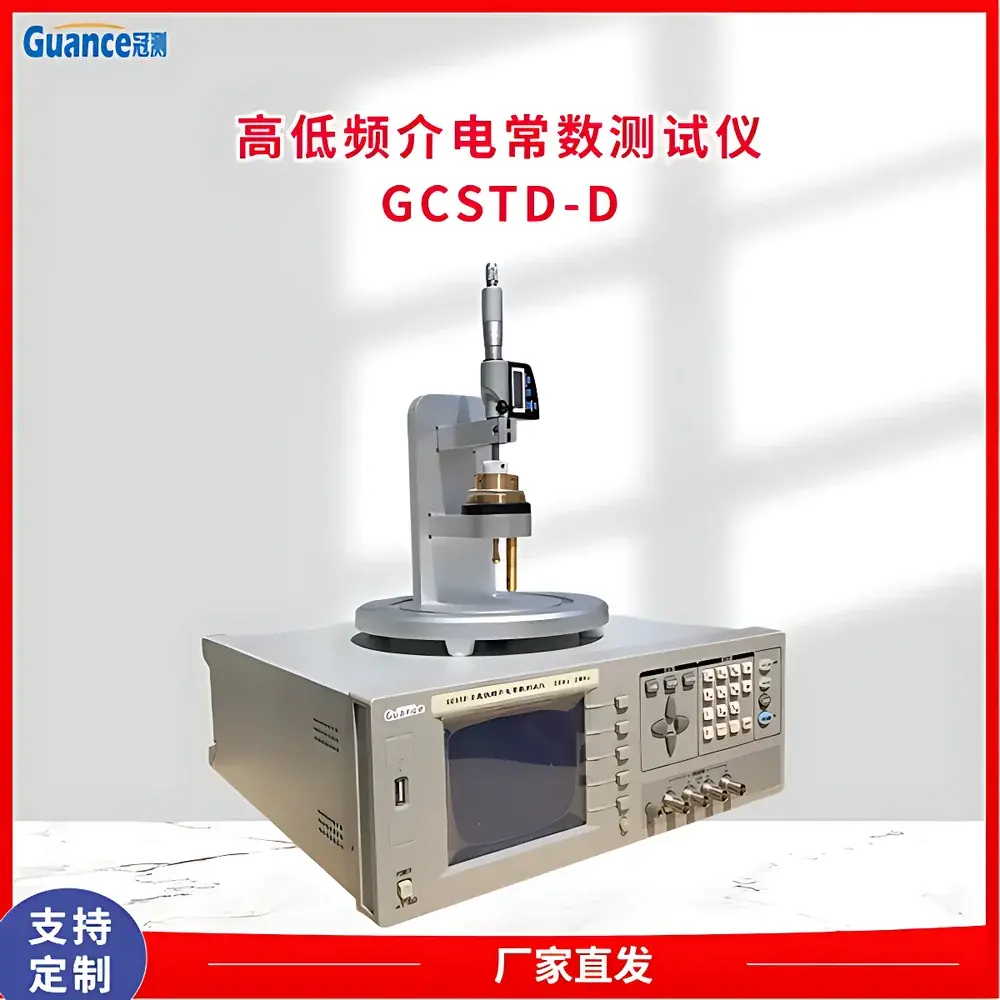
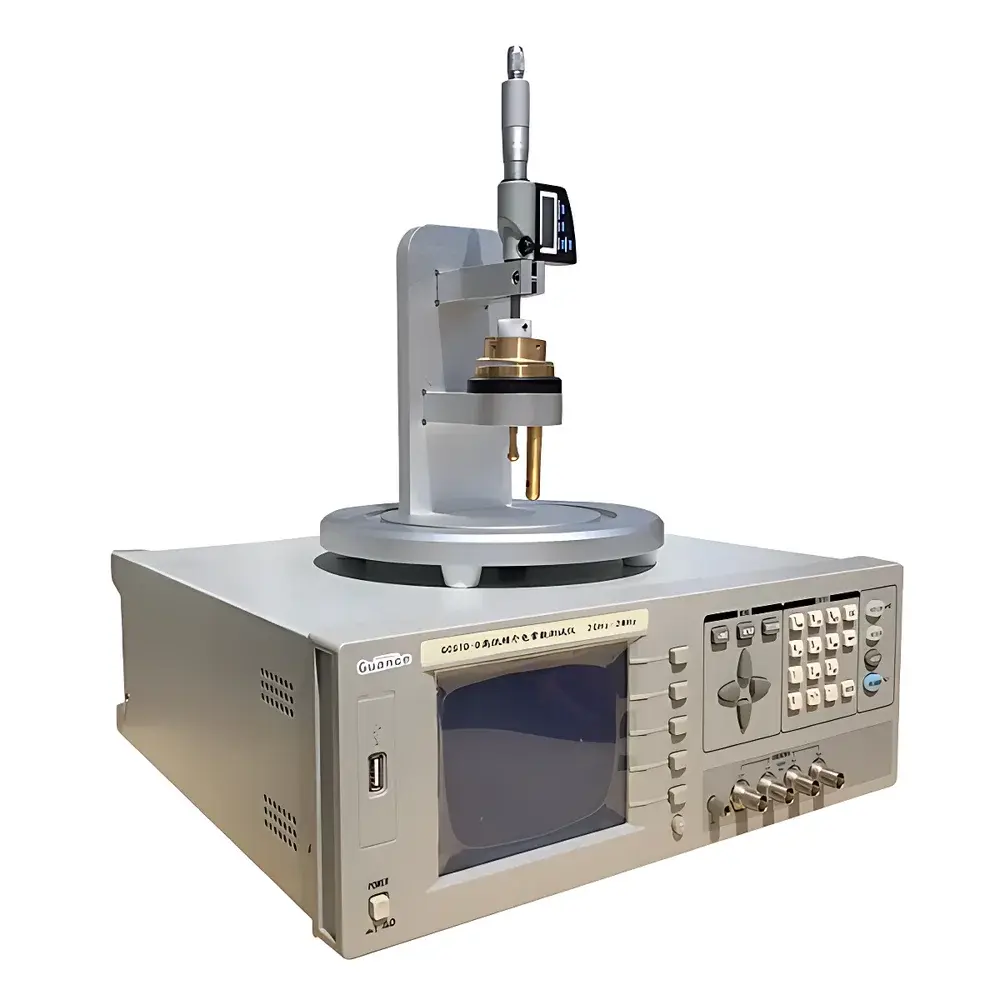
Guance Instruments GCSTD-D.1 High/Low-Frequency Dielectric Constant Analyzer
| Brand | Guance Instruments |
|---|---|
| Origin | Beijing, China |
| Manufacturer Type | Authorized Distributor |
| Country of Origin | China |
| Model | GCSTD-D.1 |
| Price | USD 265 (approx.) |
| Frequency Range | 20 Hz – 2 MHz (10 mHz resolution) |
| Test Signal Level | 10 mV – 5 V (1 mV step) |
| Basic Accuracy | ±0.1% |
| Measurement Speed | up to 200 readings/sec |
| Display | 320×240 dot-matrix LCD |
| Readout Resolution | 5 digits |
| Impedance Parameters | 22 configurable combinations |
| Output Impedance Options | 10 Ω / 25 Ω / 50 Ω / 100 Ω |
| DC Bias Source | Internal ±10 V / 100 mA |
| External DC Bias Support | Up to ±40 A (with dual TH1776 units, optional) |
| Auto Level Control (ALC) | Yes |
| V/I Monitoring | Real-time test signal voltage/current monitoring |
| Graphic Sweep Analysis | Frequency, level, and bias sweeps with on-screen plot |
| Storage | 20 instrument setups |
| Comparator | 10-bin sorting with pass/fail counting |
| Interfaces | USB Device/Host, RS232, GPIB (optional), LAN (optional) |
| Electrode Options | Fixed disk electrodes (Ø38 mm / Ø50 mm, standard: Ø38 mm), liquid cell (15 mL capacity), powder cell (customizable volume) |
Overview
The Guance Instruments GCSTD-D.1 High/Low-Frequency Dielectric Constant Analyzer is a precision impedance spectroscopy platform engineered for the quantitative characterization of dielectric properties across a broad frequency spectrum—from power-frequency (20 Hz) through audio and radio frequencies up to 2 MHz. It operates on the principle of AC impedance analysis using a four-terminal (Kelvin) measurement architecture to eliminate lead and contact resistance effects, ensuring high reproducibility in complex permittivity (ε′, ε″) and loss tangent (tan δ) determinations. Designed for R&D laboratories, quality control departments, and materials certification facilities, the GCSTD-D.1 supports standardized evaluation of insulating, semiconducting, and magnetic materials under controlled electrical excitation conditions. Its modular electrode system enables compliant testing per major international standards—including GB/T 1409–2006 (equivalent to IEC 60250), GB/T 1693–2007, ASTM D150, and ISO 60250—making it suitable for regulatory documentation in electronics, polymer, and advanced ceramics applications.
Key Features
- Wide frequency coverage: 20 Hz to 2 MHz with 10 mHz minimum resolution for fine-grained dispersion analysis
- High-accuracy impedance measurement: ±0.1% basic magnitude accuracy with five-digit resolution and real-time ALC stabilization
- Dual-mode electrode compatibility: Contact method (for flat, uniform solids) and non-contact method (for irregular, rough, or soft samples)
- Modular electrode suite: Standard 38 mm parallel-plate electrode; optional 50 mm electrode, 15 mL liquid cell, and volumetric powder cell with adjustable sample chamber depth
- Integrated DC bias capability: Internal ±10 V / 100 mA source for C–V profiling; expandable to ±40 A via external TH1776 current sources (dual-unit configuration)
- Graphical sweep functionality: Frequency, AC level, and DC bias sweeps with on-instrument plotting and export-ready data capture
- Comprehensive parameter library: Simultaneous calculation and display of 22 derived impedance parameters—including capacitance (Cs/Cp), dissipation factor (D), quality factor (Q), conductance (G), and complex permittivity components
- Regulatory-ready operation: Supports audit-trail-capable data logging when connected to compliant PC-based software; compatible with GLP/GMP workflows requiring traceable instrument settings and measurement history
Sample Compatibility & Compliance
The GCSTD-D.1 accommodates heterogeneous sample geometries and physical states without requiring metallization or geometric idealization. Solid specimens—including thin films, molded plastics, ceramic substrates, and elastomeric composites—are evaluated using calibrated parallel-plate electrodes per ASTM D150 Annex A1. Liquid electrolytes and solvent-based suspensions are measured in the sealed 15 mL quartz/glass liquid cell with temperature-stable electrode spacing. Powdered or granular dielectrics (e.g., ferrite powders, Li-ion cathode blends) are analyzed in the compression-enabled powder cell, where applied pressure and gap calibration ensure repeatable effective thickness estimation. All configurations comply with the electrode geometry and guard-ring requirements specified in IEC 60250 and GB/T 1409–2006. The instrument’s firmware implements correction algorithms for fringing field effects and stray capacitance—critical for sub-millimeter-thick or low-permittivity samples.
Software & Data Management
Data acquisition and post-processing are supported via Guance’s proprietary PC software (Windows 10/11 compatible), which provides full remote control, automated sequence execution, and compliance-oriented reporting. The software logs timestamped measurements with operator ID, environmental conditions (if external sensors are connected), instrument configuration, and raw complex impedance arrays. Export formats include CSV, Excel (.xlsx), and XML—structured to align with LIMS integration requirements. For regulated environments, the software optionally supports 21 CFR Part 11-compliant user authentication, electronic signatures, and immutable audit trails when deployed with networked license management and database-backed storage. Firmware updates are performed securely via USB HOST port using signed binary packages, eliminating dependency on third-party drivers or cloud services.
Applications
- Characterization of polymer dielectrics for capacitor film development and insulation system validation
- C–V profiling of ferroelectric thin films and perovskite oxides in memory device research
- Quality control of ceramic capacitors and MLCC base materials (e.g., BaTiO3 formulations)
- Moisture content estimation in hygroscopic polymers via dielectric relaxation peak tracking
- Dispersion analysis of nanocomposite fillers (e.g., graphene, BN) in epoxy matrices
- High-frequency loss assessment of PCB laminates (FR-4, polyimide) at GHz-relevant extrapolation points
- Conductivity and ion mobility studies in solid-state electrolytes for battery R&D
- Non-destructive evaluation of aging effects in high-voltage cable insulation systems
FAQ
Does the GCSTD-D.1 support temperature-controlled measurements?
Yes—when paired with an external environmental chamber and optional temperature probe interface (via analog input), the instrument can log synchronized impedance vs. temperature profiles. Full thermal control requires third-party hardware; no integrated oven or Peltier stage is included.
Can the system perform time-domain dielectric spectroscopy (TDS)?
No—the GCSTD-D.1 is a frequency-domain analyzer only. Time-domain measurements require complementary equipment such as a broadband TDR or FRA with impulse response deconvolution capability.
Is calibration traceable to national standards?
The factory calibration uses NIST-traceable LCR standards (Keysight/QuadTech reference units). Certificate of Calibration (with uncertainty budget) is provided with each unit; ISO/IEC 17025 accreditation is available upon request through Guance’s CNAS-accredited metrology partner.
What safety certifications does the instrument carry?
It complies with IEC 61010-1:2010 (Safety Requirements for Electrical Equipment for Measurement, Control, and Laboratory Use) and bears CE marking for EMC (EN 61326-1) and Low Voltage Directive (2014/35/EU) conformity.
How is electrode calibration performed for non-standard geometries?
A two-step open/short/load compensation routine is built into the firmware. Users may define custom electrode constants (e.g., area, gap) for non-standard cells, and the system applies geometric corrections during permittivity calculation in real time.



