
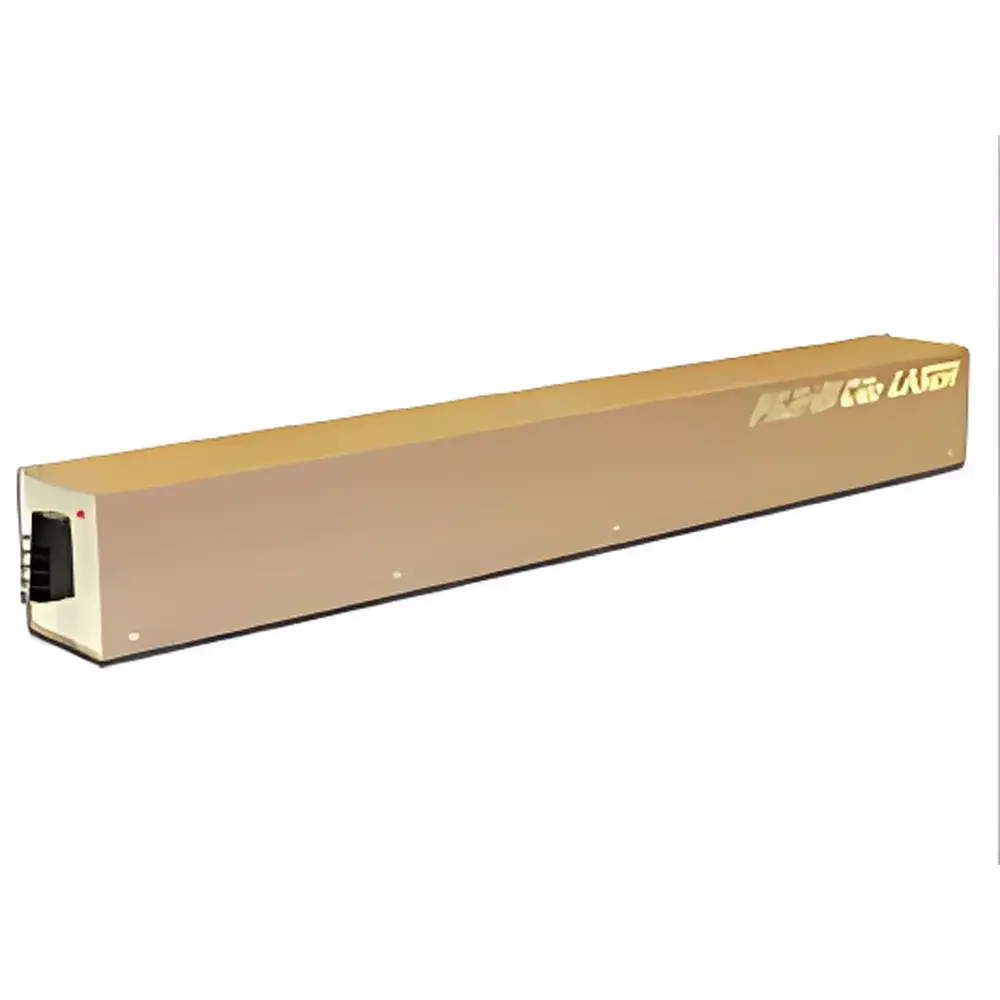
Edinburgh Instruments PL Series Continuous-Wave CO₂ Laser Systems
| Brand | Edinburgh Instruments |
|---|---|
| Origin | United Kingdom |
| Model | PL2 / PL3 / PL5 / PL6 |
| Laser Type | Gas Laser (CO₂ / CO) |
| Wavelength Range | CO₂: 9.1–10.9 µm |
| CO | 5.2–6.0 µm |
| Output Power (Flowing) | up to 180 W (PL6), 1 W (PL3) |
| Output Power (Sealed) | up to 30 W (PL2/PL3), 10 W (PL5) |
| Spectral Lines | 60–90 lines |
| Beam Quality (M²) | 1.25–1.5 |
| Beam Diameter | 4.8–11 mm |
| Divergence | 2.6–6.5 mrad |
| Polarization | Vertical or Horizontal |
| Power Stability | ±1% to ±2% (rms, 8-hr) |
| Frequency Stability | 200–500 kHz/sec (free-running) |
| Tuning Mechanism | Diffraction Grating + Piezoelectric Cavity Length Control |
| Linewidth (SLM) | <100 kHz (typ., with active stabilization) |
| Pulse Option (PL5) | Q-switched, 150 ns, 1 kHz, 2 kW peak power |
| Construction | Invar-based rigid frame for thermal & mechanical stability |
| Operating Mode | Continuous-wave (CW) and Q-switched (PL5 only) |
Overview
The Edinburgh Instruments PL Series comprises a family of high-stability, continuously tunable gas lasers engineered for precision infrared spectroscopy and fundamental research applications. Based on sealed or flowing-gas discharge architectures, the PL systems operate in the mid- to far-infrared spectral region—specifically CO₂ lines between 9.1 and 10.9 µm (PL2, PL5, PL6) and CO rotational-vibrational transitions from 5.2 to 6.0 µm (PL3). These lasers employ a robust Invar alloy mechanical frame to minimize thermally induced drift, ensuring long-term alignment integrity and cavity stability. Wavelength selection is achieved via high-resolution diffraction grating rotation coupled with piezoelectric transducer (PZT)-actuated cavity length tuning—enabling discrete line selection across >60 individual gain lines per model, with single-longitudinal-mode (SLM) operation maintained under low-pressure discharge conditions. The PL platform supports both free-running and actively frequency-stabilized configurations, with optional RF-driven Q-switching available on the PL5 variant for nanosecond-pulse generation.
Key Features
- Invar-based monolithic laser housing ensures exceptional mechanical rigidity and thermal stability over extended operational periods.
- Diffraction grating wavelength selector combined with PZT-controlled cavity length enables precise, repeatable line selection across the full emission spectrum.
- Optimized bore geometry—including micro-roughened discharge tube walls—suppresses higher-order transverse modes, delivering near-diffraction-limited beam quality (M² ≤ 1.5).
- Active frequency stabilization option reduces long-term drift to ≤±1 MHz over 10 minutes, meeting requirements for interferometric and heterodyne detection setups.
- PL5 model supports external RF Q-switching, generating 150 ns pulses at 1 kHz repetition rate with peak powers up to 2 kW—suitable for time-resolved plasma diagnostics and nonlinear optical pumping.
- Multiple packaging variants: sealed-tube (low maintenance, compact footprint) and flowing-gas (higher average power, extended spectral coverage).
Sample Compatibility & Compliance
The PL Series is designed for integration into vacuum-compatible, radiation-hardened, and vibration-sensitive environments typical of synchrotron beamlines, terahertz time-domain spectrometers, and molecular physics laboratories. All models comply with IEC 60825-1:2014 (Laser Product Safety) Class IV requirements and incorporate interlocked enclosures, beam shutters, and key-controlled enable circuits. Optical interfaces follow standard Ø1″, SM1-threaded mounts compatible with Thorlabs, Newport, and other OEM optomechanics. For regulated environments, the system supports audit-ready operation when paired with third-party data acquisition platforms compliant with FDA 21 CFR Part 11 and ISO/IEC 17025 traceability frameworks.
Software & Data Management
While the PL lasers operate as analog-controlled instruments, Edinburgh Instruments provides LabVIEW-compatible drivers and ASCII command protocols (RS-232/USB) for remote wavelength stepping, power modulation, and status monitoring. Integration with EPICS, Python (PyVISA), or MATLAB is supported via documented SCPI-like syntax. Frequency stabilization feedback loops generate TTL-synchronized error signals for external PID controllers. No proprietary software suite is required; all calibration metadata—including grating angle vs. wavelength maps and cavity length vs. mode-hop thresholds—is supplied in machine-readable CSV format for traceable instrument characterization.
Applications
- High-resolution molecular spectroscopy of greenhouse gases (CO₂, CH₄, N₂O) and isotopic species in atmospheric simulation chambers.
- Pump source for difference-frequency generation (DFG) in GaSe or orientation-patterned GaAs (OP-GaAs) crystals targeting 1–5 THz radiation.
- Plasma diagnostics via laser-induced fluorescence (LIF) and Thomson scattering in fusion-relevant magnetized plasmas.
- Interferometric measurements of thin-film thickness and refractive index dispersion in semiconductor and dielectric materials.
- Biochemical sensing using vibrational absorption fingerprints in the fingerprint region (9–11 µm) for protein conformational analysis.
- Calibration reference for Fourier-transform infrared (FTIR) spectrometers operating beyond the range of globar sources.
FAQ
What distinguishes the PL2, PL5, and PL6 models in terms of output capability?
The PL2 is a sealed-tube CO₂ laser optimized for stability and ease of use (≤30 W), while the PL5 adds Q-switching capability and supports both sealed and flowing configurations. The PL6 is the highest-power flowing-gas variant, delivering up to 180 W in CW mode with enhanced cooling and gas-handling infrastructure.
Can the PL3 CO laser be used interchangeably with CO₂-based systems in the same optical setup?
Yes—mechanical and optical interfaces are standardized across the PL family. However, due to the ~50% shorter wavelength (5.2–6.0 µm vs. 9–11 µm), users must verify anti-reflection coating specifications and detector responsivity curves for optimal signal-to-noise performance.
Is active frequency stabilization available for all PL models?
Active stabilization is an optional upgrade for PL2, PL3, PL5, and PL6. It requires integration of an external iodine-stabilized reference cell or a high-finesse Fabry–Pérot cavity, with feedback applied to the PZT actuator and grating motor.
How is single-longitudinal-mode (SLM) operation maintained across different power levels?
SLM is preserved through strict control of gas pressure (<10 Torr), discharge current density, and intracavity loss—enabled by the low-divergence resonator design and micro-textured bore surface that suppresses parasitic transverse modes.
Do PL lasers require periodic gas replenishment in flowing-gas configurations?
Yes—flowing-gas systems use recirculating or continuous-purge architectures with integrated catalysts and cold traps. Typical maintenance intervals range from 500–2000 hours depending on operating current and purity of the CO₂/N₂/He mixture.





