
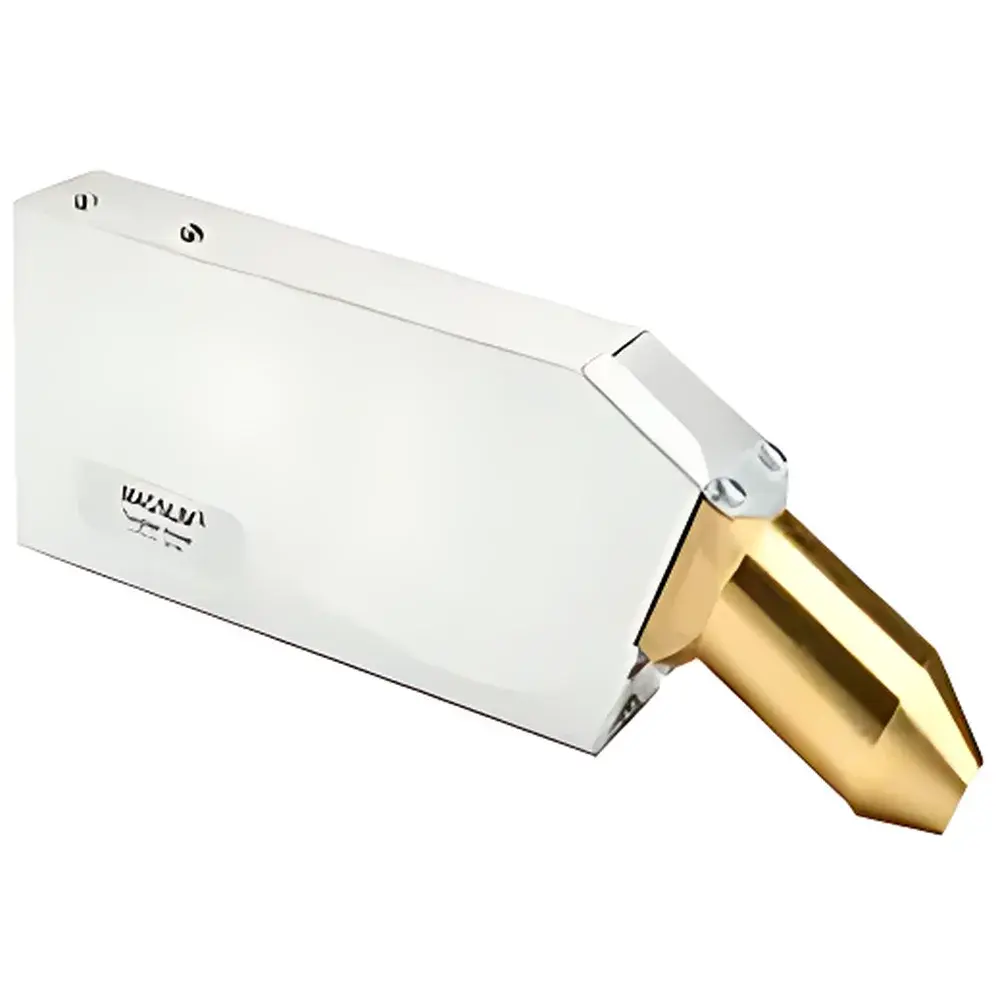
Moxtek TUB00082 Integrated 50 kV Microfocus X-ray Tube
| Brand | Moxtek |
|---|---|
| Origin | USA |
| Model | TUB00082 |
| Tube Voltage | 4–50 kV |
| Tube Current | 0–200 µA |
| Max Output Power | 4 W |
| Anode Materials | Ag, W, Rh |
| Focal Spot Size | 400 µm |
| Input Voltage | 6–12 VDC |
| Weight | 350 g |
| Warranty | 1 year |
Overview
The Moxtek TUB00082 is a compact, integrated microfocus X-ray tube engineered for precision in portable and benchtop X-ray fluorescence (XRF), energy-dispersive X-ray spectroscopy (EDS), and transmission-based X-ray imaging systems. Unlike conventional X-ray sources requiring external high-voltage generators and complex cooling infrastructure, the TUB00082 embeds the high-voltage power supply directly into the tube housing—enabling true plug-and-play operation with low-voltage DC input (6–12 VDC). This monolithic architecture eliminates interconnect losses, reduces electromagnetic interference (EMI), and improves long-term stability of both tube voltage and current. Operating across a continuous 4–50 kV range with fine-grained digital control, the tube supports optimized excitation for light-element detection (e.g., Na, Mg, Al) at lower kV and enhanced penetration for heavier elements (e.g., Pb, U) at higher kV. Its 400 µm focal spot enables spatial resolution suitable for micro-XRF mapping and small-feature analysis, while the 4 W maximum output power balances thermal management with sufficient photon flux for rapid, repeatable measurements.
Key Features
- Monolithic integration: High-voltage generator and X-ray tube co-packaged in a single hermetically sealed ceramic-metal housing.
- Ultra-compact form factor: Dimensions under 70 mm × 40 mm × 35 mm; total mass of only 350 g—ideal for handheld analyzers, drone-mounted sensors, and space-constrained OEM instruments.
- Digital current and voltage regulation: Real-time feedback control ensures ±0.1% stability in tube current and ±0.05% in kV over extended operation, critical for quantitative spectral reproducibility.
- Interchangeable anode options: Selectable target materials—silver (Ag Kα = 22.1 keV), tungsten (W Kα = 59.3 keV), or rhodium (Rh Kα = 20.2 keV)—to match application-specific excitation efficiency and spectral background requirements.
- Low-power DC operation: Eliminates need for AC line conditioning, isolation transformers, or forced-air cooling—reducing system BOM cost and improving field reliability.
- Robust vacuum integrity: Sealed tube design with getter-stabilized ultra-high vacuum (5,000 hours of operational lifetime under nominal conditions.
Sample Compatibility & Compliance
The TUB00082 is compatible with solid, powder, and thin-film samples commonly analyzed in elemental composition workflows—including geological specimens, alloy fragments, polymer additives, battery cathode materials, and semiconductor wafers. Its low thermal load and stable output support consistent excitation geometry in fixed-angle XRF configurations and enable reliable use in GLP-compliant QA/QC labs. The tube meets IEC 61010-1:2010 safety requirements for electrical equipment for measurement, control, and laboratory use. While not a standalone radiation-emitting device per FDA 21 CFR Part 1020.40, it is designed to be integrated into fully shielded analytical platforms compliant with ANSI N43.3 and ISO 11688-1 for occupational exposure control. All variants are RoHS 3 and REACH-compliant.
Software & Data Management
The TUB00082 interfaces via TTL-level digital control lines (UART or SPI optional) and analog monitoring outputs (0–5 V proportional to kV and µA), enabling seamless integration with OEM instrument firmware. Moxtek provides reference drivers and configuration libraries for Linux-based ARM platforms and Windows-compatible USB-to-serial gateways. When embedded in systems supporting ASTM E1361 (Standard Practice for Calibration of Energy-Dispersive X-ray Spectrometers) or ISO 21043 (XRF instrumentation specifications), the tube’s repeatability supports traceable calibration protocols. Audit-trail-capable data acquisition software may log real-time tube parameters alongside spectral data—facilitating 21 CFR Part 11 compliance when paired with electronic signature modules and secure database backends.
Applications
- Portable and handheld XRF analyzers for scrap metal sorting, soil screening, and consumer product safety testing (e.g., RoHS, CPSIA).
- OEM integration into benchtop micro-XRF mapping systems for materials science research and failure analysis.
- Miniaturized X-ray sources for educational spectrometry kits and undergraduate physics laboratories.
- Transmission-mode X-ray imaging in micro-CT preclinical modules where dose efficiency and focal spot definition are critical.
- In-line process monitoring in additive manufacturing, where real-time elemental verification of powder feedstock is required.
FAQ
What anode material should I select for light-element analysis (e.g., Mg, Al, Si)?
For optimal excitation efficiency below 2 keV, silver (Ag) or rhodium (Rh) anodes are recommended due to their lower characteristic line energies and reduced Bremsstrahlung background relative to tungsten.
Can the TUB00082 operate continuously at maximum power?
Continuous operation at 4 W is thermally permissible only with adequate heat sinking (≥15 cm² of copper surface area, ≥2 mm thickness) and ambient temperature ≤30°C; duty cycling is advised for sustained high-load applications.
Is firmware update support available for digital control interfaces?
Yes—Moxtek provides versioned firmware binaries and release notes for UART/SPI control modules, with backward compatibility maintained across minor revisions.
Does the tube include built-in radiation shielding?
No—the TUB00082 is supplied as a bare source module; end-users must integrate it into a fully shielded enclosure meeting local regulatory limits for leakage radiation (e.g., <1 µSv/h at 5 cm).
How is calibration traceability established for quantitative XRF using this tube?
Traceability is achieved at the system level—not the tube alone—via certified reference materials (CRMs) aligned with NIST SRMs and validated against ISO 12885 or ASTM E2869 practices.




