
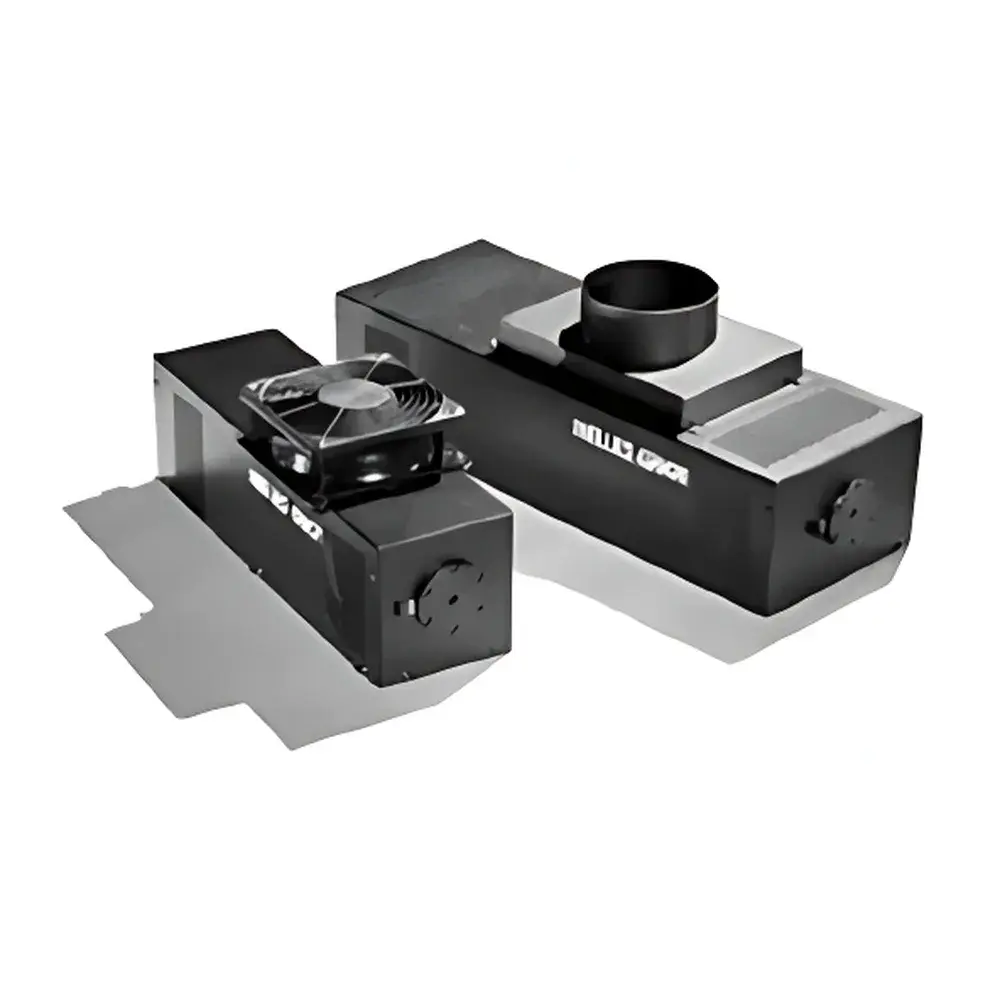
CVI 35 LAP321 Tunable Argon-Ion Laser System
| Brand | CVI |
|---|---|
| Origin | USA |
| Manufacturer Type | Authorized Distributor |
| Origin Category | Imported |
| Model | 35 LAP321 |
| Laser Type | Gas Laser (Argon-Ion) |
| Wavelength Range | 454–520 nm (discrete lines), including 457, 465, 472, 476, 488, 496, 502, and 514 nm |
| Output Mode | TEM₀₀ |
| Max Single-Line Power | 120 mW @ 488 nm |
| Beam Diameter | ~0.65 mm (1/e²) |
| Beam Divergence | <1.5 mrad |
| Cooling Method | Air-Cooled |
| Compliance | CE, RoHS, FDA 21 CFR Part 1040.10 (Laser Product Safety) |
Overview
The CVI 35 LAP321 is a compact, air-cooled tunable argon-ion laser system engineered for high-stability continuous-wave (CW) emission across multiple discrete visible wavelengths in the 454–520 nm range. Unlike diode-pumped solid-state (DPSS) or tunable dye lasers, this instrument operates on the fundamental principle of ionized argon gas discharge within a sealed plasma tube, where electron-impact excitation generates population inversion in Ar+ energy levels. The resulting spectral output consists of up to nine primary lasing lines — notably 457 nm, 465 nm, 472 nm, 476 nm, 488 nm, 496 nm, 502 nm, and 514 nm — each selectable via internal Brewster-angle prism tuning or external line-selecting optics. Designed for integration into precision optical platforms, the 35 LAP321 delivers TEM₀₀ spatial mode quality with M² < 1.1, enabling diffraction-limited focusing essential for confocal microscopy, fluorescence excitation, and Raman spectroscopy applications requiring high photon flux density and minimal beam distortion.
Key Features
- Air-cooled architecture eliminates need for external chillers or water recirculation systems — reduces footprint and operational complexity while maintaining thermal stability over extended duty cycles.
- TEM₀₀ Gaussian beam profile with beam diameter ≤ 0.65 mm (1/e²) and divergence < 1.5 mrad ensures optimal coupling into single-mode fibers and high-NA microscope objectives.
- Factory-aligned resonator with hard-sealed plasma tube provides long-term power stability (10,000-hour tube lifetime under recommended operating conditions.
- Integrated current regulation and soft-start circuitry minimize cathode sputtering and extend tube longevity; compatible with standard 100–240 VAC, 50/60 Hz inputs.
- Front-panel analog modulation input (0–5 V) supports TTL-compatible intensity control for time-resolved experiments and synchronization with external detectors or scanners.
- Compliant with IEC 60825-1:2014 and FDA 21 CFR Part 1040.10 laser safety standards; includes interlock connector, key switch, and emission indicator LED.
Sample Compatibility & Compliance
The 35 LAP321 is routinely deployed in regulated analytical environments where traceable performance and documentation integrity are mandatory. Its fixed-wavelength operation aligns with ASTM E275 (Standard Practices for Describing and Measuring Performance of UV-Visible Spectrophotometers) and ISO/IEC 17025:2017 requirements for calibration traceability when used as a stable reference source. While not intrinsically GMP-compliant, the system supports integration into GLP/GMP workflows through third-party validation packages that include IQ/OQ documentation templates, beam power drift logs, and alignment verification protocols. No hazardous substances beyond standard argon gas (non-toxic, non-flammable) are employed; full RoHS and CE declarations are supplied with shipment.
Software & Data Management
The 35 LAP321 operates as a standalone analog instrument without embedded firmware or digital interfaces. However, it is fully compatible with industry-standard lab automation frameworks via its 0–5 V analog modulation port and TTL-ready interlock interface. Integration with LabVIEW™, MATLAB® Instrument Control Toolbox, or Python-based PyVISA drivers enables remote power ramping, duty-cycle scheduling, and synchronized acquisition triggering. For audit readiness, users may log operational parameters — including tube current, case temperature, and output power (measured via external NIST-traceable photodiode sensors) — using compliant data acquisition systems compliant with FDA 21 CFR Part 11 when paired with electronic signature and audit trail modules.
Applications
- Confocal Laser Scanning Microscopy (CLSM): Stable 488 nm excitation enables high signal-to-noise ratio imaging of FITC, GFP, and Alexa Fluor 488 conjugates; low temporal intensity noise (< 0.3% RMS) minimizes photobleaching artifacts.
- Fluorescence Spectroscopy: Discrete-line selection allows excitation wavelength optimization for quantum yield measurements and lifetime decay analysis without broadband background interference.
- Raman Spectroscopy: High-brightness 514 nm output serves as an efficient excitation source for visible-Raman systems targeting carbon nanotubes, graphene, and pharmaceutical polymorphs.
- Flow Cytometry Calibration: Used as a reference light source for photomultiplier tube (PMT) gain calibration and spectral overlap correction due to narrow linewidth (100:1).
- Optical Trap Alignment: Low beam pointing instability (< 2 µrad/hour) and minimal power drift support stable trap positioning in biophysics instrumentation.
FAQ
Is the 35 LAP321 compatible with fiber coupling?
Yes — its TEM₀₀ output is optimized for coupling into 4–6 µm core single-mode fibers using standard aspheric collimators and XYZ translation stages.
What is the warm-up time to achieve specified power stability?
Typical stabilization time is 30–45 minutes from cold start at ambient temperatures between 15–30 °C.
Can multiple wavelengths be selected simultaneously?
No — the system emits only one discrete line at a time; multi-line operation requires external dichroic combiners or sequential scanning with mechanical filters.
Does CVI provide factory recalibration services?
Yes — CVI Metrology Services offers traceable power calibration against NIST SRM 2211 photodiodes, with full uncertainty budgets and ISO/IEC 17025-accredited reports.
Is ozone generation a concern during operation?
Negligible — unlike UV-excimer or deep-UV lasers, argon-ion lasers operating below 300 nm are not present; no ozone-producing wavelengths are emitted.




