
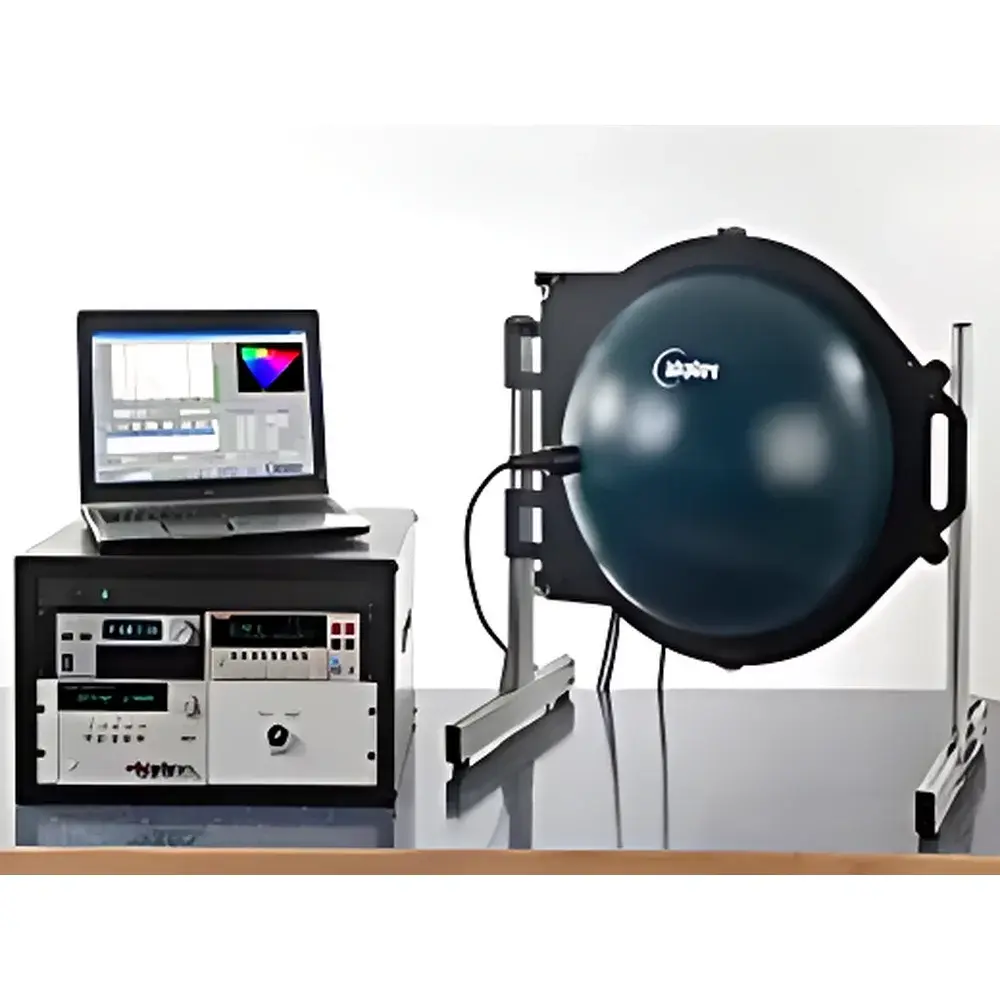
Labsphere Illumia Pro Integrating Sphere System
| Brand | Labsphere |
|---|---|
| Origin | USA |
| Model | Illumia Pro |
| Sphere Diameter Options | 0.5 m, 1.0 m, 1.65 m, 2.0 m |
| Measurement Geometry | 2π and 4π compatible |
| Compliance | IESNA LM-79, IESNA LM-80 |
| Core Components | High-resolution CCD spectrometer, precision programmable current source, thermoelectric cooler (TEC) temperature controller with real-time junction temperature monitoring, auxiliary calibration lamp, Illumia Pro measurement software |
| Data Management | Automated acquisition, traceable metadata logging, export to CSV, XML, and industry-standard report formats |
Overview
The Labsphere Illumia Pro Integrating Sphere System is a fully integrated, turnkey platform engineered for simultaneous electrical, optical, and thermal characterization of LEDs, LED modules, and multi-die arrays under controlled operating conditions. Built upon the foundational principles of integrating sphere photometry—where diffuse reflection and uniform spatial light distribution enable accurate total flux measurement—the Illumia Pro extends conventional photometric analysis by embedding real-time thermal management and high-fidelity spectral radiometry into a single synchronized workflow. Unlike standalone spectroradiometers or benchtop power supplies, this system maintains strict metrological traceability across all three domains: voltage and current are measured with sub-millivolt/microamp resolution; spectral irradiance and luminous flux are acquired using a calibrated, thermally stabilized CCD spectrometer; and junction temperature is inferred via TEC-based thermal control coupled with embedded thermistor feedback and forward-voltage correlation algorithms. The system’s architecture supports both 2π (hemispherical) and 4π (full-sphere) configurations, enabling compliance with IESNA LM-79–2019 (Electrical and Photometric Measurements of Solid-State Lighting Products) and LM-80–2015 (Measuring Lumen Maintenance of LED Light Sources), critical for energy certification, reliability modeling, and DOE ENERGY STAR qualification.
Key Features
- Modular integrating sphere options: 0.5 m, 1.0 m, 1.65 m, and 2.0 m diameters—each optimized for specific sample sizes and flux ranges while maintaining NIST-traceable sphere wall reflectance (>98% BaSO₄ coating)
- Synchronized multi-domain acquisition: Simultaneous recording of forward voltage (Vf), drive current (If), spectral power distribution (SPD), chromaticity coordinates (CIE 1931 x,y), luminous flux (lm), radiant flux (W), luminous efficacy (lm/W), and correlated color temperature (CCT)
- Active thermal management: Integrated Peltier-based temperature control stage with ±0.1 °C stability, real-time thermistor monitoring at the LED substrate level, and junction temperature estimation per JEDEC JESD51-1
- Programmable DC current source: 0–2 A range, <0.05% line/load regulation, low-noise output suitable for pulsed and DC operation modes
- Illumia Pro software suite: Windows-based application supporting automated test sequencing, pass/fail thresholding, statistical process control (SPC) charting, and audit-ready data export compliant with FDA 21 CFR Part 11 requirements (electronic signatures, audit trails, user access controls)
Sample Compatibility & Compliance
The Illumia Pro accommodates packaged mid-power and high-power LEDs (including SMD, COB, and ceramic-substrate types), linear and 2D LED modules, and edge-lit or direct-lit backlight units up to 300 mm in diagonal dimension. Its mechanical design permits rapid reconfiguration between 2π and 4π geometries without recalibration. All sphere variants meet ANSI/IESNA LM-79–2019 geometric and detector placement specifications, including mandatory baffle positioning, detector field-of-view constraints, and stray-light suppression criteria. Optional environmental chamber integration enables testing across –20 °C to +85 °C ambient conditions, supporting LM-80 extended-life testing protocols. System validation reports include sphere throughput calibration certificates, spectrometer spectral responsivity curves, and current source accuracy verification per ISO/IEC 17025–2017 accredited procedures.
Software & Data Management
Illumia Pro software provides a deterministic, scriptable measurement environment with built-in support for standardized test sequences defined in LM-79 Annex B and LM-80 Annex A. Each dataset includes embedded metadata: timestamp, operator ID, instrument serial numbers, calibration expiration dates, ambient temperature/humidity, and thermal stabilization status. Raw spectral files adhere to IES TM-27-14 format; photometric summaries conform to IES LM-63–2019 XML schema. Audit logs record all parameter modifications, report generations, and user logins with immutable timestamps—enabling full GLP/GMP traceability. Export modules support direct integration with MATLAB, Python (via HDF5), and enterprise LIMS platforms through RESTful API endpoints.
Applications
- LED package qualification and binning based on lumen maintenance, chromaticity shift, and thermal resistance (Rth,j–s)
- Thermal design validation of MCPCBs, heat sinks, and active cooling systems
- Color consistency verification for display backlighting and architectural lighting systems
- Development of accelerated life-test models correlating junction temperature rise with lumen depreciation (L70/L50)
- Third-party verification testing for ENERGY STAR, DesignLights Consortium (DLC), and CE marking submissions
FAQ
Does the Illumia Pro system support IESNA LM-79 and LM-80 compliance out of the box?
Yes—hardware configuration, sphere geometry, detector placement, and software reporting templates are pre-validated against both standards. Full compliance documentation is provided with each system.
Can I measure phosphor-converted white LEDs and narrow-band monochromatic emitters with the same setup?
Yes—the CCD spectrometer covers 350–1000 nm with <1.5 nm FWHM resolution and includes UV-corrected optics and cosine-corrected input optics for accurate SPD reconstruction across spectral classes.
Is junction temperature measurement direct or inferred?
Junction temperature is inferred using the calibrated forward-voltage method (per JEDEC JESD51-52) combined with real-time TEC-stage temperature feedback and thermal resistance modeling. Direct micro-thermocouple integration is available as an optional add-on.
What data security and regulatory features does the software provide?
The software implements role-based access control, electronic signatures, time-stamped audit trails, and encrypted local database storage—all aligned with FDA 21 CFR Part 11 and ISO 13485 requirements for regulated environments.
Are calibration services included with purchase?
A full factory calibration certificate—including sphere throughput, spectrometer responsivity, current source accuracy, and temperature sensor linearity—is delivered with every system. On-site recalibration and ISO/IEC 17025–accredited certification are available as annual service contracts.



