
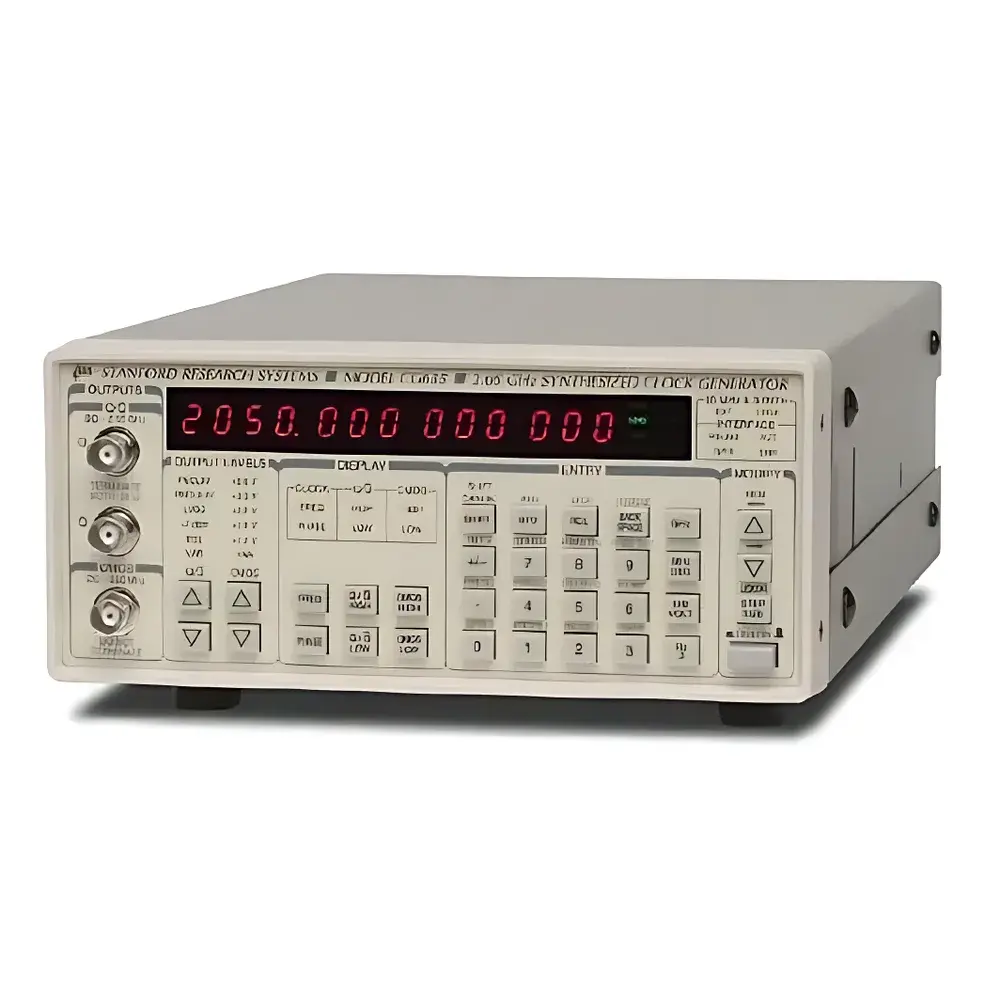
CG635 Square Wave Clock Generator by Stanford Research Systems
| Brand | SRS/Stanford Research Systems |
|---|---|
| Origin | USA |
| Model | CG635 |
| Frequency Range | 1 µHz to 2.05 GHz |
| Random Jitter | < 1 ps RMS |
| Frequency Resolution | 16-bit |
| Rise/Fall Time | 80 ps |
| Output Logic Families | CMOS, PECL, ECL, LVDS, RS-485 |
| Phase Control & Time Modulation | Yes |
| Optional Timebases | OCXO or Rubidium Standard |
Overview
The CG635 Square Wave Clock Generator is a high-performance, laboratory-grade timing instrument engineered for precision digital system validation, synchronization of ultrafast optical and electronic instrumentation, and metrology-grade clock distribution in spectroscopy and quantum measurement setups. Built upon a low-phase-noise architecture, the CG635 synthesizes highly stable square wave outputs across an unprecedented frequency span—from microhertz-level ultra-slow modulation rates up to 2.05 GHz—enabling direct clocking of high-speed ADCs, pulsed lasers, lock-in amplifiers, time-of-flight detectors, and multi-channel data acquisition systems. Its core operation relies on direct digital synthesis (DDS) combined with analog post-processing stages to preserve edge fidelity and minimize deterministic jitter. Unlike conventional function generators, the CG635 prioritizes spectral purity, temporal stability, and deterministic phase behavior—critical attributes when synchronizing time-sensitive components in pump-probe spectroscopy, cavity ring-down experiments, or coherent Raman imaging platforms.
Key Features
- Ultra-wide frequency coverage: 1 µHz to 2.05 GHz, supporting both ultra-low-frequency modulation (e.g., for slow-scanning interferometers) and high-speed digital interface testing (e.g., PCIe Gen5 or DDR5 clock validation).
- Sub-picosecond timing stability: Random jitter specified at < 1 ps RMS (measured over 10 kHz–100 MHz offset bandwidth), ensuring minimal uncertainty in time-domain measurements and precise event triggering.
- 16-bit frequency resolution: Enables fine-grained tuning down to 0.000015 Hz at 1 Hz output—essential for resonance tracking, narrow-linewidth laser locking, and fractional-N frequency synthesis applications.
- Edge performance optimized: 80 ps typical rise/fall times (20%–80%) into 50 Ω, preserving signal integrity for high-bandwidth oscilloscopes, sampling scopes, and photodetector drivers.
- Multi-standard logic compatibility: User-selectable output levels and terminations for CMOS (0–5 V), PECL (+3.3 V or +5 V), ECL (−1.0 V to −1.8 V), LVDS (±0.35 V), and differential RS-485, eliminating external level-shifting circuitry.
- Advanced timing control: Real-time phase adjustment (0.001° resolution), programmable pulse delay (10 ps steps), and built-in time modulation (AM/FM/PM) for dynamic synchronization and jitter injection testing.
- Optional high-stability timebases: Field-upgradable OCXO (±5 × 10⁻⁹/day aging) or rubidium standard (±5 × 10⁻¹¹/month) support long-term frequency traceability compliant with ISO/IEC 17025 calibration requirements.
Sample Compatibility & Compliance
The CG635 is routinely deployed in environments requiring strict adherence to timing-related standards in analytical instrumentation workflows. It interfaces seamlessly with spectrometers equipped with gated CCD/CMOS detectors (e.g., for time-resolved fluorescence or LIBS), FTIR systems requiring precise mirror velocity synchronization, and ultrafast transient absorption platforms where pump-probe delays must be reproducible within sub-100 ps windows. The device conforms to IEC 61000-4 electromagnetic compatibility (EMC) specifications and meets CE/UKCA marking requirements for laboratory equipment. Its firmware supports audit-ready logging of configuration changes and output state transitions—facilitating GLP-compliant operation in regulated QC laboratories performing spectral calibration verification per ASTM E1421 or USP .
Software & Data Management
Control is provided via front-panel keypad with intuitive menu navigation or through industry-standard interfaces: USB 2.0 (virtual COM port), Ethernet (TCP/IP + SCPI), and optional GPIB. The included SRS CG Control software (Windows/macOS/Linux) enables scriptable waveform sequencing, multi-unit synchronization via IEEE-1588 PTP, and real-time jitter spectrum analysis using integrated FFT-based phase noise estimation. All settings—including frequency, phase offset, amplitude, and modulation parameters—are stored in non-volatile memory with timestamped versioning. Configuration files are exportable in JSON format for integration into LabVIEW, Python (PyVISA), or MATLAB automation frameworks. Audit trails include user ID, timestamp, parameter name, pre-change and post-change values—fully compatible with FDA 21 CFR Part 11 electronic record requirements when hosted on validated network infrastructure.
Applications
- Synchronization of femtosecond laser oscillator-amplifier chains in transient absorption and 2D spectroscopy.
- Reference clock distribution for multi-channel digitizers in high-resolution mass spectrometry data acquisition.
- Modulation source for electro-optic modulators (EOMs) in heterodyne detection schemes used in cavity-enhanced absorption spectroscopy.
- Jitter characterization testbed for evaluating clock recovery circuits in optical coherence tomography (OCT) systems.
- Phase-locked trigger generation for time-correlated single-photon counting (TCSPC) modules in fluorescence lifetime imaging (FLIM).
- Calibration reference for time-interval analyzers and high-precision frequency counters in metrology labs accredited to ISO/IEC 17025.
FAQ
Can the CG635 generate arbitrary waveforms?
No. The CG635 is optimized exclusively for square wave synthesis with precise edge control and phase agility. For arbitrary waveform generation, consider the SRS DS360 or DG645 series.
Is remote programming supported over LAN without additional hardware?
Yes. The built-in 10/100 Ethernet interface supports full SCPI command set over TCP port 5025; no external controller or adapter is required.
What is the warm-up time to achieve specified frequency stability?
With standard internal TCXO: ≤ 5 minutes to ±1 ppm; with optional OCXO: ≤ 10 minutes to ±0.1 ppm; with rubidium option: ≤ 15 minutes to ±5 × 10⁻¹⁰.
Does the CG635 support synchronization to an external 10 MHz reference?
Yes. The rear-panel REF IN accepts 10 MHz sine or square wave (0.5–5 Vpp) for disciplined operation, enabling phase-coherent multi-instrument setups.
Are calibration certificates available with NIST traceability?
Yes. Factory calibration includes a NIST-traceable certificate (ISO/IEC 17025 accredited) documenting frequency accuracy, jitter, and phase linearity across the full operating range.





