
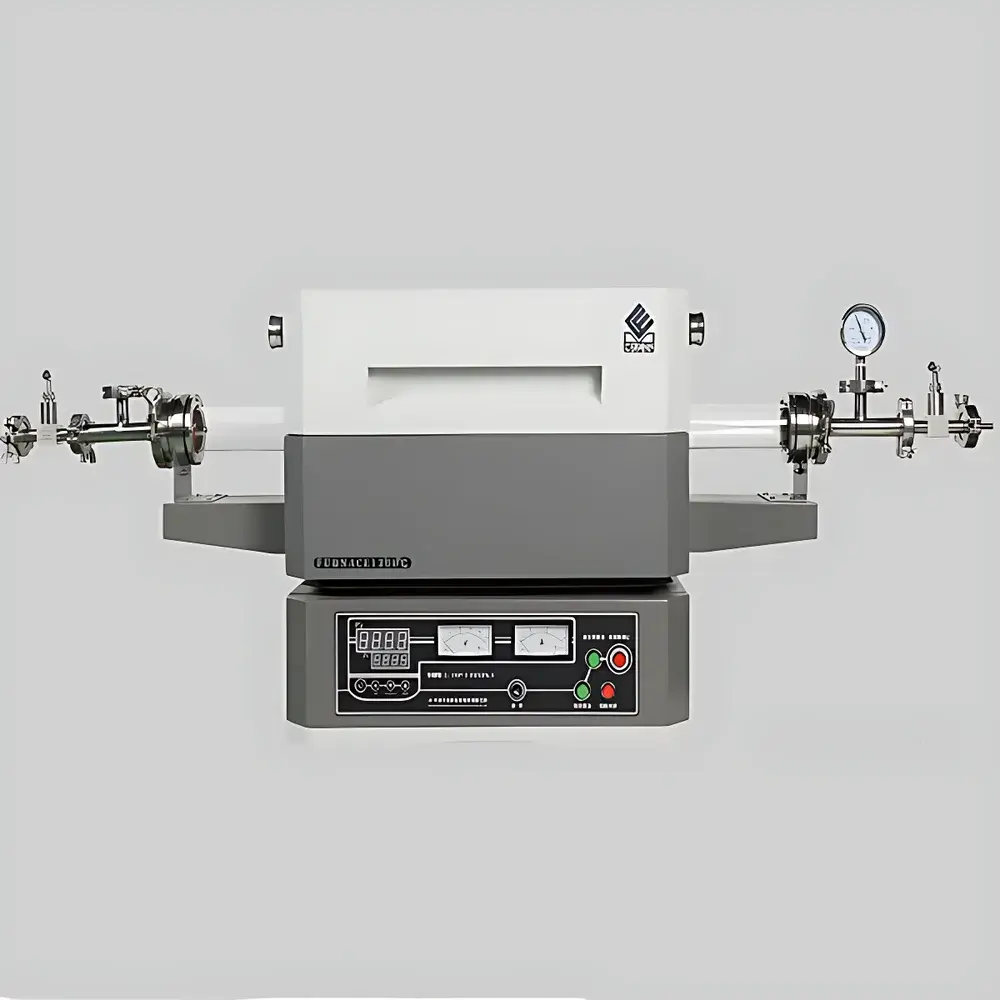
ZHONGHUAN FURNACE 1200°C Open-End Vacuum & Atmosphere Tube Furnace
| Brand | ZHONGHUAN FURNACE |
|---|---|
| Origin | Tianjin, China |
| Model | 1200°C Open-End Vacuum & Atmosphere Tube Furnace |
| Max Temperature | 1200°C |
| Temperature Control Accuracy | ±1°C |
| Max Power | 3 kW |
| Heating Rate | ≤5°C/min (≤500°C), ≤10°C/min (500–800°C), ≤5°C/min (800–1000°C), ≤2°C/min (1000–1200°C) |
| Heating Element | OCr27Al7Mo2 High-Resistance Alloy Wire |
| Internal Chamber Dimensions | 340 × 580 × 555 mm (W × L × H) |
| Sealing | Dual-Ring Flange Seal |
| Cooling | Auto-activated Surface-Cooling Fan (triggered at ≥50°C external surface temp) |
Overview
The ZHONGHUAN FURNACE 1200°C Open-End Vacuum & Atmosphere Tube Furnace is a precision-engineered thermal processing system designed for controlled high-temperature synthesis, annealing, sintering, and heat treatment under vacuum or reactive/inert gas atmospheres. Its open-end configuration—featuring rear-hinged top furnace section with 110° tilt—enables unobstructed access to the reaction zone without disassembly, significantly reducing experimental downtime and mechanical stress on quartz or alumina tube assemblies. The furnace operates on resistive heating via OCr27Al7Mo2 alloy wire embedded in a multi-crystalline mullite fiber insulation matrix, delivering exceptional thermal uniformity (±3°C across the hot zone) and energy efficiency—verified to reduce power consumption by up to 50% versus conventional refractory-lined designs. This architecture supports stable operation from ambient to 1200°C with ±1°C steady-state control accuracy, meeting core requirements for materials science, catalysis, battery electrode development, and ceramic processing laboratories.
Key Features
- Rear-hinged upper furnace section tilts 110° for full axial access—eliminates need for tube removal during sample loading/unloading.
- Dual-ring flange sealing system ensures leak rates <1×10⁻³ mbar·L/s under vacuum; compatible with roughing pumps and turbomolecular systems.
- Quick-connect pneumatic flanges with single-clamp coupling—reduces gas-line setup time by >70% and minimizes risk of tube fracture during installation.
- Intelligent surface-cooling system: integrated thermal sensor activates high-volume axial fans automatically when external casing temperature exceeds 50°C—maintains operator safety and structural integrity.
- Interlocked safety architecture: automatic power cutoff upon furnace lid opening, independent over-temperature cutout (hardware-based, non-software dependent), and grounded chassis with RCD (Residual Current Device) protection.
- Modular control interface: standard RS-485 port enables integration into centralized lab networks; supports daisy-chaining up to 200 units with timestamped logging and remote parameter adjustment.
Sample Compatibility & Compliance
The furnace accommodates standard OD 60–100 mm quartz, alumina, or silicon carbide tubes (length ≤600 mm). Its internal chamber (340 × 580 × 555 mm W×L×H) provides ample volume for multi-position sample holders, crucibles, and custom fixtures. Dual gas inlet/outlet ports support precise atmosphere control using mass flow controllers (MFCs) or calibrated rotameters—enabling reproducible N₂, Ar, H₂, NH₃, or forming gas environments. Vacuum compatibility extends from 10⁵ Pa (rough vacuum) to <10⁻³ Pa (high vacuum) when paired with optional diffusion or turbo pumping stations. The system conforms to IEC 61000-6-2 (EMC immunity) and IEC 61010-1 (electrical safety for laboratory equipment); temperature profiles comply with ASTM E220 and ISO/IEC 17025 calibration traceability requirements when used with NIST-traceable thermocouples.
Software & Data Management
The furnace integrates with ZHONGHUAN’s LabFurnaceControl Suite (Windows/Linux), supporting real-time monitoring, multi-segment ramp-soak programming (50 segments standard; 40 segments with optional Eurotherm or Watlow controllers), and audit-trail generation compliant with FDA 21 CFR Part 11 Annex 11 principles. All temperature logs include metadata: timestamp, setpoint, actual PV, power output %, and alarm status—exportable as CSV or PDF with digital signature capability. Remote access permits concurrent supervision of distributed furnace arrays via secure HTTPS interface; historical data retention exceeds 12 months with automated backup to NAS or cloud storage.
Applications
- Solid-state synthesis of Li-ion cathode materials (e.g., NMC, LFP) under controlled O₂ partial pressure.
- Graphene oxide reduction and CVD precursor pyrolysis in H₂/Ar mixtures.
- Thermal gravimetric analysis (TGA) pre-treatment protocols requiring inert or reducing atmospheres.
- Pre-sintering of metal-organic frameworks (MOFs) and covalent organic frameworks (COFs).
- Calibration and aging studies of thermoelectric modules and piezoelectric ceramics.
- Low-oxygen annealing of semiconductor thin films to suppress interfacial oxidation.
FAQ
What vacuum level can this furnace achieve with standard configuration?
With included mechanical pump interface and dual-ring flange, base pressure reaches ≤5×10⁻² mbar. For pressures below 10⁻³ mbar, optional turbomolecular pump integration is required.
Is the furnace compatible with Type S or Type K thermocouples?
Yes—standard configuration uses Type K (NiCr/NiAl) for 0–1200°C range; optional Type S (Pt/Rh) upgrade available for extended stability above 1000°C.
Can the heating program be modified during active operation?
Yes—real-time parameter adjustment is supported via touchscreen or software interface, including dynamic ramp rate changes and soak duration extension without cycle interruption.
Does the system meet GLP/GMP documentation requirements?
When operated with validated firmware version 3.2+ and paired with certified thermocouple calibrators, full electronic records—including user login, parameter changes, and alarm events—meet ALCOA+ data integrity criteria for regulated environments.
What maintenance intervals are recommended for long-term reliability?
Inspect insulation integrity and element tension every 200 operating hours; replace OCr27Al7Mo2 heating wires after 3,000 cumulative hours at ≥1000°C; clean flange gaskets and verify seal compression annually.



