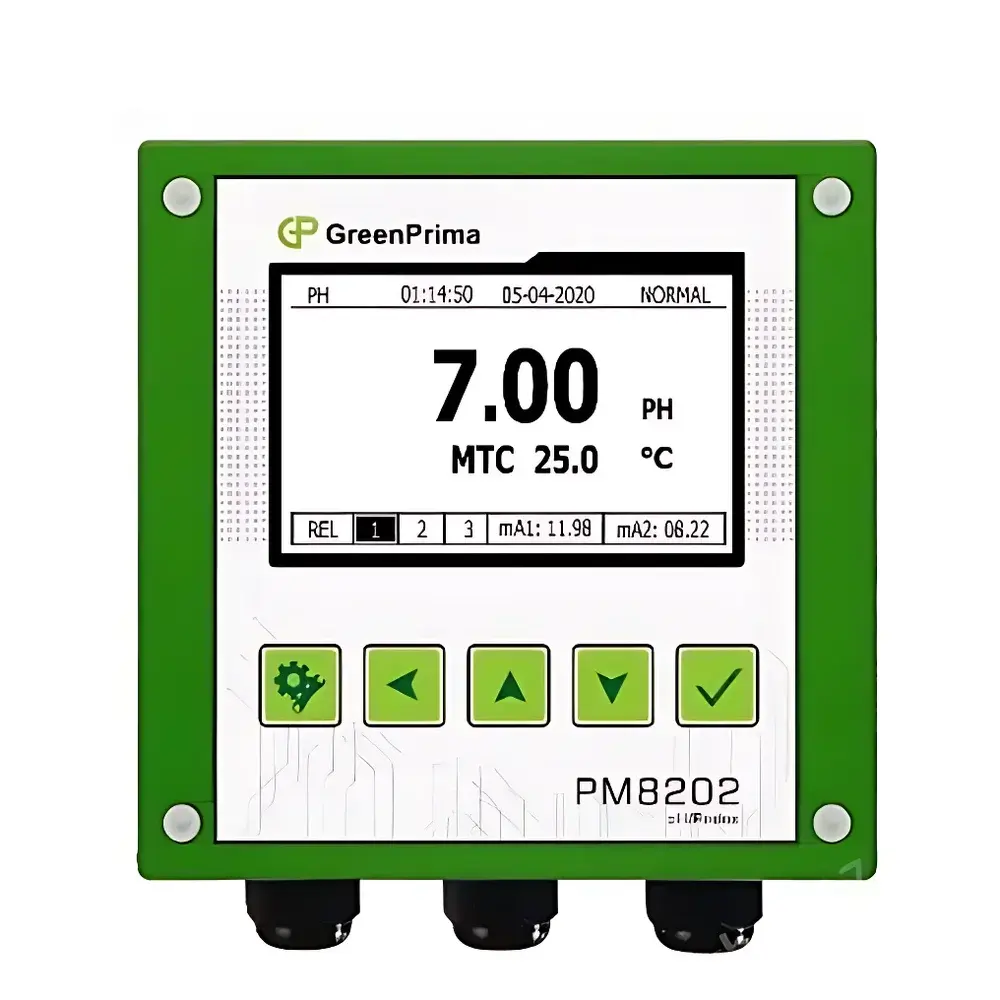
GreenPrima PM820-2P Online pH Analyzer
| Brand | GreenPrima |
|---|---|
| Origin | United Kingdom |
| Manufacturer Type | Original Equipment Manufacturer (OEM) |
| Product Category | Imported Industrial Online pH Meter |
| Model | PM820-2P |
| Measurement Range | -2 to 16 pH, -2000 to +2000 mV, 0 to 130 °C |
| Resolution | 0.01 pH, 1 mV, 0.1 °C |
| Accuracy | ±0.01 pH, ±0.1 mV, ±0.1 °C |
| Temperature Compensation Range | -10 to 130 °C (manual/automatic |
| Dimensions | 144 × 144 × 108 mm |
| Weight | 0.87 kg |
Overview
The GreenPrima PM820-2P Online pH Analyzer is an industrial-grade, microprocessor-based process analyzer engineered for continuous, high-stability monitoring of hydrogen ion activity (pH), oxidation-reduction potential (ORP/mV), and temperature in liquid streams. Based on potentiometric measurement principles using glass electrode technology, the system delivers real-time electrochemical response with built-in temperature compensation—critical for maintaining measurement integrity across dynamic thermal environments. Designed for integration into water treatment plants, municipal drinking water facilities, wastewater effluent lines, industrial cooling circuits, and chemical dosing control loops, the PM820-2P operates as a complete analyzer node when paired with GreenPrima’s Bsens-series pH sensors (e.g., Bsens110T, Bsens210, Bsens120T, Bsens130, Bsens140T, Bsens150T, Bsens180T), enabling application-specific sensor selection based on chemical compatibility, fouling resistance, and pressure rating requirements.
Key Features
- IP65-rated fully sealed enclosure with corrosion-resistant housing—certified for operation in humid, dusty, and splash-prone industrial environments
- Backlit high-contrast dot-matrix LCD display showing simultaneous pH/ORP value, temperature, timestamp, relay status, and system diagnostics
- Dual isolated 4–20 mA analog outputs configurable for pH, ORP, or temperature signals—with full-scale accuracy of ±0.1% FS and loop load capability up to 500 Ω
- RS485 serial interface compliant with Modbus RTU protocol for seamless integration into SCADA, DCS, and PLC-based control architectures
- Configurable cleaning output with adjustable cycle interval (0.1–1000 h) and duration (1–1000 s), supporting automated electrode maintenance via solenoid valves or ultrasonic cleaners
- Two independent programmable alarm relays (Hi/Lo) with user-defined hysteresis, rated at 5 A / 250 VAC / 30 VDC
- Onboard data logging capacity for up to 600,000 records—including timestamped pH, mV, temperature, and event flags—with non-volatile memory retention during power loss
- Multi-language UI (English/Chinese) with password-protected configuration access and one-button factory reset functionality
- Flexible mounting options: panel-mount (138 × 138 mm cutout), wall-mount, or inline pipe-mount configurations
Sample Compatibility & Compliance
The PM820-2P supports direct connection to a wide range of aqueous media, including potable water, surface water (rivers, lakes), activated sludge effluents, reverse osmosis permeate, boiler feedwater, and low-conductivity process streams. Its input circuitry is optimized for high-impedance glass electrodes and reference junctions compatible with ISO 3696 Grade 3 water, ASTM D1129, and USP environmental monitoring guidelines. Temperature compensation utilizes either NTC10K or PT1000 sensors—both traceable to NIST standards—ensuring compliance with ISO 17025 calibration traceability requirements when used in GLP/GMP-regulated laboratories or validated process environments. The device meets CE marking directives for electromagnetic compatibility (2014/30/EU) and low voltage safety (2014/35/EU).
Software & Data Management
Configuration and diagnostics are performed locally via the front-panel keypad or remotely through Modbus-enabled supervisory software. Logged data can be exported via USB or serial download for trend analysis in Excel, MATLAB, or LIMS platforms. Audit trail functionality records all parameter changes, calibration events, and alarm activations with timestamps and operator IDs—supporting FDA 21 CFR Part 11 compliance when deployed with appropriate access controls and electronic signature protocols. Firmware updates are field-upgradable via secure binary upload, ensuring long-term adaptability to evolving regulatory or operational needs.
Applications
- Municipal water treatment: real-time pH monitoring pre- and post-coagulation, disinfection, and fluoridation stages
- Wastewater treatment: control of anaerobic digesters, nitrification/denitrification basins, and tertiary polishing units
- Power generation: boiler water chemistry control, condensate pH surveillance, and demineralizer effluent verification
- Food & beverage processing: CIP rinse validation, syrup dilution control, and fermentation broth monitoring
- Pharmaceutical manufacturing: purified water (PW) and water-for-injection (WFI) distribution loop surveillance per EU GMP Annex 1 and USP
- Chemical process industries: acid/base neutralization control, catalyst bath management, and scrubber solution monitoring
FAQ
What types of pH sensors are compatible with the PM820-2P?
The analyzer supports GreenPrima’s Bsens series of industrial pH electrodes—including differential, gel-filled, refillable, and high-pressure variants—selected based on media conductivity, suspended solids content, and chemical aggressiveness.
Does the unit support automatic temperature compensation?
Yes—ATC is enabled by default using either integrated NTC10K or external PT1000 sensors, with compensation range spanning -10 to 130 °C.
Can the data logger be accessed remotely?
Remote data retrieval is supported via Modbus RTU over RS485; logged datasets require host-side parsing tools or GreenPrima’s optional configuration utility.
Is the device suitable for use in explosion-hazardous areas?
The PM820-2P is not intrinsically safe certified; it must be installed outside classified zones or housed within certified barrier enclosures if deployed near hazardous atmospheres.
What is the recommended calibration frequency?
Calibration interval depends on application severity; typical practice follows ISO 5725-2 guidance—daily verification for critical processes, weekly two-point calibration for general monitoring, with documented traceability to NIST-traceable buffers.